HUNG(a)RY

When I was a student in France 4 years ago I was fortunate enough to travel extensively throughout Western Europe, but I never made it to the East. Okay, okay: I had previously visited Prague and Germany, but they felt too picturesque and clean and I still felt as if I hadn’t seen the real Eastern Europe. So, when a friend suggested I join her in Budapest during our break, I jumped at the chance. And so, here is the tale of 6 hungry 20-something girls grazing their way through one of the world’s most beautiful cities: Budapest, Hungary.

View of the Danube River and the Chain Bridge in Budapest

I met up with my friends in Paris and then we flew together to Budapest. We found our way rather easily into the city on public transportation and were met at the metro station by our smiling host, an Italian man named Piergiuseppe, who led us to the apartment we had rented (if you’re planning a trip to Hungary, it’s a great place to stay – follow this link). Our apartment was very centrally located on the Pest side (yes, Buda and Pest were actually 2 separate cities dissected by the Danube, but are now one entity). Holy high ceilings: each room in this apartment was bigger than each of our tiny French apartments. We ran around like little kids, jumping on the beds and stretching out on the pristine parquet floors.

And then we got down to business: it was time to sample the local cuisine. I had studied up on Hungarian food a bit before my departure, so I knew that meat and cheese and paprika were the big things there. But for the most part I had no idea what to expect as we sat down to our first Hungarian meal at a traditional restaurant around the corner from our apartment. The menu was overwhelming: I wanted to try everything. But, I took a deep breath and reminded myself that I had all week to sample all of the traditional dishes. Finally, I settled on an appetizer called “cold snacks” which consisted of raw veggies, quark cheese and cold meats. As a main dish I had cholent, a very traditional meal made of red beans, steak and hard-boiled egg.
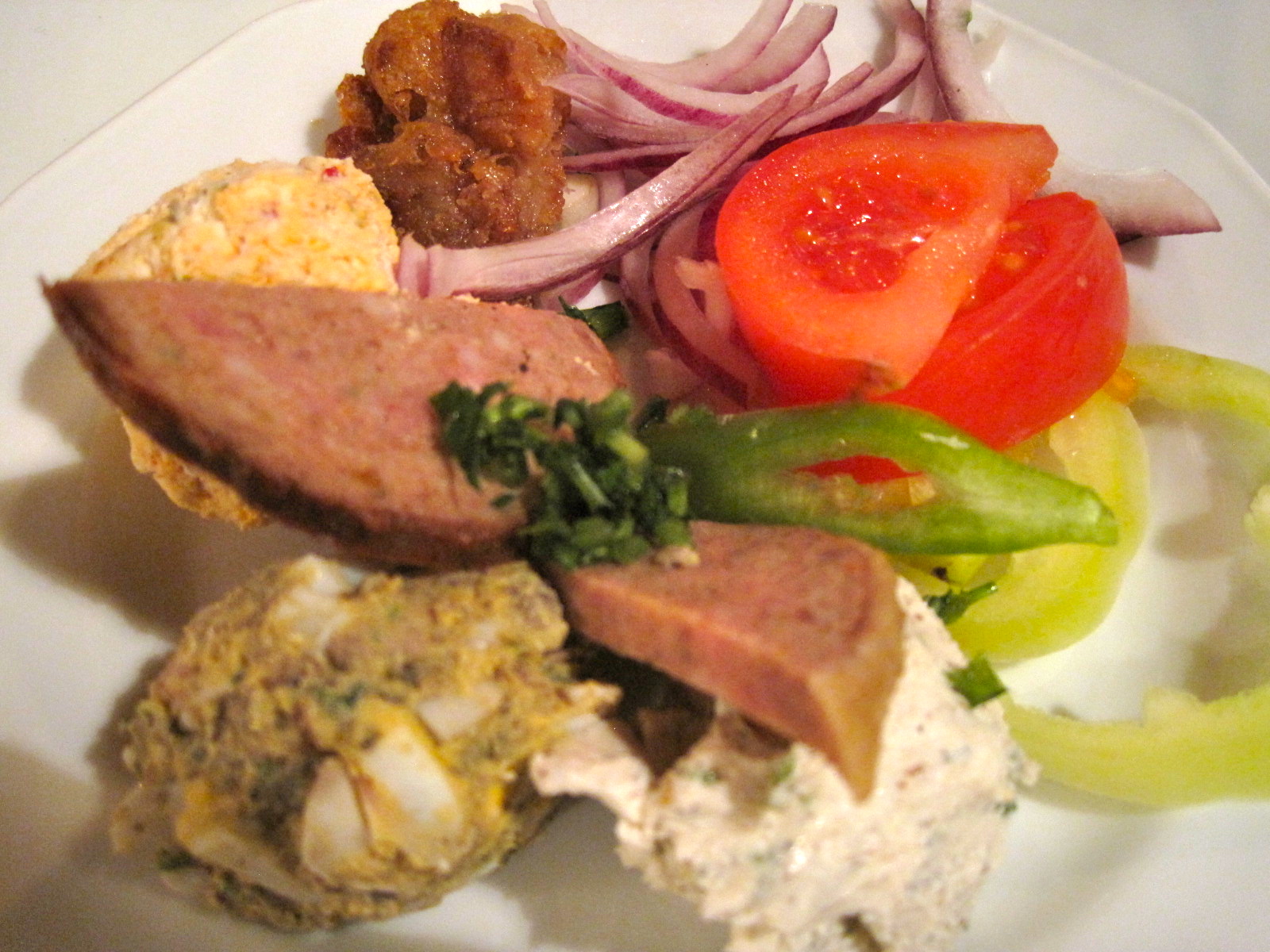
Some of the other girls ordered the paprika chicken and others the duck breast, both of which are extremely traditional Hungarian dishes.

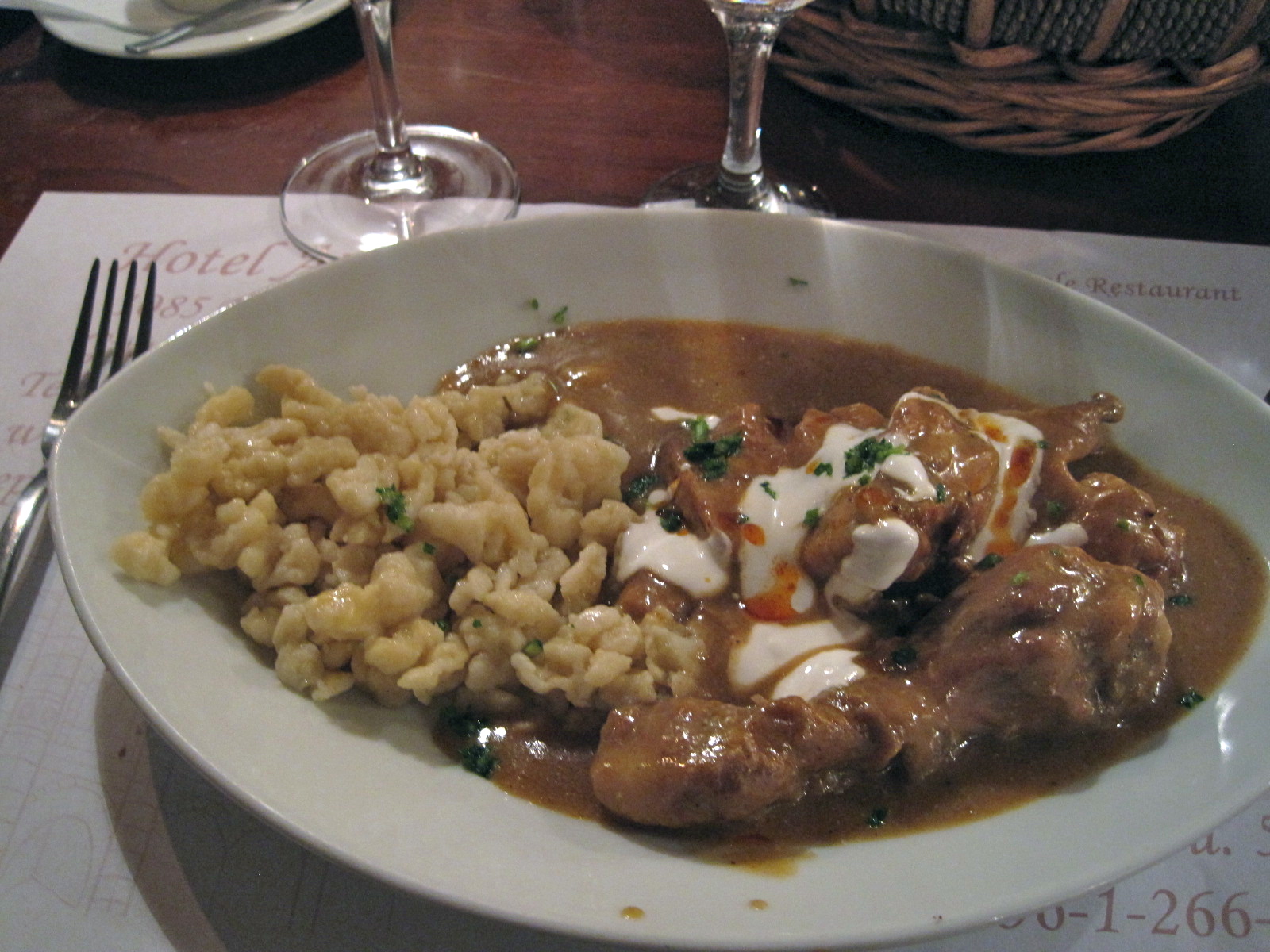
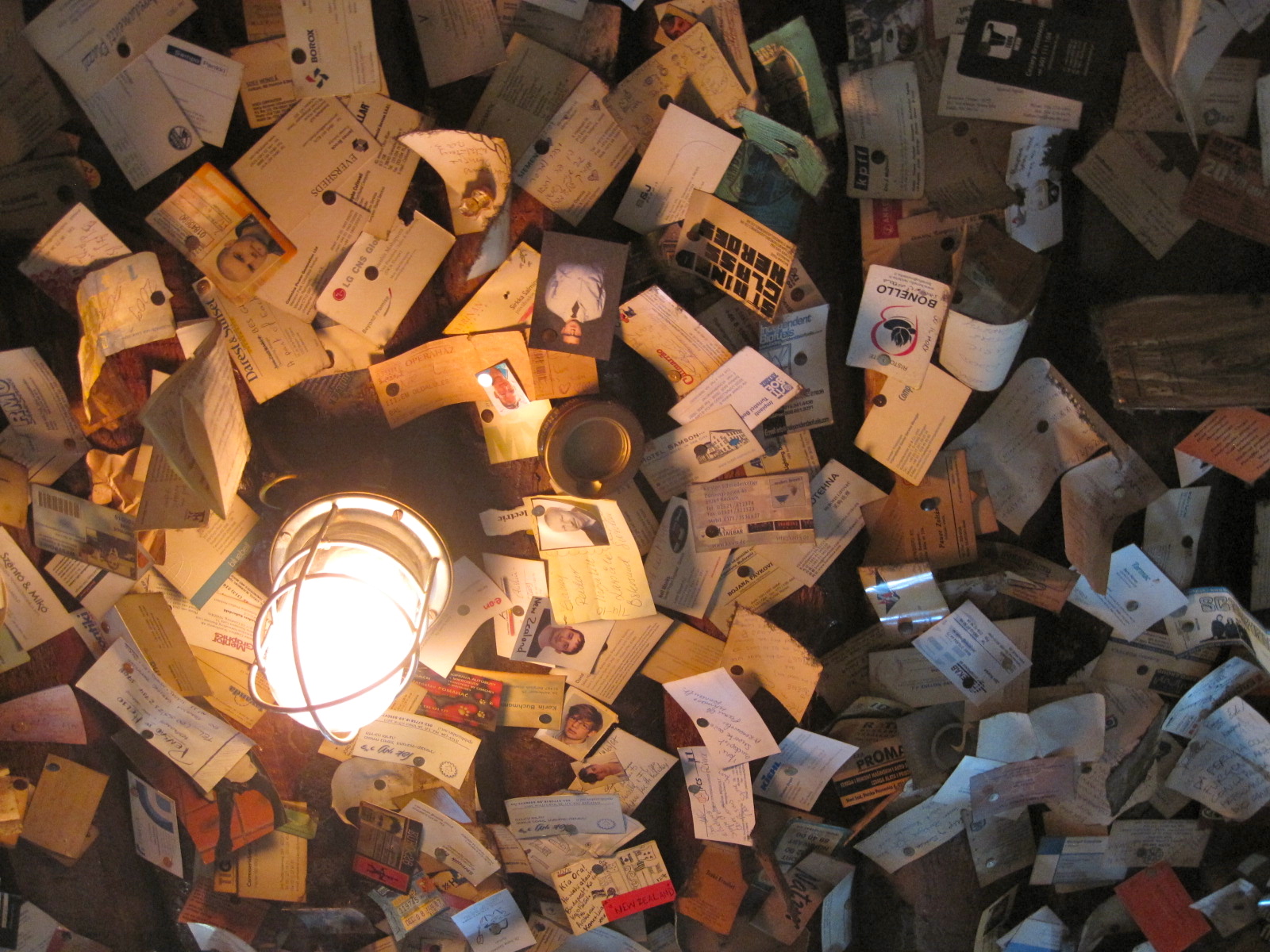
And we all had dessert too. We left the restaurant full and content and excited to sample even more Hungarian delights. Our next dose of traditional Hungarian fare came in the form of lunch the next day. We went to an amazing little restaurant called For Sale Pub that features massive portions of typical Hungarian plates. The restaurant itself is dark and cave like and sort of looks like something out of the wild, wild West. There are bits of memorabilia stuck all over the walls in the form of photos and poems and plane tickets, etc. Every customer seems to leave something of themselves behind. Further adding to the ambiance are the peanut shells that are strewn all over the hay-littered floor. My dad’s dream come true: a restaurant that supplies limitless buckets of all shell-them-yourself peanuts while you wait for your food.

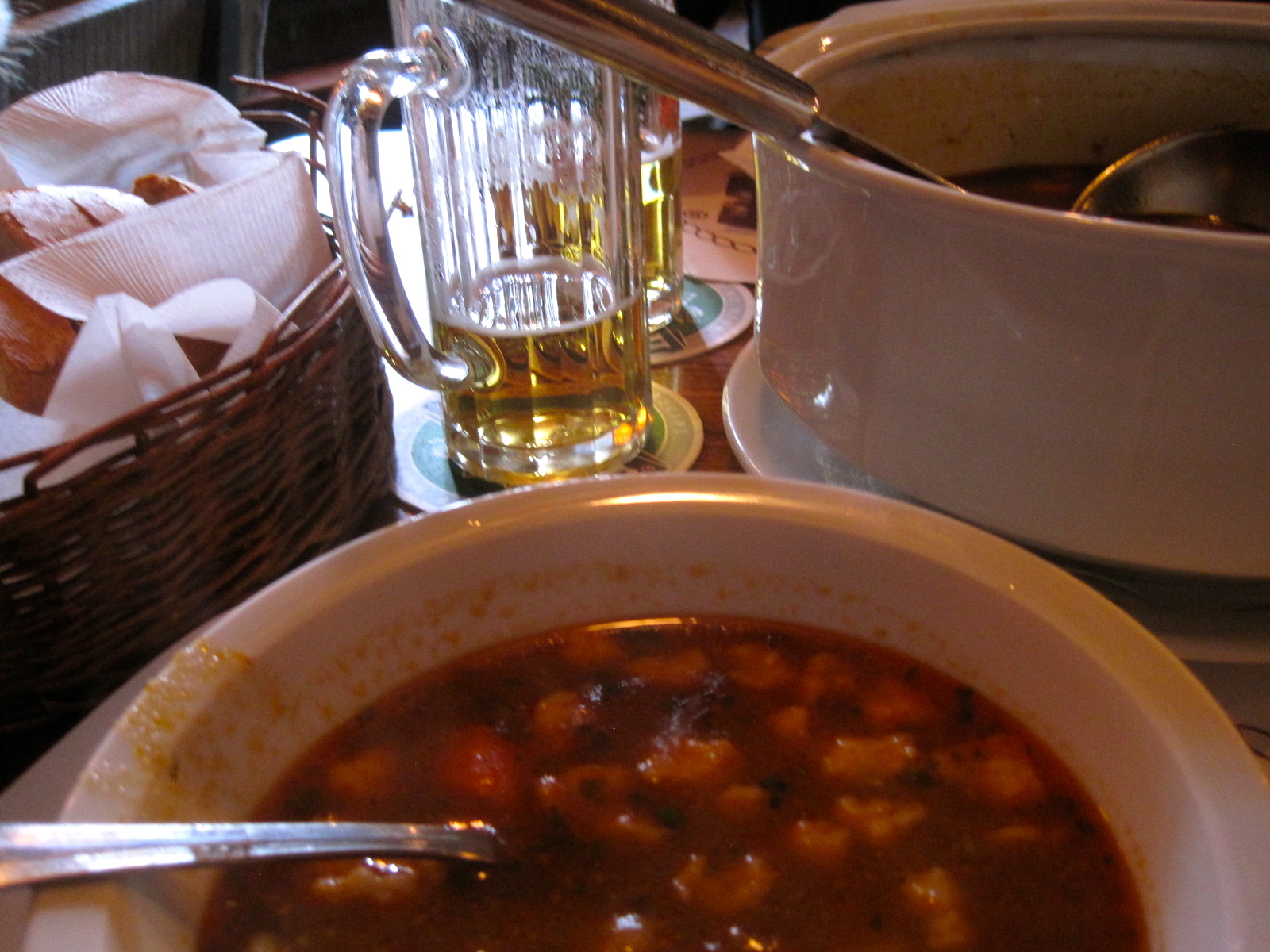
We sipped on soproni, a popular Hungarian beer and ate way too many peanuts while we hungrily awaited our lunch. Most of us ordered the goulash, a soup with red meat, potato gnocchi and a caraway broth. It was so delicious, and I can see why it is the most popular Hungarian dish.

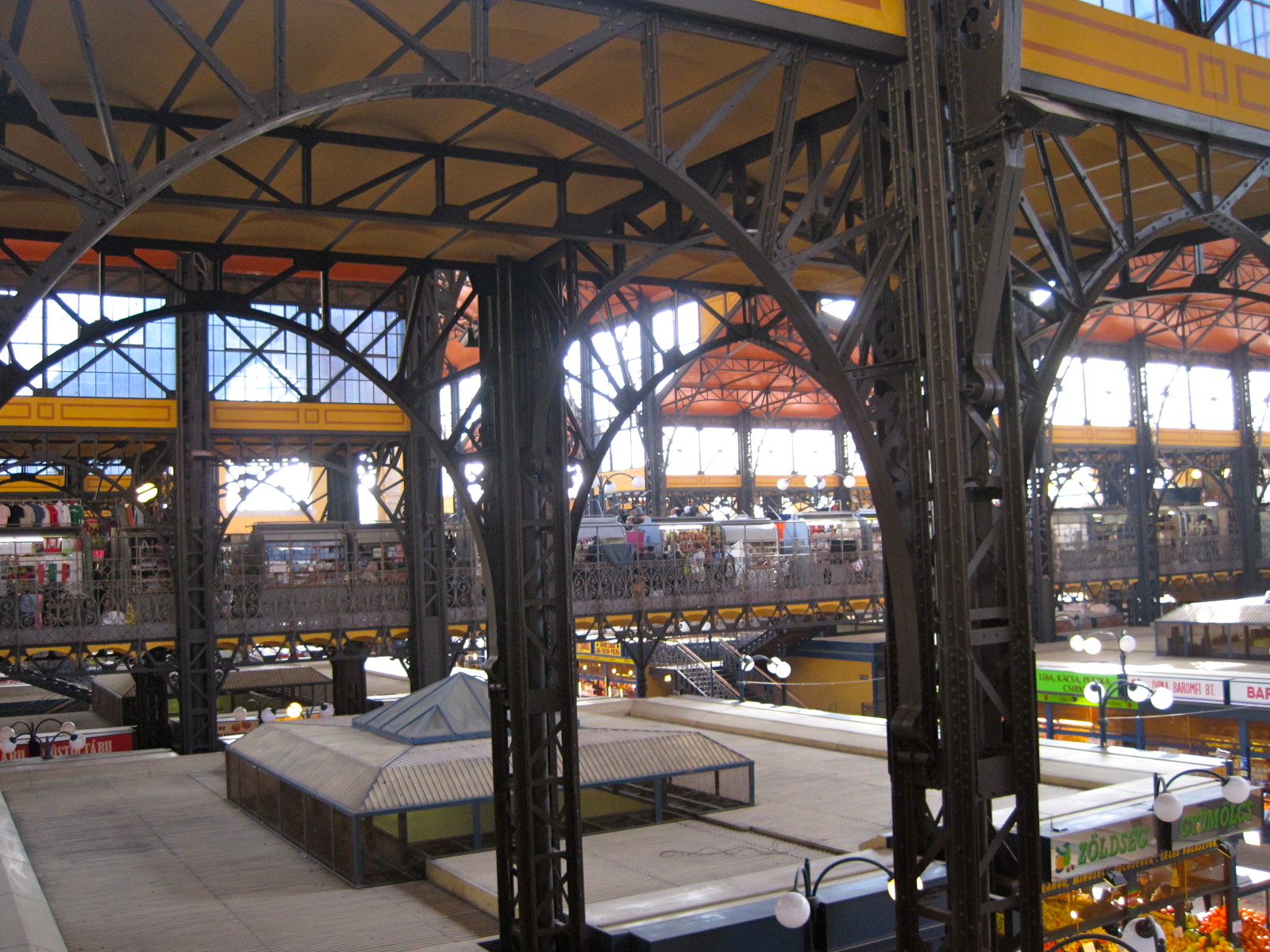
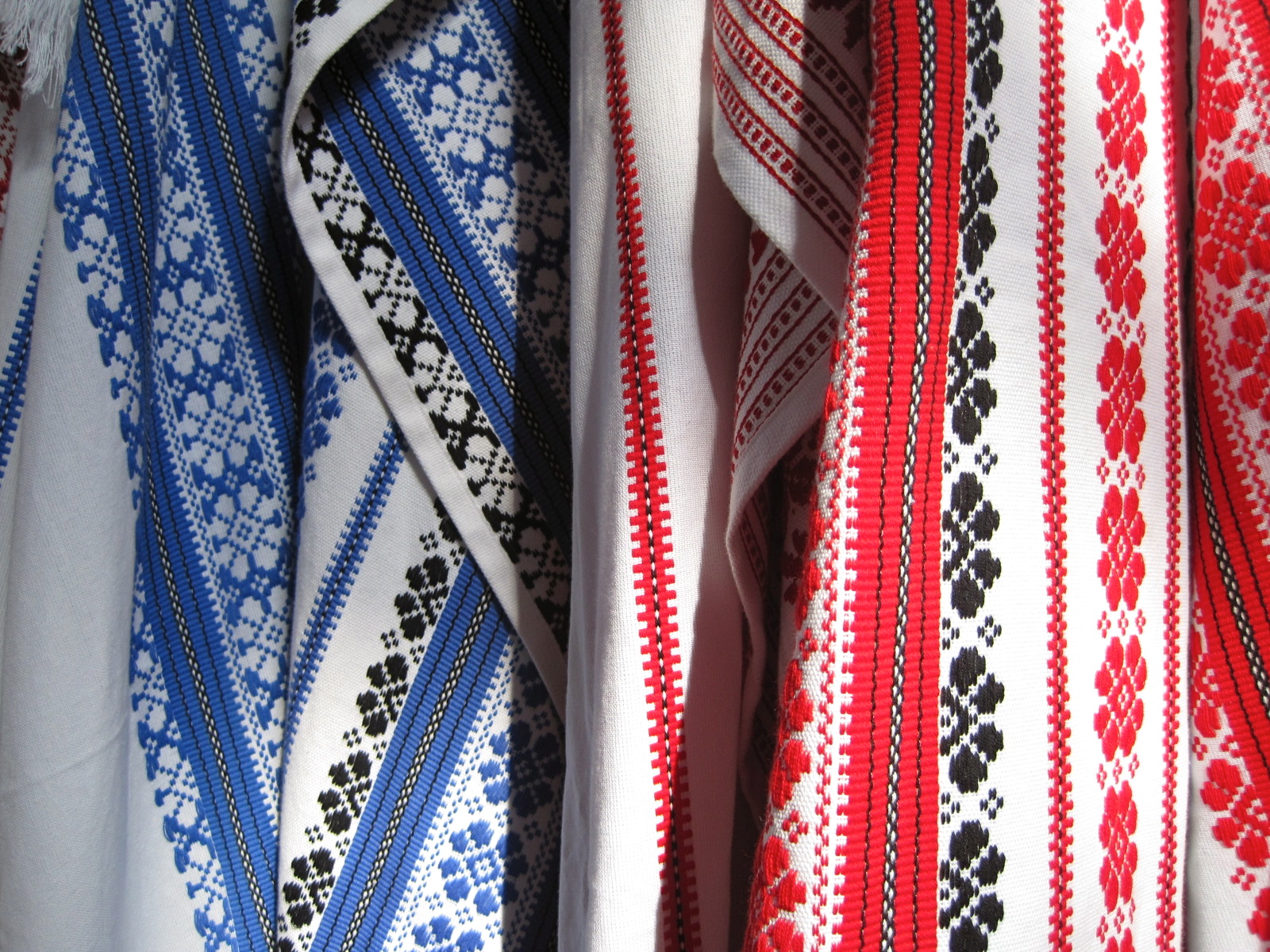
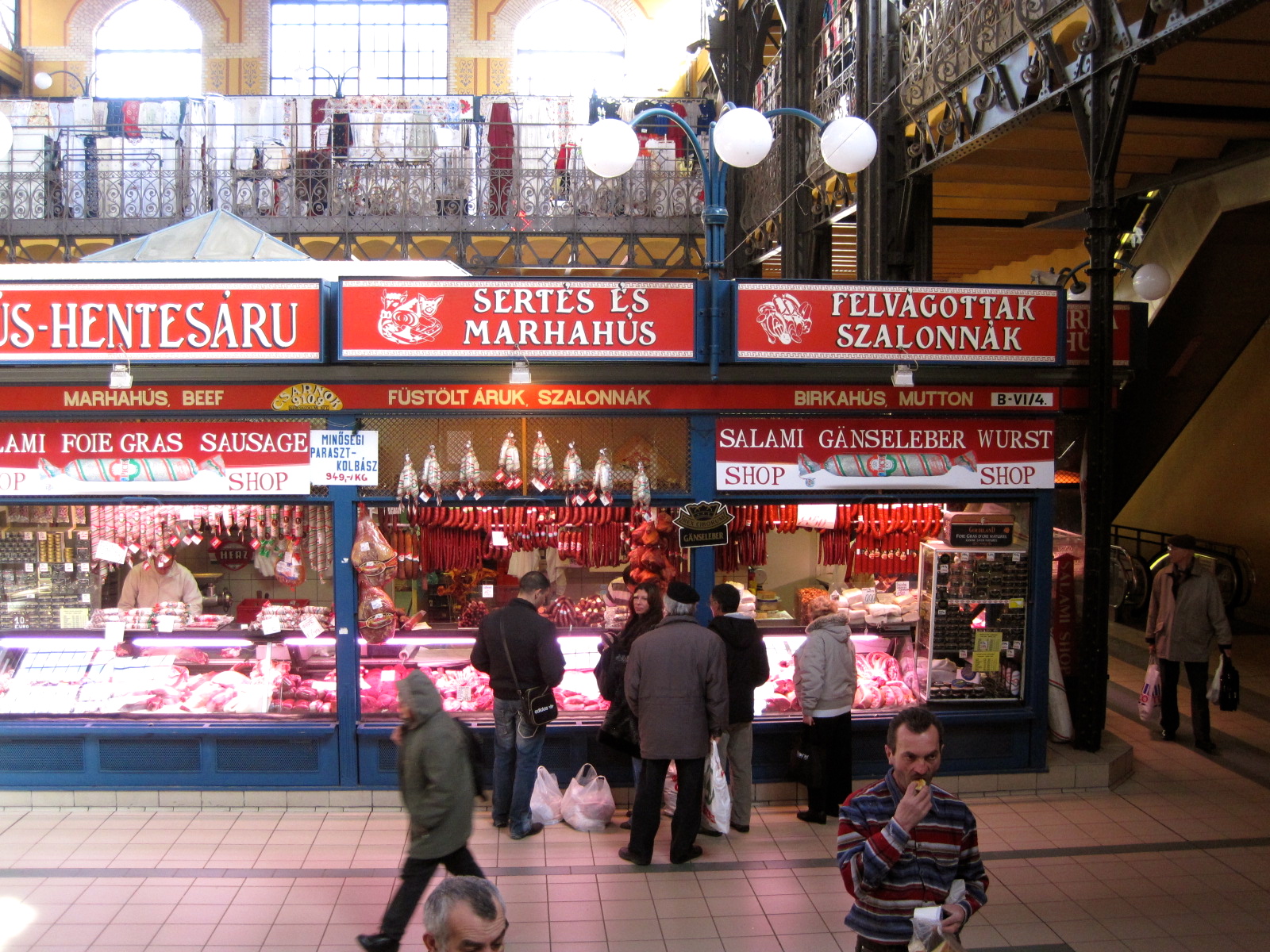
Most days saw us sleep in, lase around eating breakfast and drinking coffee (hey, we’re all on vacation from teaching – sleeping in is precious, even if we had a whole new city to explore). By the time we got out of the apartment, it was usually time for lunch. That’s where the Central Market came in. Located in a beautiful building right in the heart of Pest, it’s gigantic and chock-full of vendors hawking salami, cheese, bread, paprika and other spices, pastries, produce, textiles and souvenirs.

But the most important, delicious and worthwhile thing that is sold at this market is strudel. Strudel is perfection in the form of puff pastry wrapped around some delicious baked stuffing, most traditionally apples. No one can agree on who invented strudel – was it the Austrians or the Hungarians or the Germans? They all lay claim to it. But I think that we can all agree that it is delicious. We had strudel from the market for lunch most days that week, and all in all we tried  almost every flavor they had to offer which included 4 different types of curd cheese strudel: original, dill, apricot and sour cherry. They also had cabbage, potato, walnut, apple-nut, pumpkin-poppy seed , sour cherry-poppy seed, the list goes on….

We were faithful patrons of this strudel stand for one glorious week

I need to just say, eating poppy seeds in Hungary was an epiphany. They don’t just sprinkle them on baked goods like we’re used to in the US. No, no: they fill their pastries with them. As in, you get a whole mouthful of nothing but straight up poppy-seeds. It’s a bit of an acquired taste, but by the end of the week we were all well-acclimated and fully addicted. My friend told me that when Hungary was to join the EU they were meant to stop harvesting poppy seeds or else cede their membership. Hungary said, in so many words, “F*** that s***” and their poppy-seed industry is still alive and well, and we have the pastries to prove it!
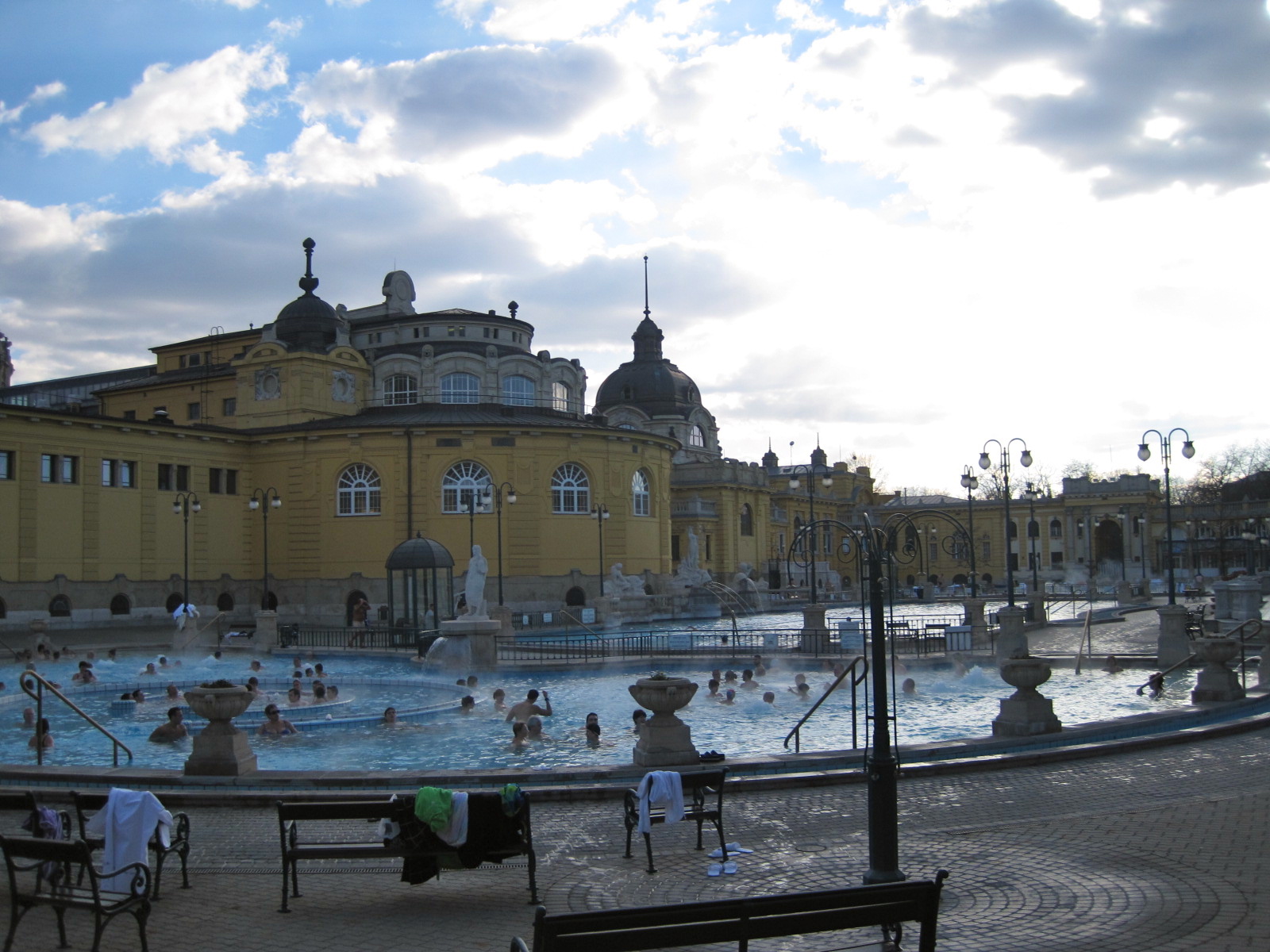
Szechenyi Baths where you can bathe outdoors

Anyways, after getting our strudel on we would usually walk (a lot) to see one of the many cultural attractions  the city has to offer. In one short week we saw almost all of Budapest’s main attractions. One of the first we visited was Andrassy ut, a magnificent boulevard that leads to Hero’s Square and the Szechenyi Baths. Budapest is sprinkled with Turkish bath houses, and the Szechenyi Baths are the newest in the city and among the most frequented. These are the first ones we visited and they are magnificent. We braved the freezing air to jump into the outdoor thermal pools, and then we headed inside to sample the range of sulfur/thermal pools and saunas, all heated to varying degrees.

View of Budapest from Castle Hill

We also saw Castle Hill, an old fortress/town/church located on the Buda side overlooking Pest – one of the best panoramas of any city that I have ever encountered. It was hard for us to leave that sunny perch above the city and move on to see other things. But there were so many other things to see, such as Gellert Hill and baths, Memento Park (a park outside the city that houses what is left of the communist statues/artwork), the Museum of

One of the communist statues at Memento Park

Terror (a place where the Soviets tortured and interrogated mostly innocent people), St Stephen’s Basilica (which houses St. Stephen’s millenia-old hand – creepy!), Margaret Island, Parliament, and countless other beautiful Baroque buildings and monuments. It is easy to see why the Hungarians are such a proud people: after enduring centuries of domination, oppression and torture at the hands of many different empires and regimes, they are finally democratic and free. It is so curious that they have really only been independent for 20 years. When you walk around the city, one is amazed at how much of its grandeur has survived despite the wars, the bombs and the constant terror.

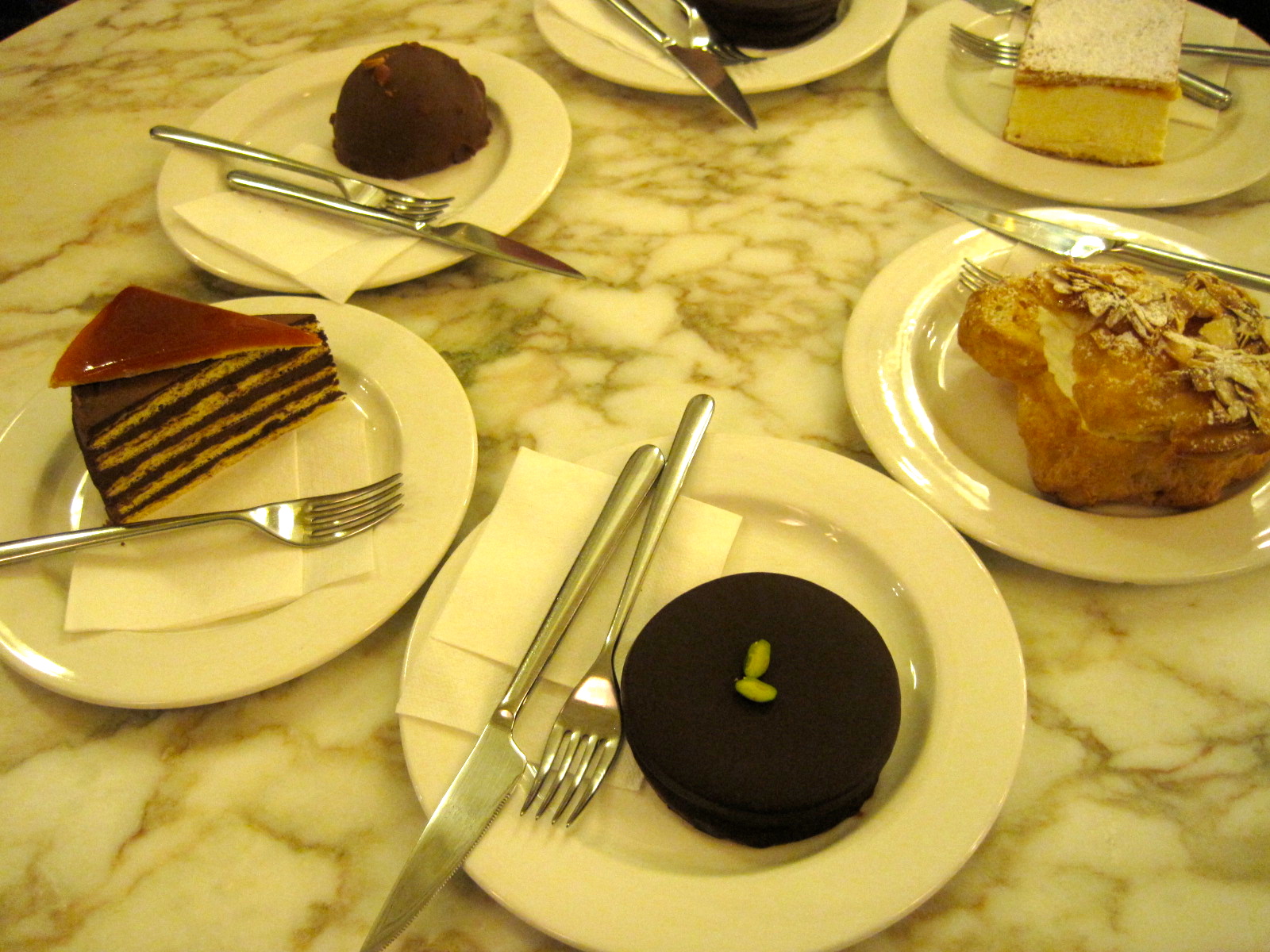
But on to happier things – pastries: one of the few positive things that came out of the Austrians rule over Hungary. Budapest is renowned for its coffee shops where Hungarians go dressed-up in their Sunday best to enjoy coffee and cake. I won’t even say much about it, just check out this selection of pastry porn:

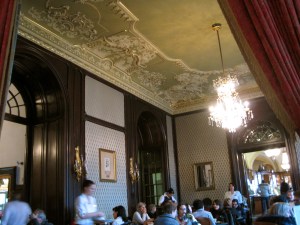
And the pastry shops themselves weren’t too shabby:
While I was sad to bid adieu to the goulash, the strudel and the pastries, I really was ready to get back home to Rennes. Though we’ve been living in France, I don’t think any of us were prepared for the heaviness of the food in Hungary, and the lack of veggies involved. I never thought I would say this, but I am relieved to be back in France where the food is a bit lighter and more balanced! But I will miss Budapest, which is why I am already plotting the menu for my next dinner party which will be (quelle surprise) Hungarian themed!

And, there are plenty more pictures from the trip up on my flickr page. Just scroll up and to the right, and you’ll find ’em.
Posted in Culture, Food | 5 Comments

Asian addiction

I am a huge fan of all Asian cuisine, from Chinese Dim Sum to Japanese sushi to Indian curry, there aren’t many Asian cuisines or dishes that I don’t gobble down with absolute enthusiasm. Is there anything better than Pad Thai or Cantonese fried rice? Or how about fresh Vietnamese spring rolls on a balmy summer’s day or a steaming bow of Pho on a cold winter’s night?

I’ve been fortunate enough to travel and eat amazing meals and experience some of the finest restaurants in cities such as San Francisco, New York and Paris. However, easily one of the most delicious and memorable meals of my life was at an absolute hole-in-the-wall Schezuan restaurant in Queens: not the most glamorous locale. But the food was delicious and authentic and positively unforgettable.

Living in San Francisco for 5 years, where there is a rather sizable Asian-American population, I had a whole plethora of Asian restaurants at my finger tips. You want Burmese? Sure. How about  Hunan? Why not. Any type of Asian cuisine you could imagine, no matter how specific or what the region, there was a restaurant somewhere in the city to cure your craving. And then I moved to France. Talk about  quitting cold turkey. While I could ramble on for days about the glories of French cuisine (and I do, and you read it for some reason…) sometimes you just want something different! And what I’ve been wanting lately is Asian food, in any form!

France is not big on “ethnic cuisine”. This may be changing in a bigger city like Paris, Rennes, however, is sadly behind the times.  While you can choose from about 6 different crêperies on one single street, Asian restaurants are rather thin on the ground here. The few Chinese restaurants I’ve found are dismal and over-priced, and the sushi prices are astronomical. I have found one Tibetan place that is great, but it’s not enough I tell you!

So, I recently took matters into my own hands. I hunted out a huge, gorgeous specimen of an Asian market (where I have dropped far too many euros now…), I stocked up on ingredients and then I hosted an Asian potluck. 7 guests came, all with a different Asian dish in hand. Unfortunately, instead of quelling my mounting cravings, tasting all of that sushi, curry, pho and peanut sauce just made me ever more crack-addled and desperate for more, more, more!

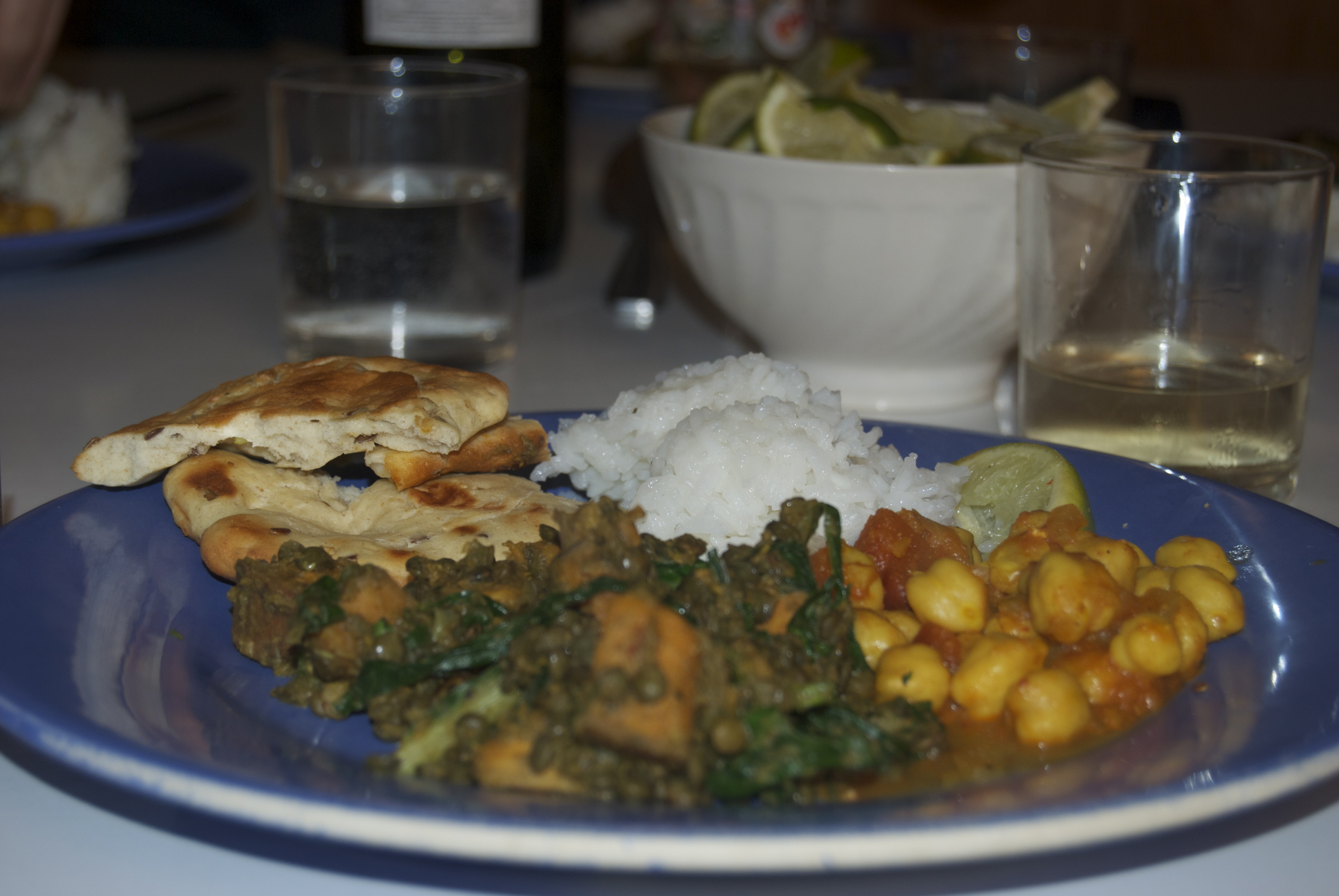
Hence, my second dinner party of last night for which I cooked an Indian feast. Voici, the menu:

Homemade garlic naan

Fragrant Jasmine rice

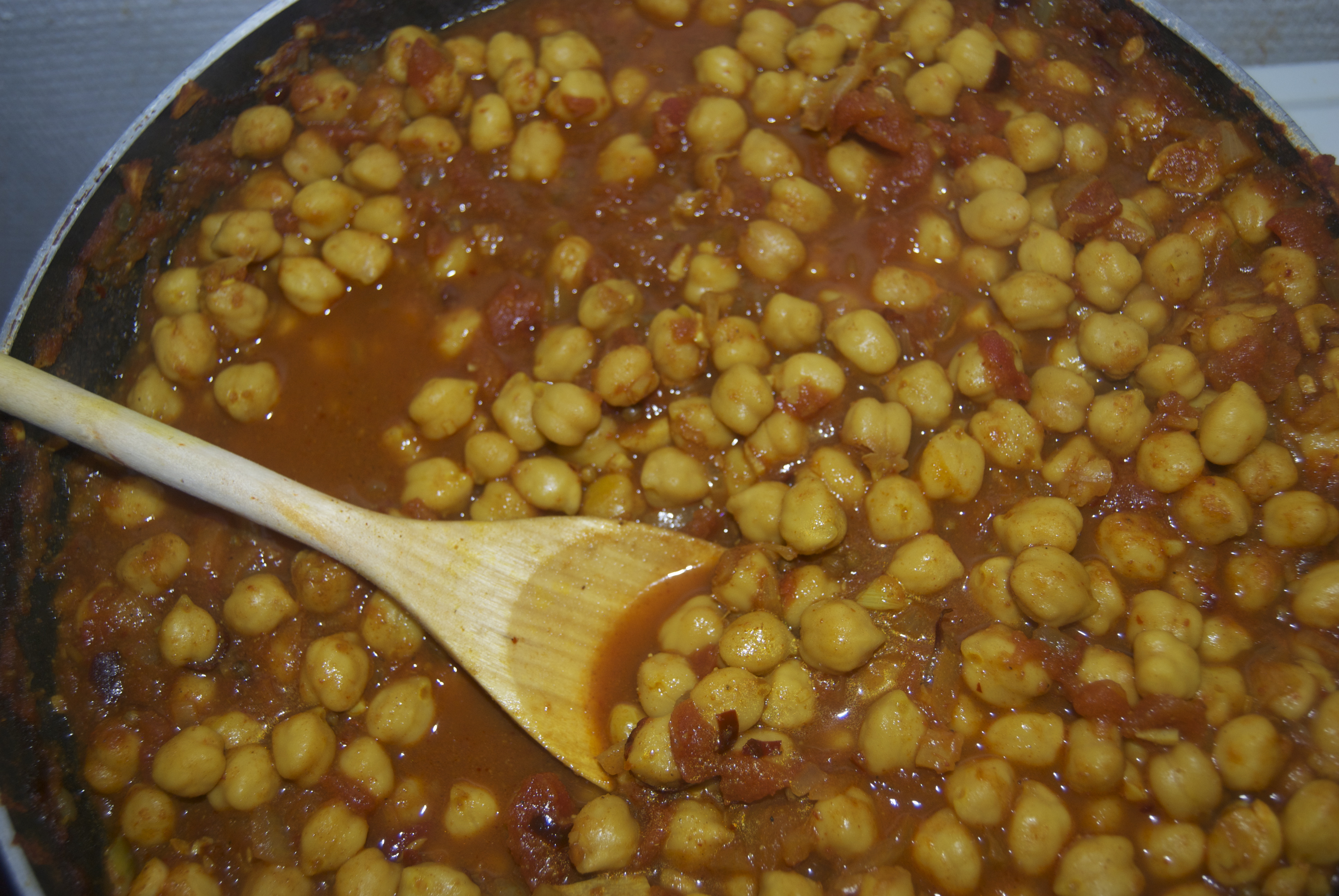
Chana masala (chick peas stewed with tomatoes)

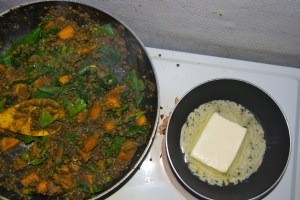
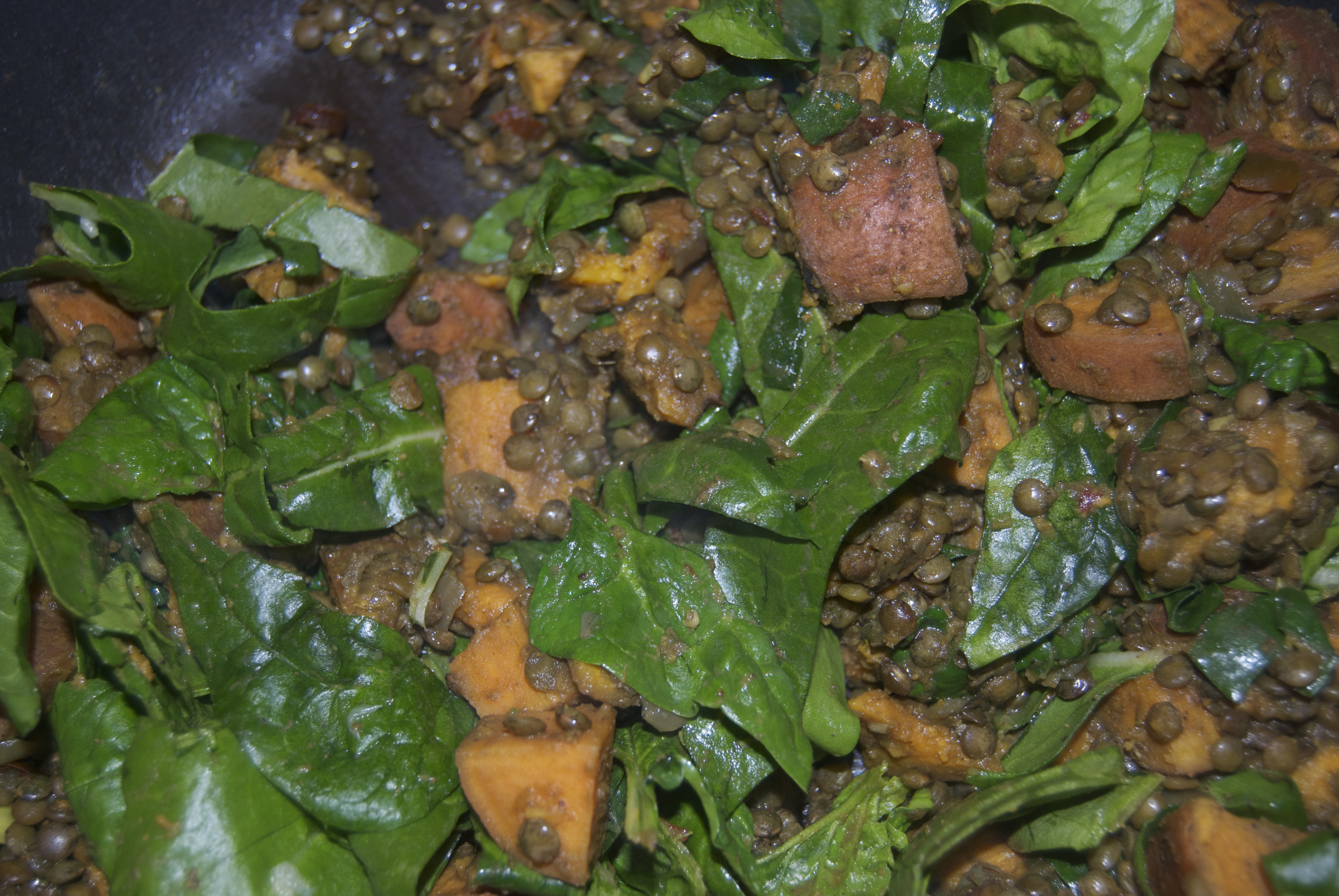
Curried lentils and sweet potatoes with spinach and chard


I am feeling a little bit better  about things now that my belly’s been full of Indian food the past 24-hours. Everything turned out so beautifully, and it was all so simple to make. The chana masala was unctuous and spicy, and the curried lentils with sweet potatoes were balanced, hearty and subtle.

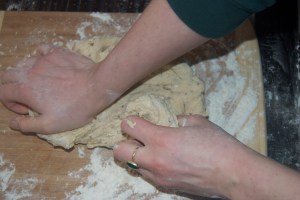
However, the unequivocal hit of the night was the homemade naan bread: everyone was so impressed by it. I’m not sure why people are so scared of making their own doughs. Nothing could be simpler really. So next time you feel intimidated by a dough, just take a deep breath and dive in, because I promise you will be surprised by how easy it is. Not to mention homemade doughs taste sooooo much better than anything pre-made.

Here’s the recipe for homemade garlic parsley naan:

Ingredients

  • 1 (.25 ounce) package active dry yeast
  • 1 cup warm water
  • 1/8 – 1/4 cup white sugar
  • 3 tablespoons milk
  • 1 egg, beaten
  • 2 teaspoons salt
  • 4 1/2 cups bread flour ( I used multi-grain with seeds, which made for a hearty and chewy naan)
  • 2 teaspoons minced garlic
  • 1/4 cup butter, melted
  • 2 tbsp parsley, chopped

Directions

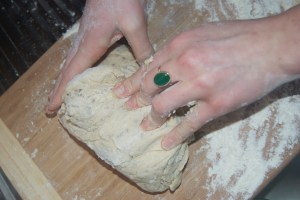
In a large bowl, dissolve yeast in warm water. Let stand about 10 minutes, until frothy ontop.  Stir in milk, egg, sugar and salt. Slowly incorporate flour until a soft dough has formed (no need for any utensils here besides your hands!). Knead the dough for 6 to 8 minutes on a lightly floured surface, or until smooth. Place dough in a well oiled bowl, cover with a damp cloth, and set aside to rise. Let itrise 1 hour, until the dough has doubled in volume.

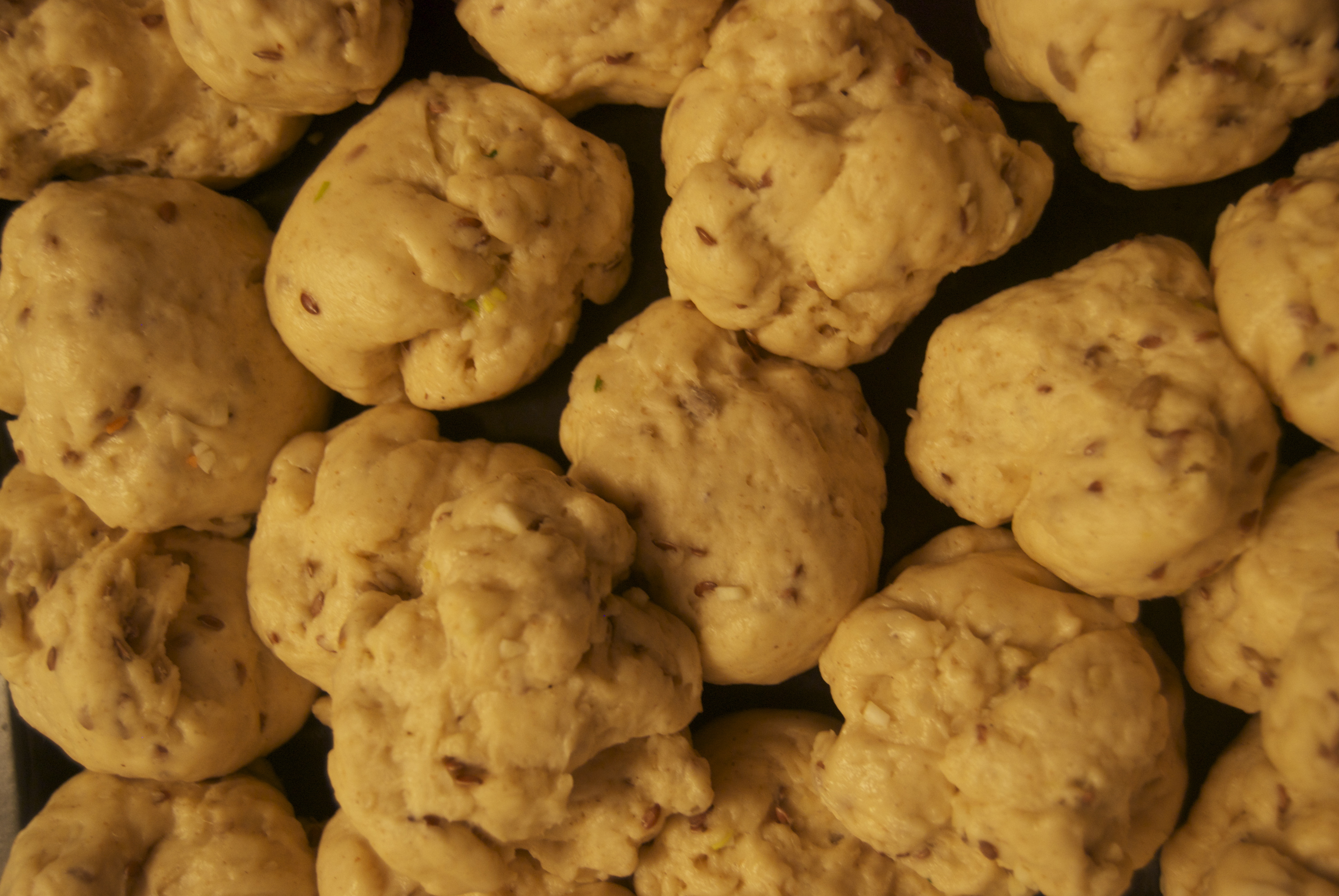
Punch down dough, and knead in garlic. Pinch off small handfuls of dough about the size of a golf ball. Roll into balls, and place on a tray. Cover with a towel, and allow to rise until doubled in size, about 30 minutes.

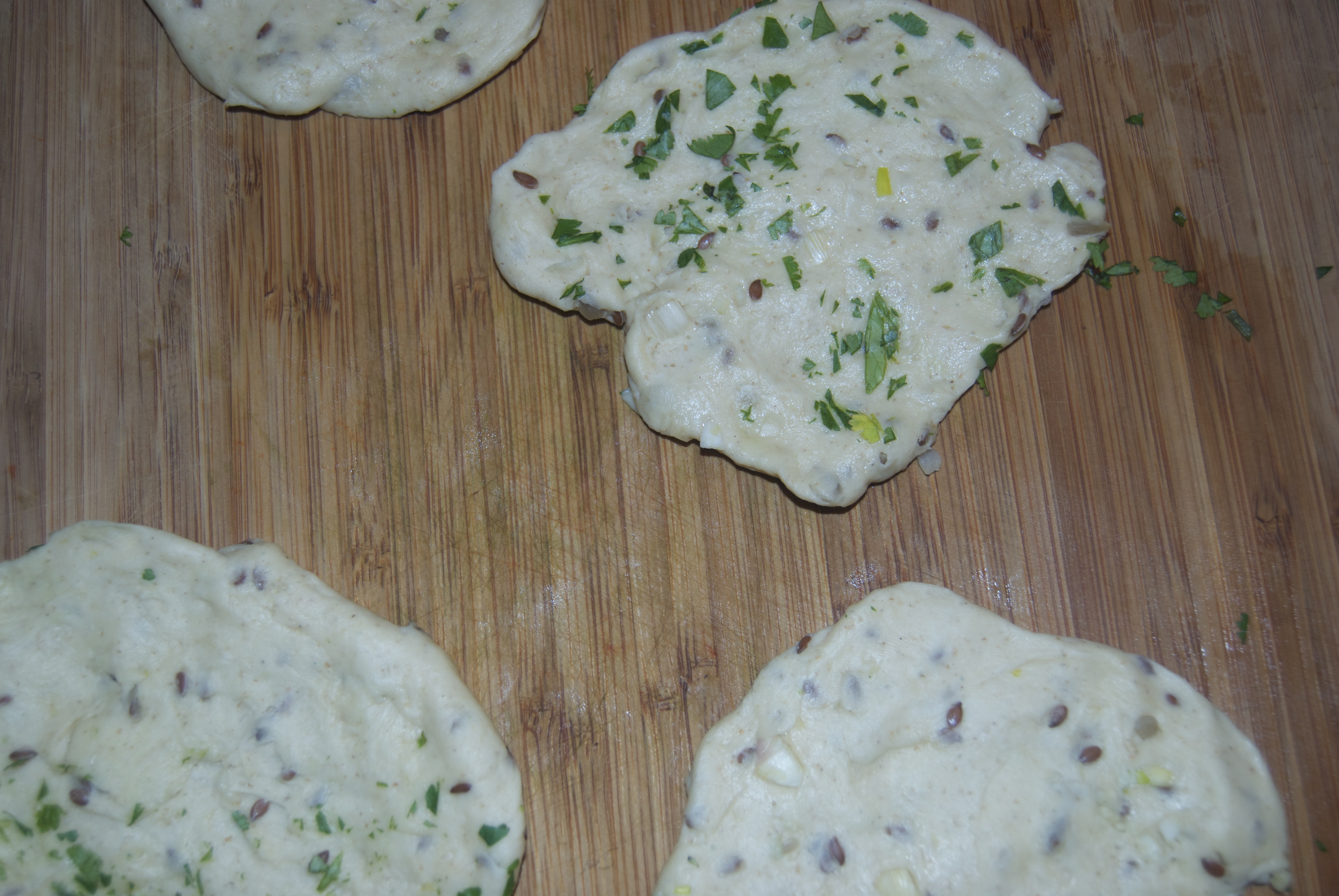
During the second rising, preheat oven to 400 degrees. Roll the balls of dough out into thin circles. Brush with melted oil and sprinkle with parsley.

Place on a cookie sheet lined with aluminum foil and cook for 2 to 3 minutes, or until the naan is puffy and lightly browned. Turn the naan over and brush the uncooked side with butter, and continue cooking until browned, another 2 to 4 minutes. Remove from oven, and continue the process until all the naan has been prepared.

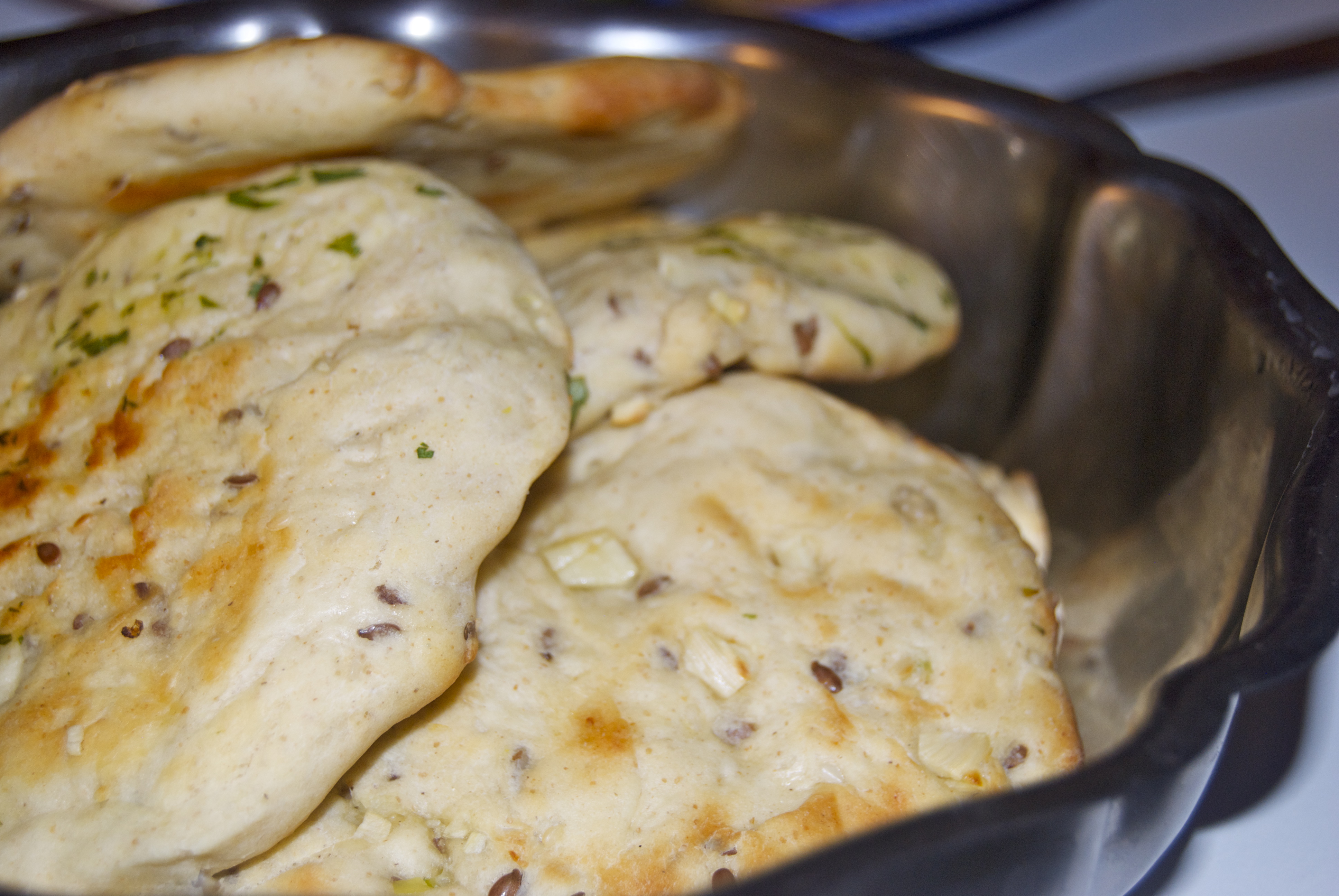
Homemade naan bread with garlic and parsley

So, I hope you’ve enjoyed a little taste of India in France. Stay tuned for more recipes from the Asian invasion that has taken hold in my kitchen. Next up, the perfect antidote to winter my vegetarian pho!

Posted in Food, Recipes | 4 Comments

Apple Pie

Within a few weeks of my arrival in Rennes, I began to hear talk of Apple Pie, an organic tea shop/restaurant owned by an Irish woman. Some of my fellow assistants had stumbled upon it accidentally, and quickly became obsessed. The girls I speak of are all from the UK, so they in particular were soothed by the presence of this cozy, bilingual tea house and its traditional Irish scones and tea. They praised its cute ambiance, warm atmosphere and delicious pastries. But more than anything, they lauded the kindness and sincerity of the propiotor.

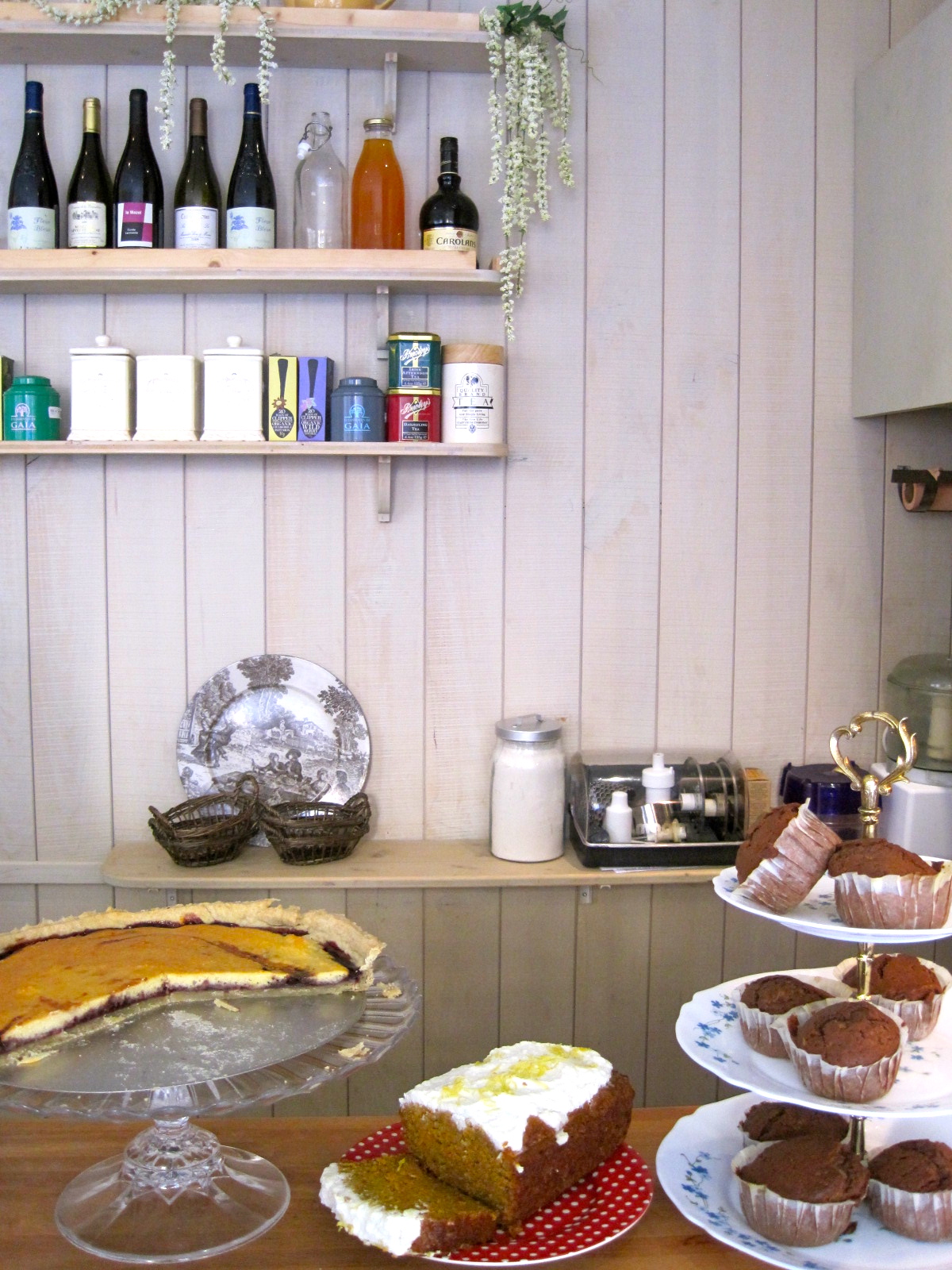
Bake Well Tart, Carrot Cake and Chocolate Clementine Muffins

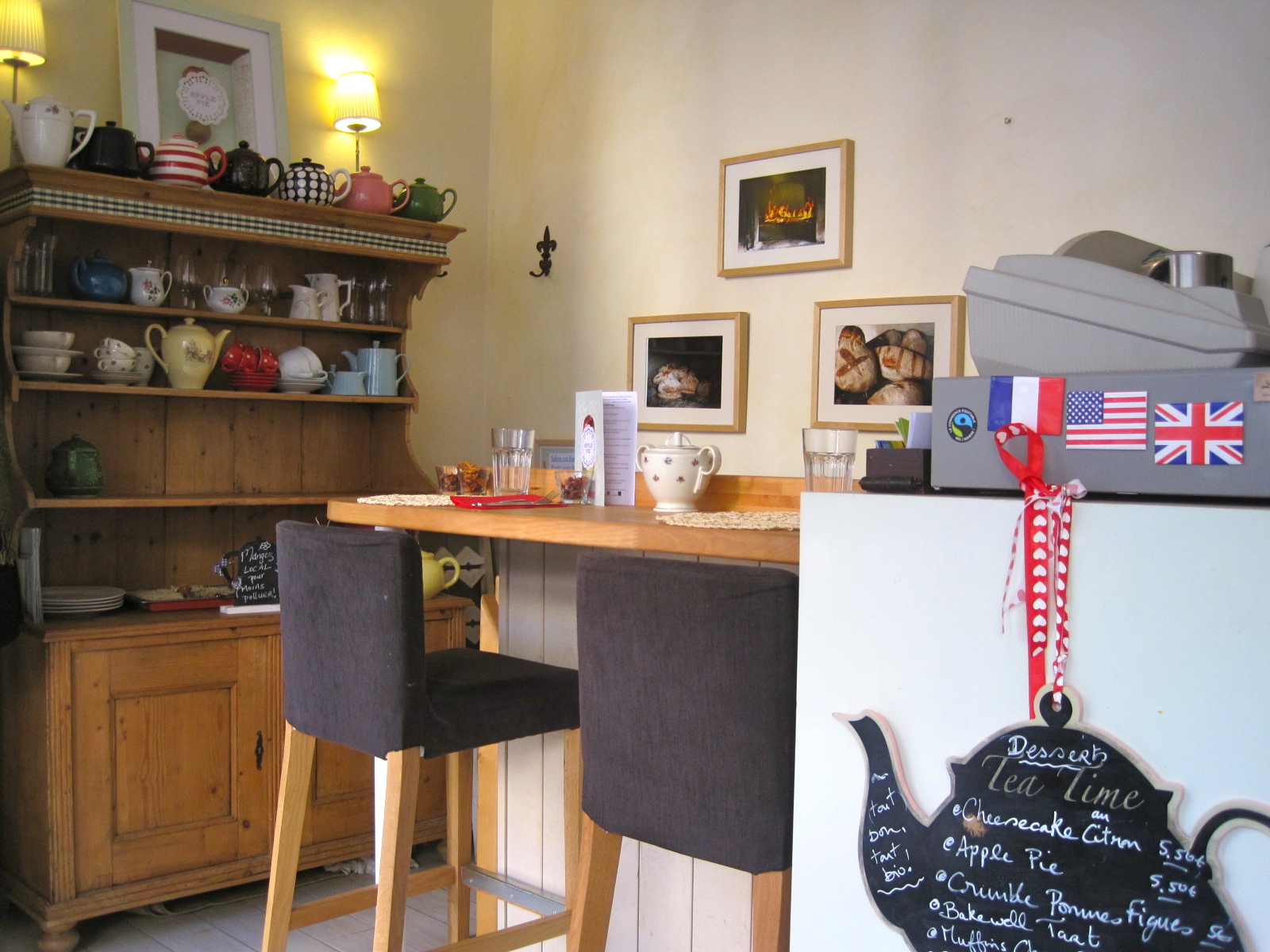
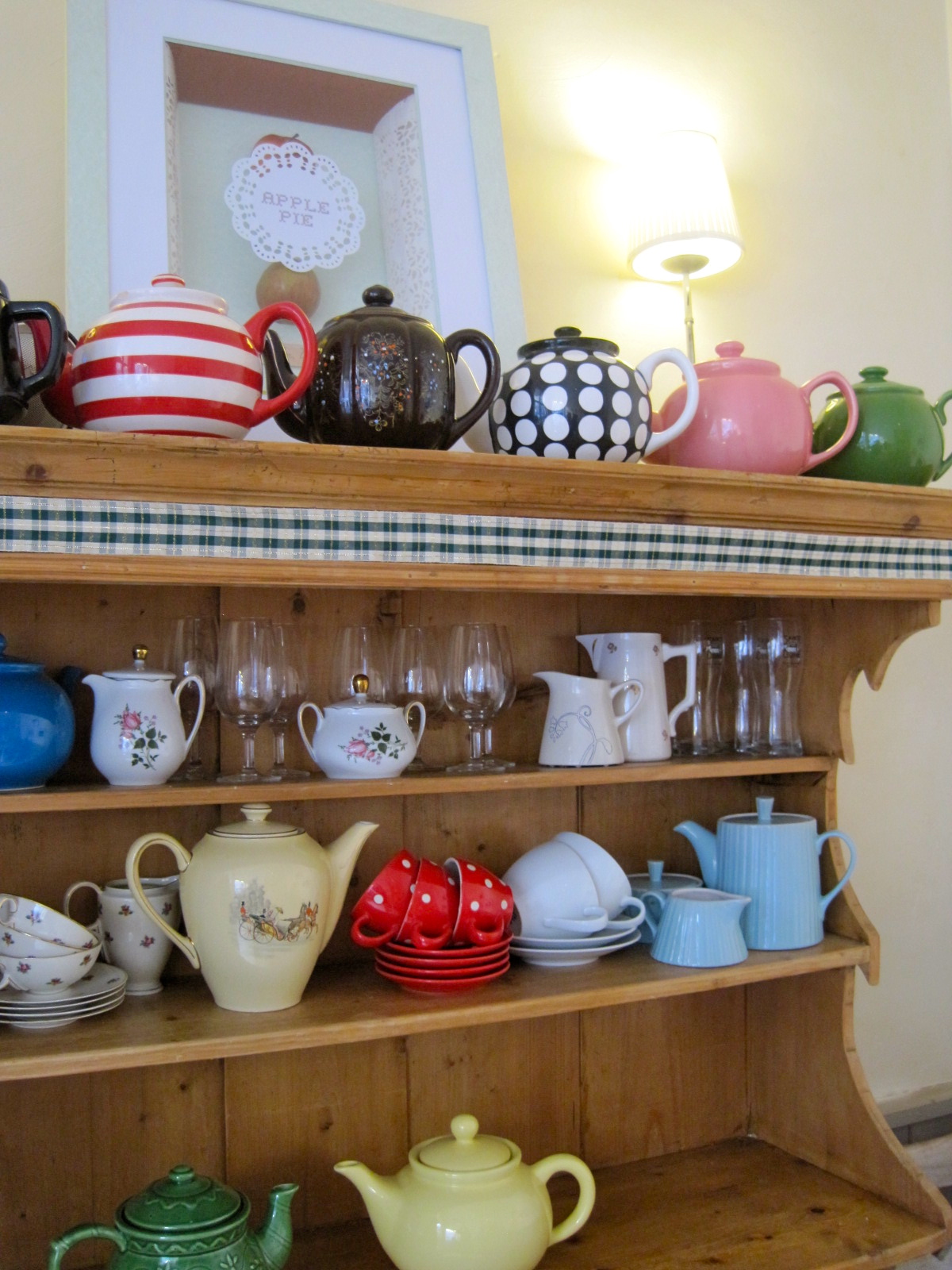
Time passed, more friends discovered Apple Pie and sang its praises, but still I didn’t go. Finally, sometime around December I made it in there for an afternoon coffee with a friend. I was not disappointed: Apple Pie definitely lives up to its reputation. The interior is quaint and cozy: antique cake tiers full of scones and muffins are scattered amongst mismatched tea pots and saucers. The walls are decorated with beautiful photos of the proprietor’s farm, where the very flour that is used in the restaurant is milled. The tables are covered in vintage-looking mis-matched tablecloths and the napkins are nestled in quirky napkin rings. Everything about the place seems to say “welcome, come in, make yourself comfy.”


But nothing makes the atmosphere cozier than the propietor herself. Lisa hails from Ireland but has been living in France for 20 years. She is extremely warm, kind and outgoing, and makes every customer feel instantly at home. And she never fails to serve up a fresh vat of interesting stories, anecdotes and Irish wisdom along with her scones and tea.

But what makes me a particularly big fan of this spot is its commitment to local and sustainable food. As mentioned earlier, the flour is milled on Lisa’s organic farm located just outside the city. All of her produce, meat and other ingredients are also organic and locally-sourced.

The sign says "Eat local to pollute less". Hear hear! And notice the lovely scones on the left...

I wouldn’t normally go this into-depth about a restaurant, but this place is like my imagination come to life. My time in France has made me so much more passionate about food and cooking and the vital connection between farm and fork. I hope to one day find my niche in this community of passionate cooks and farmers  who foster mindful and sustainable cooking. I don’t have any clue, really, what I want to faire dans la vie (do with my life), but France is making me think more and more that I just want to live on a farm and grow things and cook and make jam all day. (I know, I’m a grandma trapped in a 24 year-old body).  Lisa and her Apple Pie give me hope that this is possible. So, who knows that the future will bring. At least in the meantime, while I’m figuring it out, I have a place to go and eat good food…

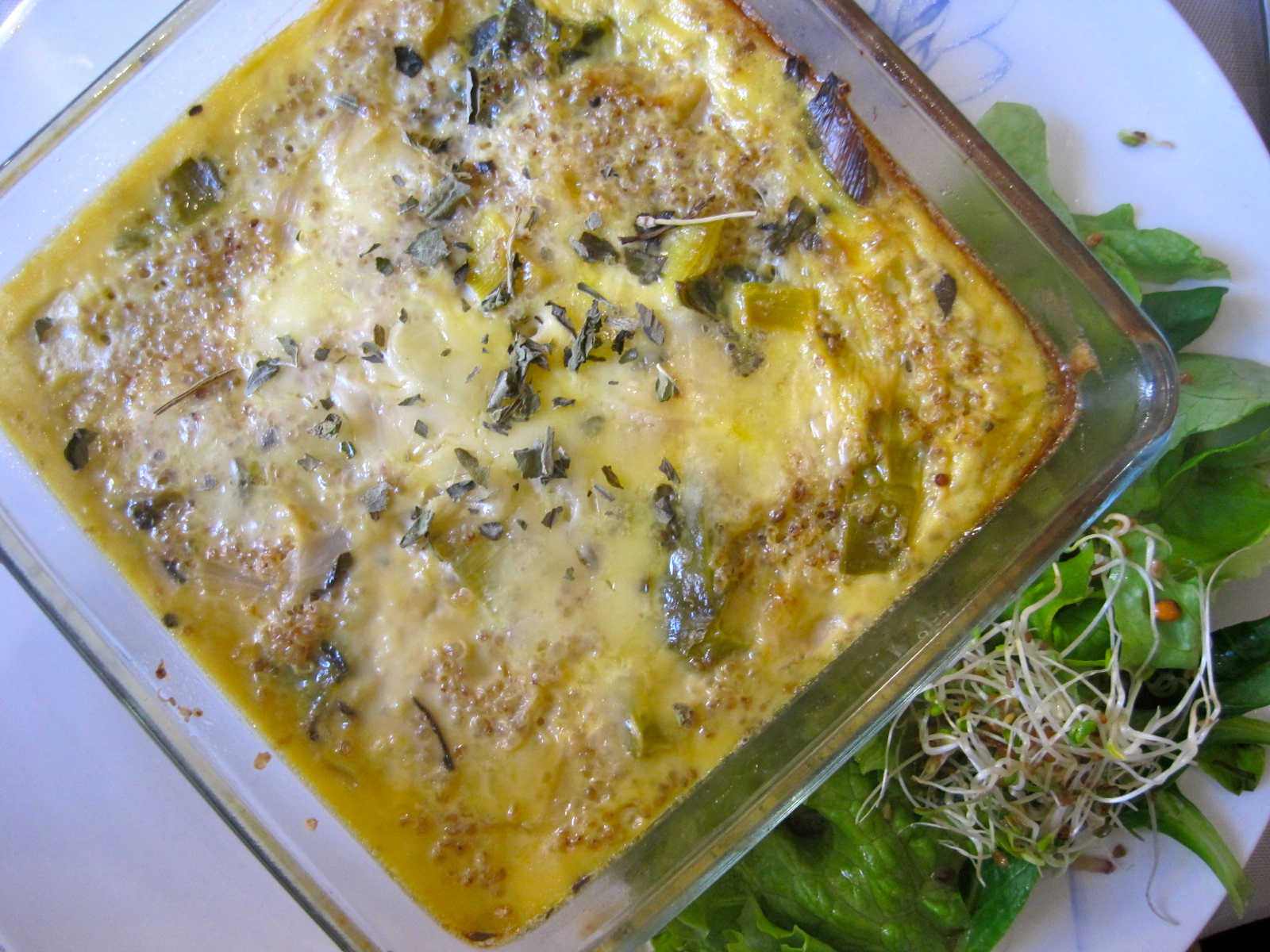
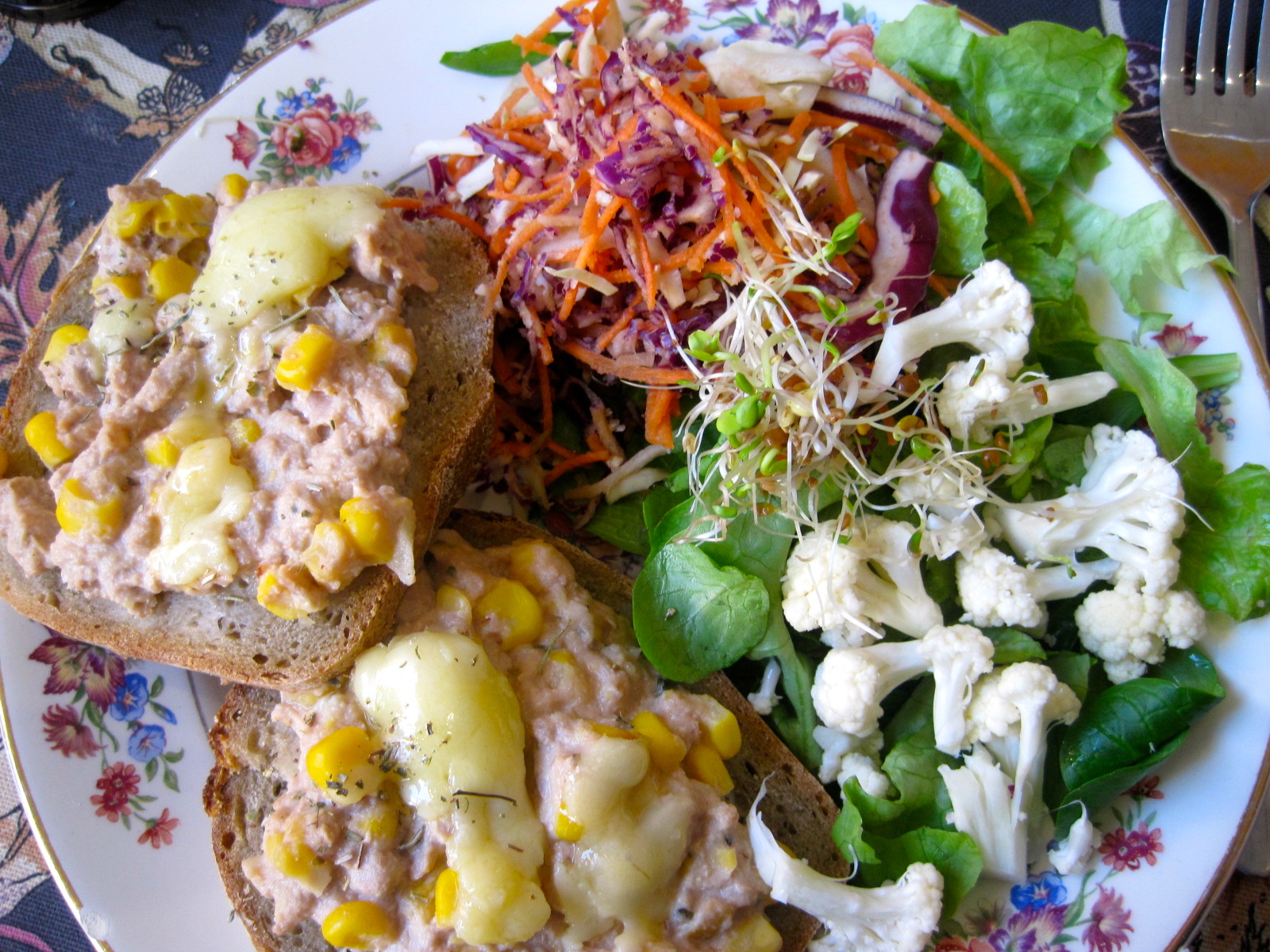
Pictures: Flan with leeks, cabbage, quinoa and cheddar and a tuna melt with corn.

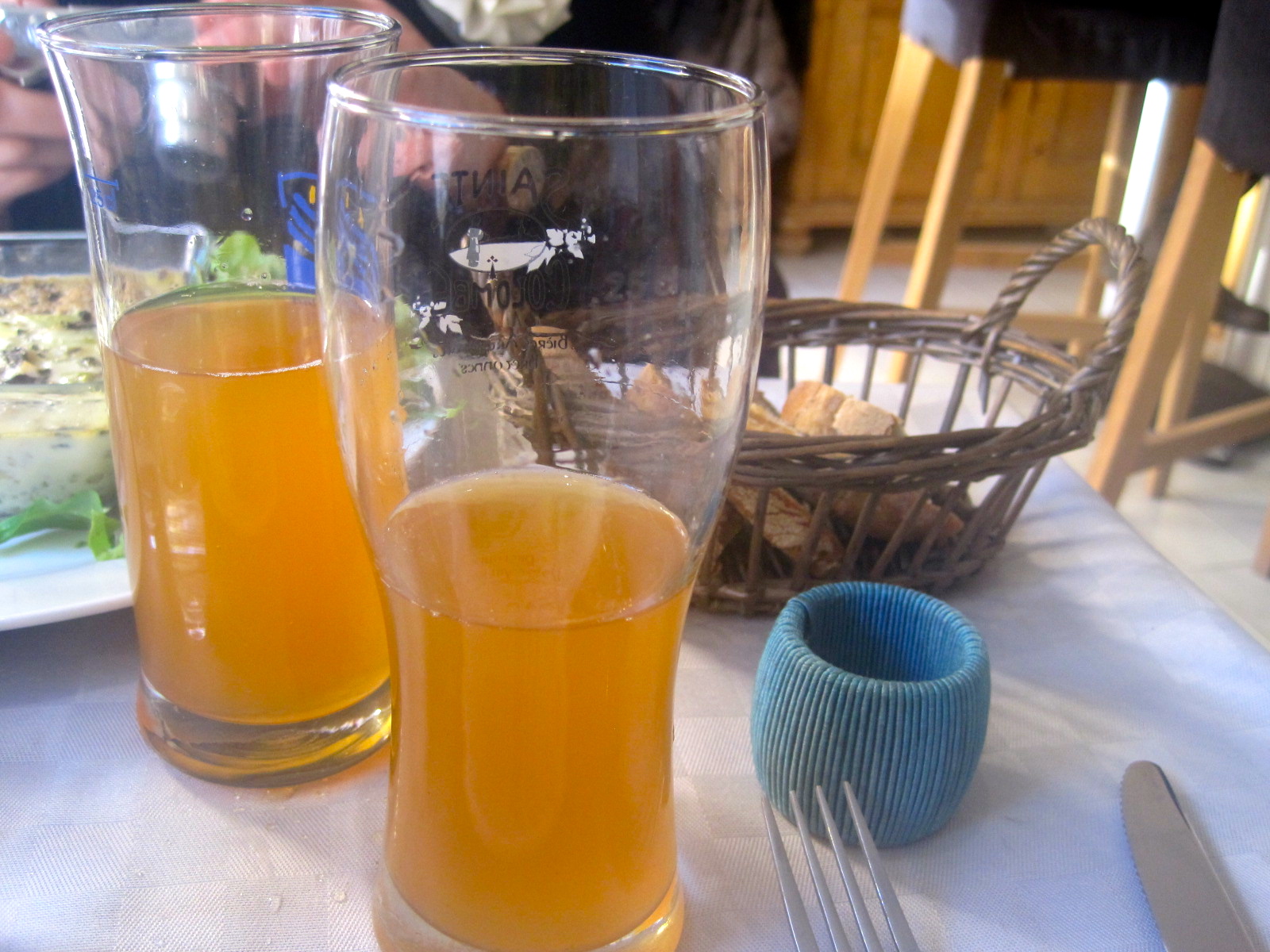
Apple juice grown and pressed on Lisa's farm


Posted in Food, Restaurants | 9 Comments

La Recette de la Tartiflette

When I returned from my trip to California about a month ago, I was delightfully surprised to find that the weather was unseasonably warm in Brittany. We had about 2 weeks of 50 degree weather which meant that I was able to leave my apartment with just a jacket, as opposed to the fortress of layers, hats, scarves and mittens I had been donning previously. I even began to think “Hey, maybe winter is over! Maybe it will just keep getting warmer until it is spring, and then summer…” I was already planning trips to the beach and imagining breaking my bikini out of the recesses of my suitcase. And then the cold, hard reality set in once again (cold being the operative word…). Just as quickly as the warmth had set-in, it evaporated: the weather is now just as cold, if not colder than it was before I left for California in December. I am reminded once again that the seasons never march forward in one straight line in Brittany. But, rather like the Breton people themselves, the seasons here seem to zig zag lazily, finding their own carefree and independent path. So, I guess I’ll have to wait patiently for a few more months until my first spring in Brittany arrives.

Until then, I am beating the cold with an arsenal of heart-warming winter dishes. In December, I wrote a post about the Christmas Market here in Rennes. If you remember, I sang the praises of a traditional French dish called tartiflette. It is pure brilliance in the form of potatoes, ham and reblochon cheese, all laced together with crème fraiche and white wine.  I vowed to make it. Last week, the time finally came…

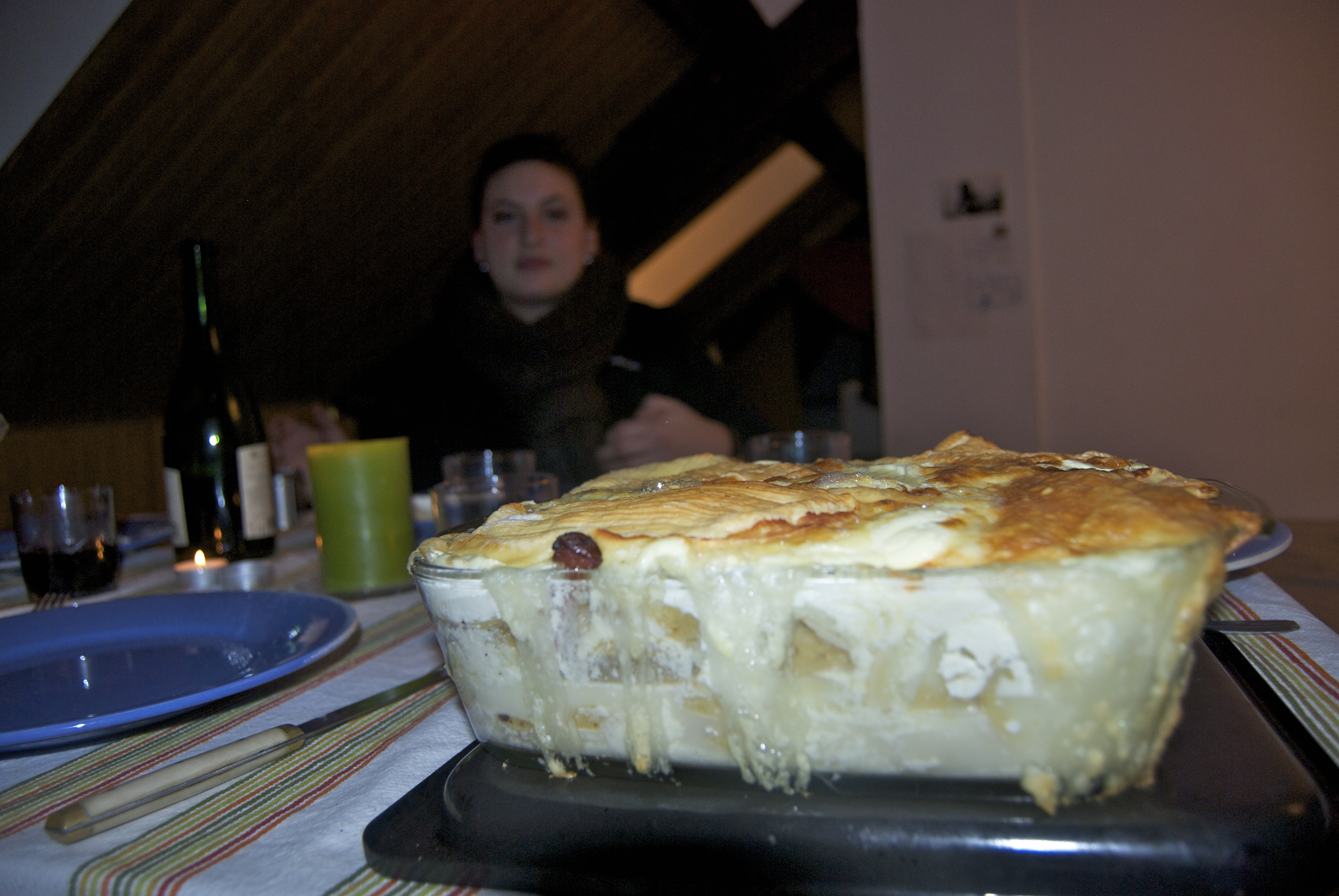
The finished tartiflette right before I pulled it out of the oven and the wolves descended…

After much research, I settled on this recipe. However, if you’ve been following this blog at all than you know that I am rather incapable of following a recipe. So, I’ve re-written the recipe (in English, as the one is used is written in French), including my own little rebellions.

Caely’s Americanized Tartiflette

2 kg potatoes (4.4 pounds)
1-2 TBSP olive oil or butter
2 onions, halved and then sliced thinly
200 g smoked lardons (7-8 ounces), chopped into 1″ cubes
1 tub (8 ounces) crème fraiche at 30% fat content
6 ounces dry white wine
1 wheel reblochon cheese
Salt and freshly-ground black pepper to taste

Preheat oven to 375 degrees fahrenheit.

Halve and then slice the potatoes at about 1/2″ thickness. Boil them in salted water about 15 minutes, or until they are pierced easily with a knife.

Meanwhile, in a large skillet over medium high heat, add 1-2 tbsp of olive oil or butter (0r a combination of the two). Once the oil is heated through (you can test this by lightly sprinkling water over the oil – if it sizzles, it’s ready!) add the onions. Add salt and pepper to taste. Remember the lardon is quite salty, so don’t overdo the salt! Cook about 10 minutes or until the onions are beginning to look translucent. Add the lardons and cook a further 10 minutes.

In a medium-sized bowl, whisk the crème fraiche and the white wine together. Add salt and pepper to taste.

Butter a large gratin or casserole dish. Add half of the potatoes, then half of the crème fraiche mixture followed by half of the onions and lardons. Repeat the last 3 steps.

Cut the block of reblochon cheese into thick strips and layer evenly over the top of the casserole.

Bake the tartiflette for 30 minutes, or until the top is brown and bubbly. It’s a good idea to cook the casserole on some sort of baking sheet, as the cheese is likely to drip over the sides of the dish.

Let sit 10 minutes, and then dig in!

Here are more teasing photos that will motivate you to recreate this dish chez vous!

As the tartiflette is very heavy, I served it with a very light salad comprised of lettuce and a lemon vinaigrette. We enjoyed it with a bottle (or two…) of Chotes du Rhone and had a chocolate mousse (from the supermarket shelves) for dessert. I just love that I have access to amazing chocolate mousse and wine for so cheap!

And, as usual, what made the whole meal worth it was the company…

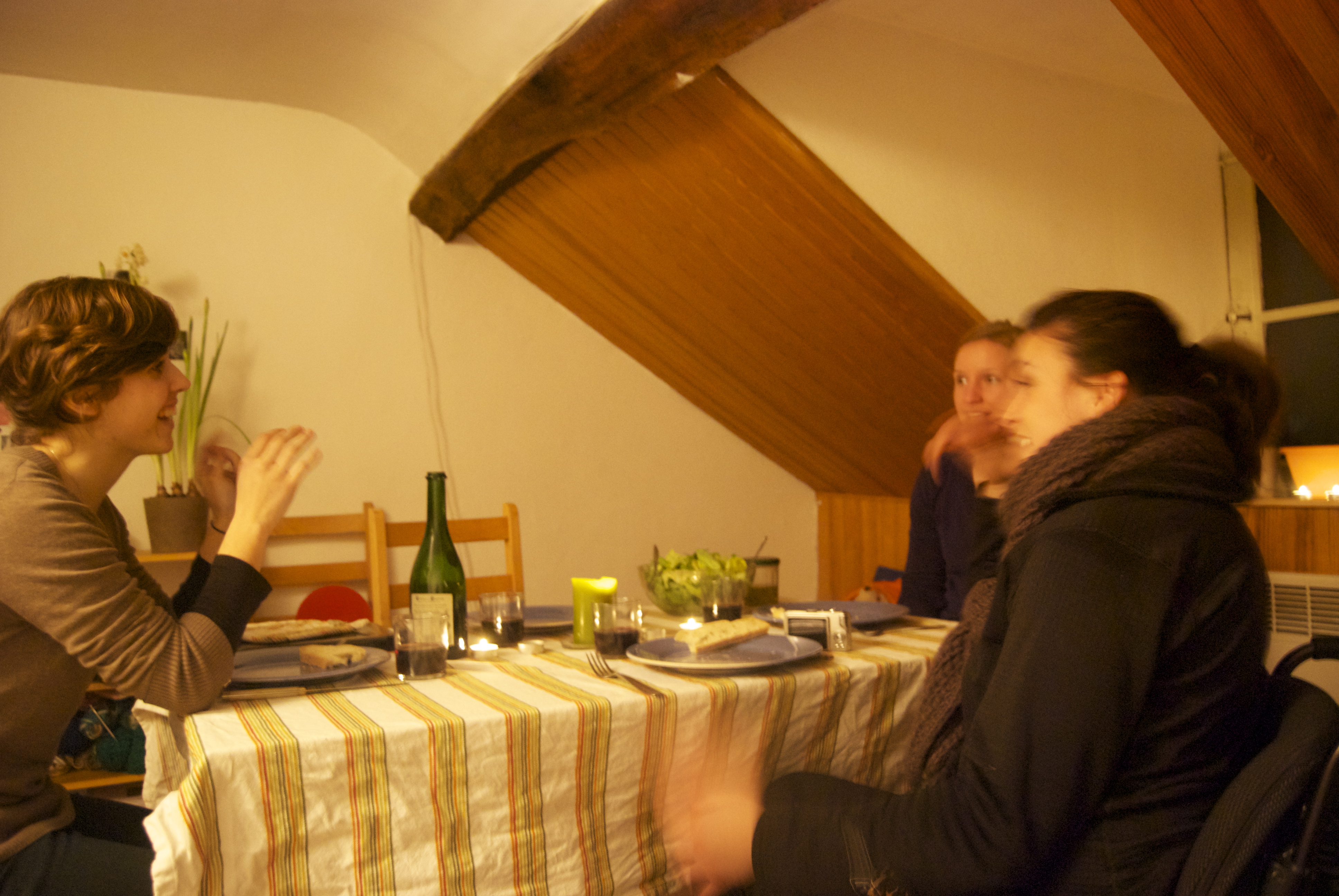
Good friends enjoying good food at one of our favorite local restaurants: my apartment!

Stay tuned for more heart-warming winter dishes. I see some soups in my near future. Until then, bon appétit!

Posted in Food | 4 Comments

La marchée à la place de lices….

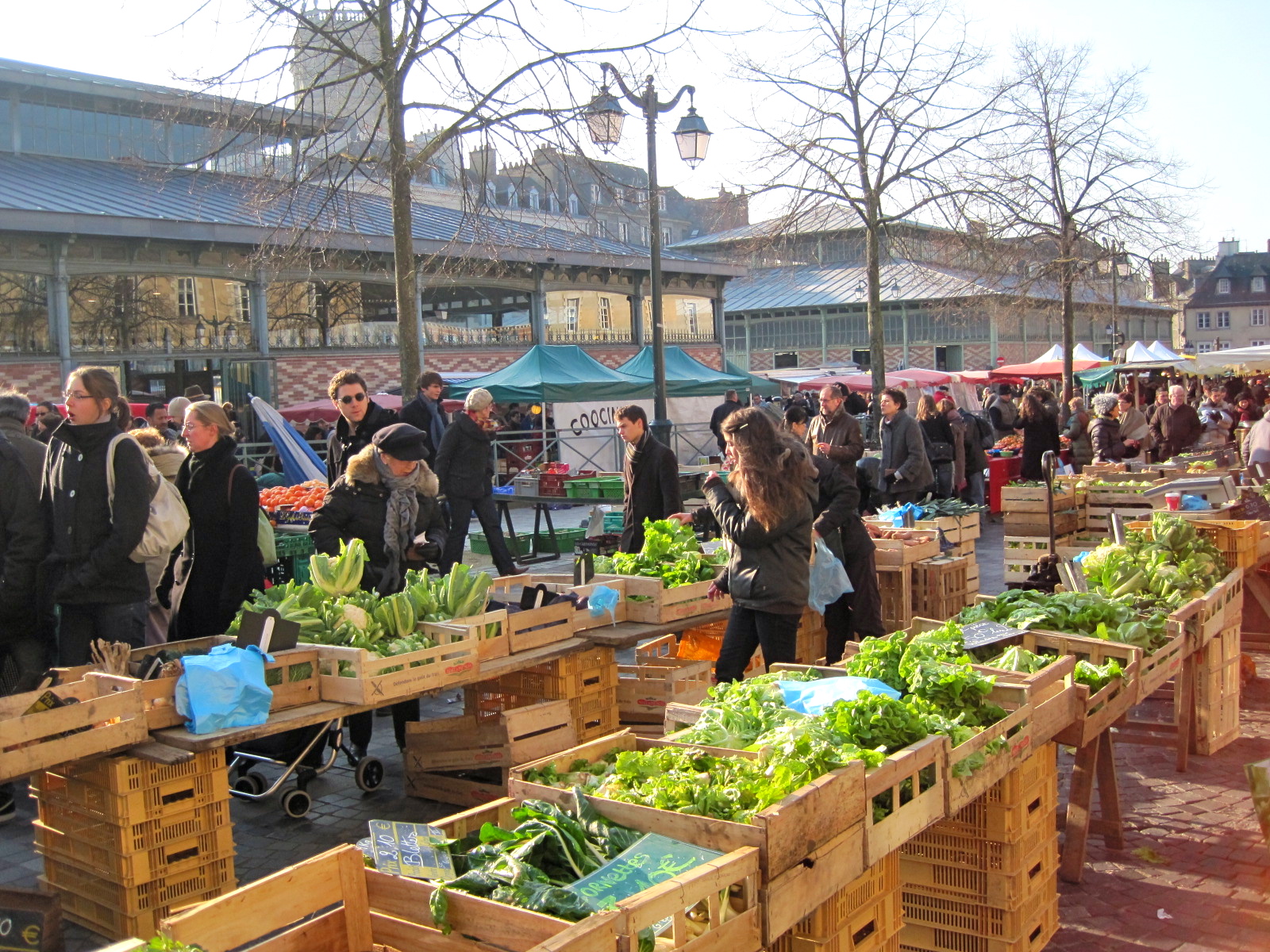
My Saturday tradition is to do my shopping for the week in the open-air market in one of Renne’s largest squares, the Place de Lices. I’ve gone every Saturday since I moved here, unless I was out of town. It’s my favorite day of the week,  not only because I don’t have to wake up early for work, but also because I get to smell, see and taste the best of what Brittany has to offer.

There are many farmer’s markets throughout the week here. I am very lucky to be able to get farm-fresh produce almost any day of the week. But I am particularly fortunate to have access to this market at the Place de Lices as it is one of the largest and most-reknowned open-air markets in France.

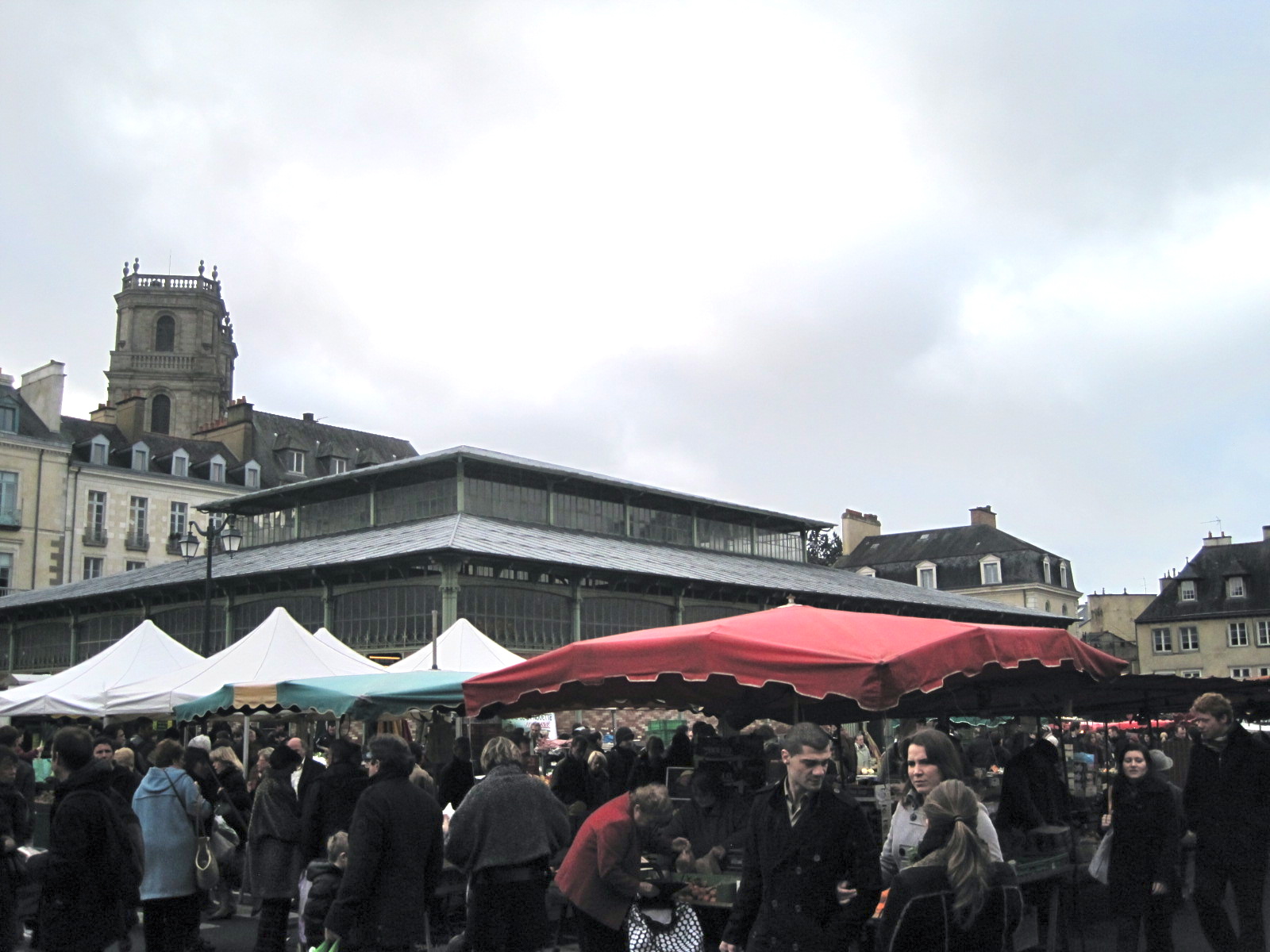
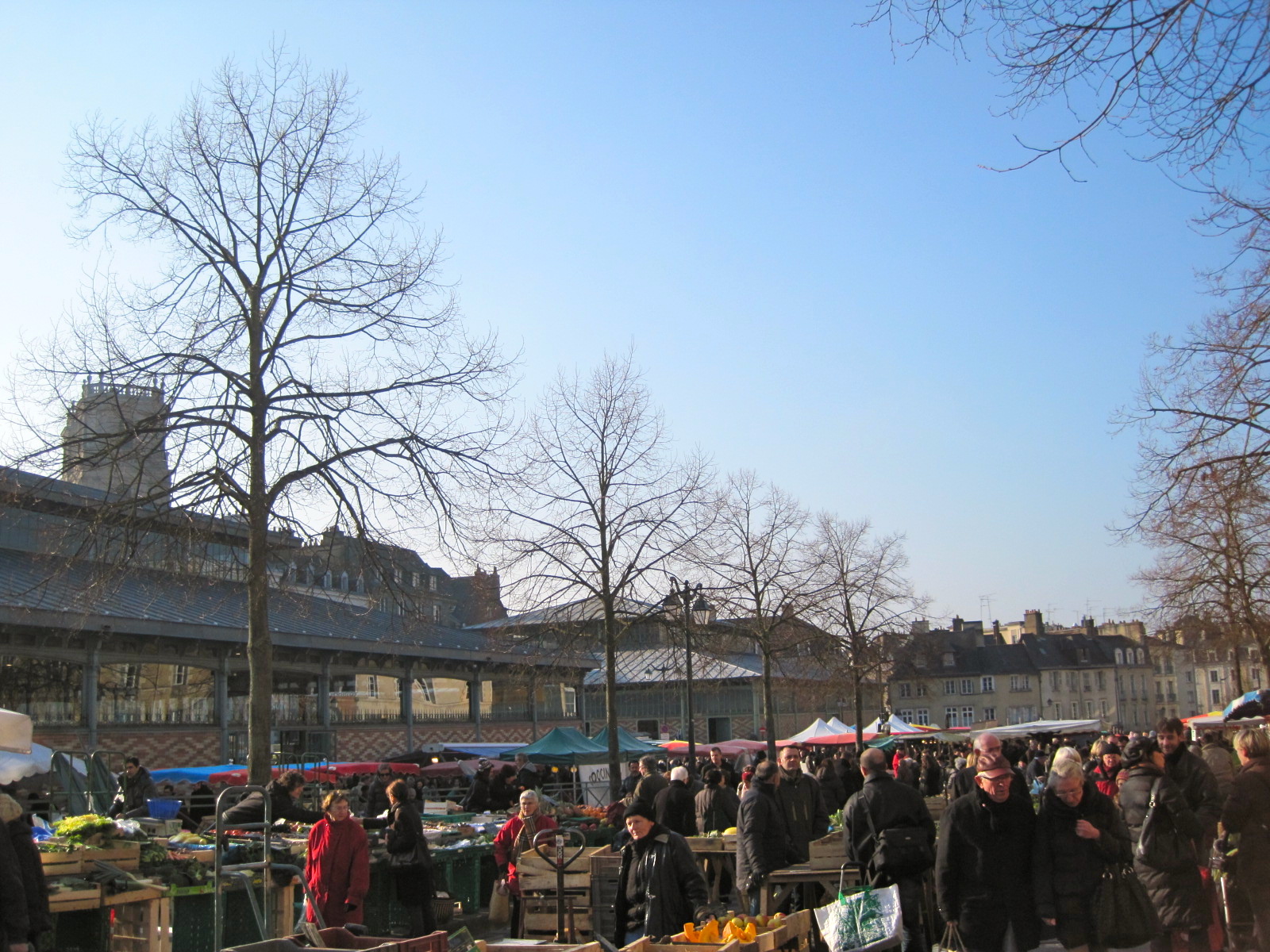
There really is no way to describe the vastness and the vibrancy of it. The Place de Lices itself is a huge, lively rectangular area, surrounded by bars, restaurants and posh estate agencies. It butts up against the beautfiul old cathedral, and is located one block away from the historic center of Rennes (built in the 15th century). But the best aspect of the Place is the huge glass, copper and brick buildings in the center of it.

The glass and copper building (one of two) is visible rising up behind the crowd of vendors and eager shoppers. The cathedral is the building jutting up on the left.

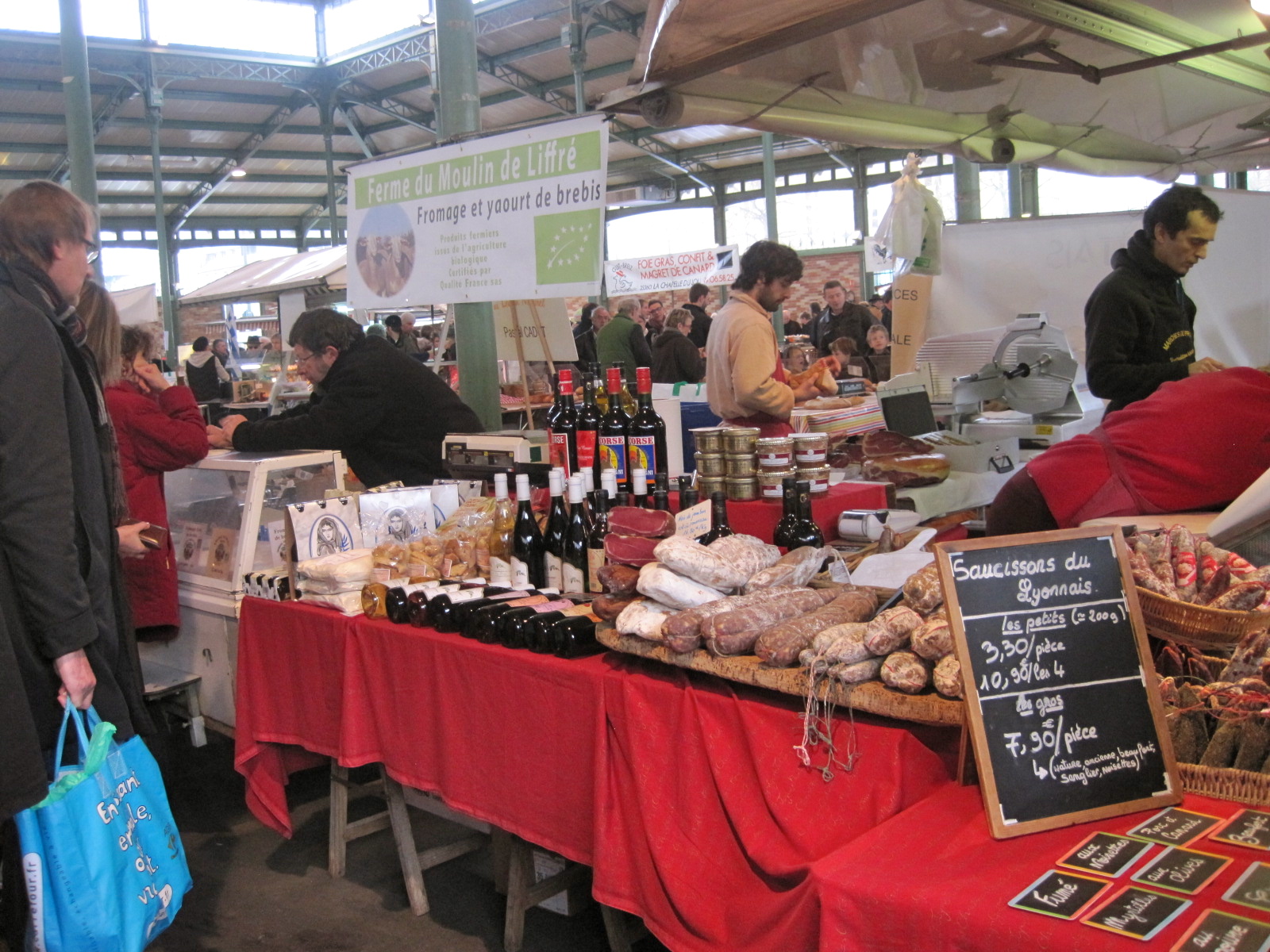
These normally empty buildings are used for cultural events such as trade fairs and fundraisers. Every Saturday, however, is when they truly spring to life: they fill with vendors from across Brittany  who sell everything from local honey, fresh-made cheese, sausages and pastries to Chinese food and discount wine. The building is so tightly packed that it is always a tricky operation to weave in and out of all the other shoppers whie holding bags full of produce and fragile eggs and goat cheese. And that is just one of the buildings: the other is completely full of butchers (and these are big buildings – so that’s a lot of butchers!).

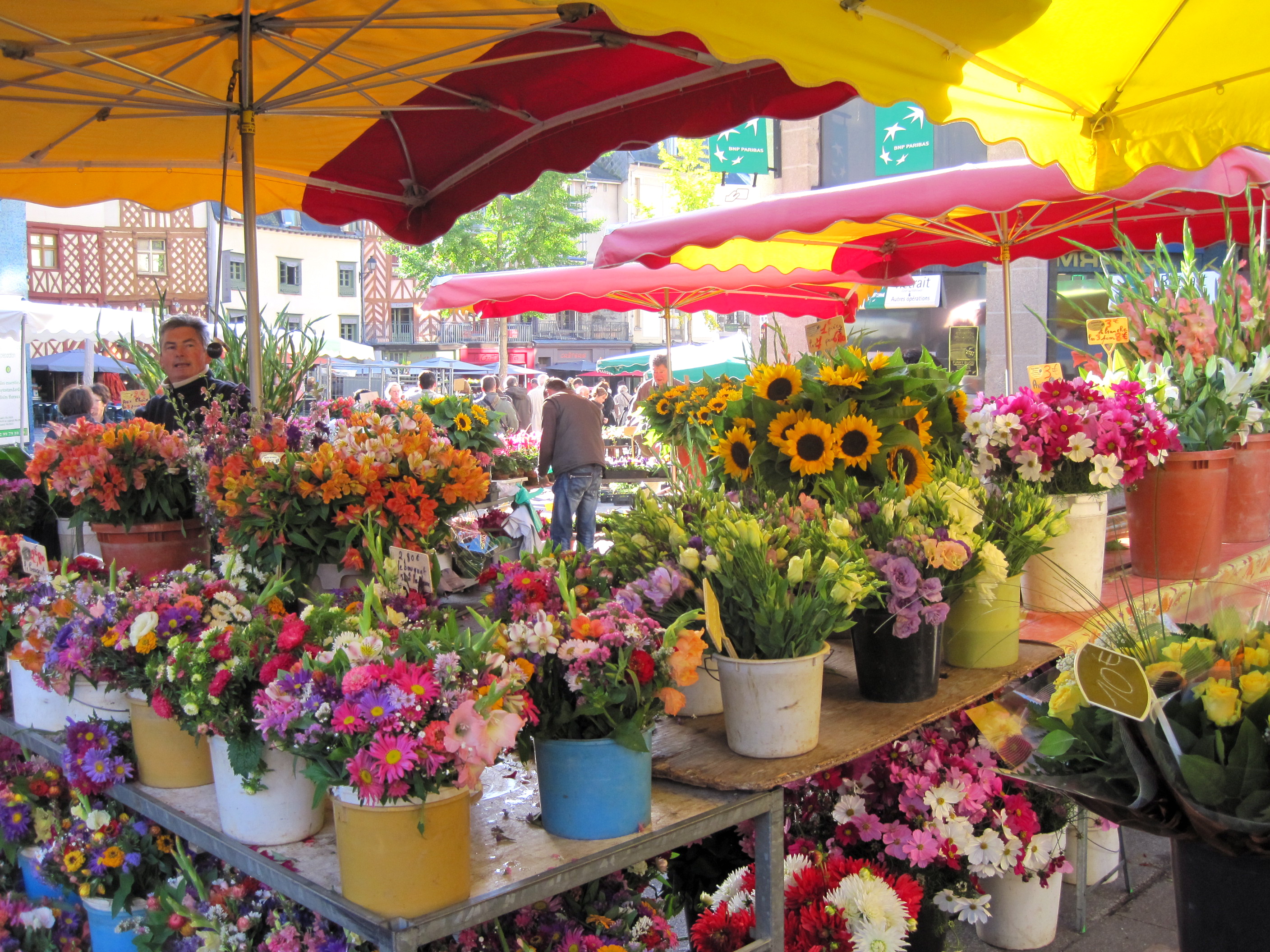
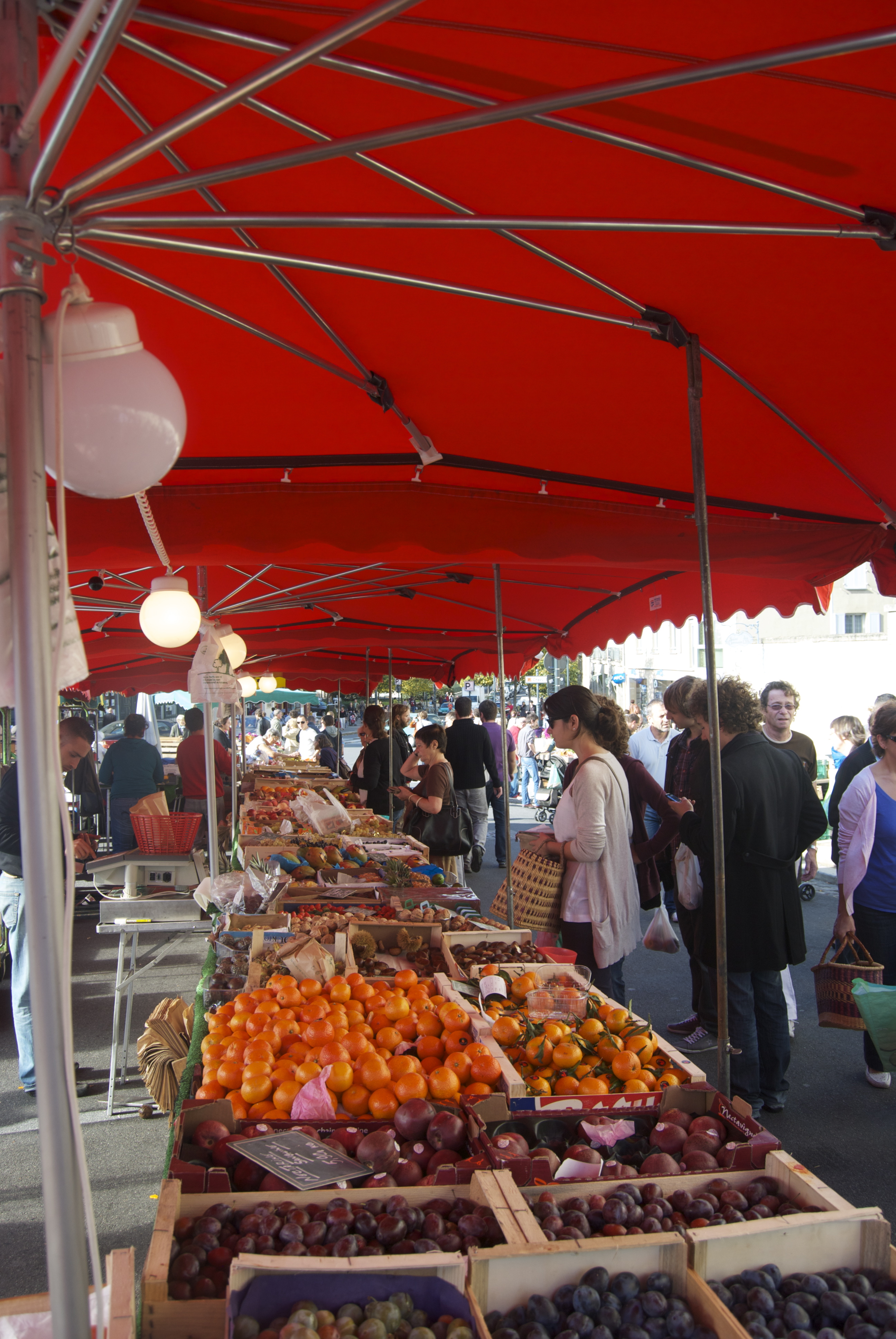
But before you even reach the glass and copper buildings, you must negotiate your way through the stalls surrounding them. I’ll take you through my normal route: I meet my friends at Place St. Anne, and we find our way to the market. We enter at the far end where all the flower vendors are gathered.

We then make our way down the many rows of produce vendors, winding our way past old men on bikes, old ladies with straw bags bigger than themselves, and musicians bellowing so as to be heard above the din of the crowd .

This is one of the better music duos I've seen at the market. The woman sounded very cabaret-esque, and had such a strong, beautiful voice. The guy to the left was their biggest fan; he was a bit cooky.

There are hundreds of different vendors, some selling olives and tapenades, or else spices and dried fruit, or farm-fresh produce. I was so overwhelmed the first time I went to this market, wondering how I would ever choose what vendors to buy from. Now that I’ve been going for four months, I finally have it narrowed down to about 6 vendors. I have my garlic and onion guy, my apple guy, and then about 4 different vegetable vendors that I bounce between: one who has the best radishes and the other who has the best mache and leeks.
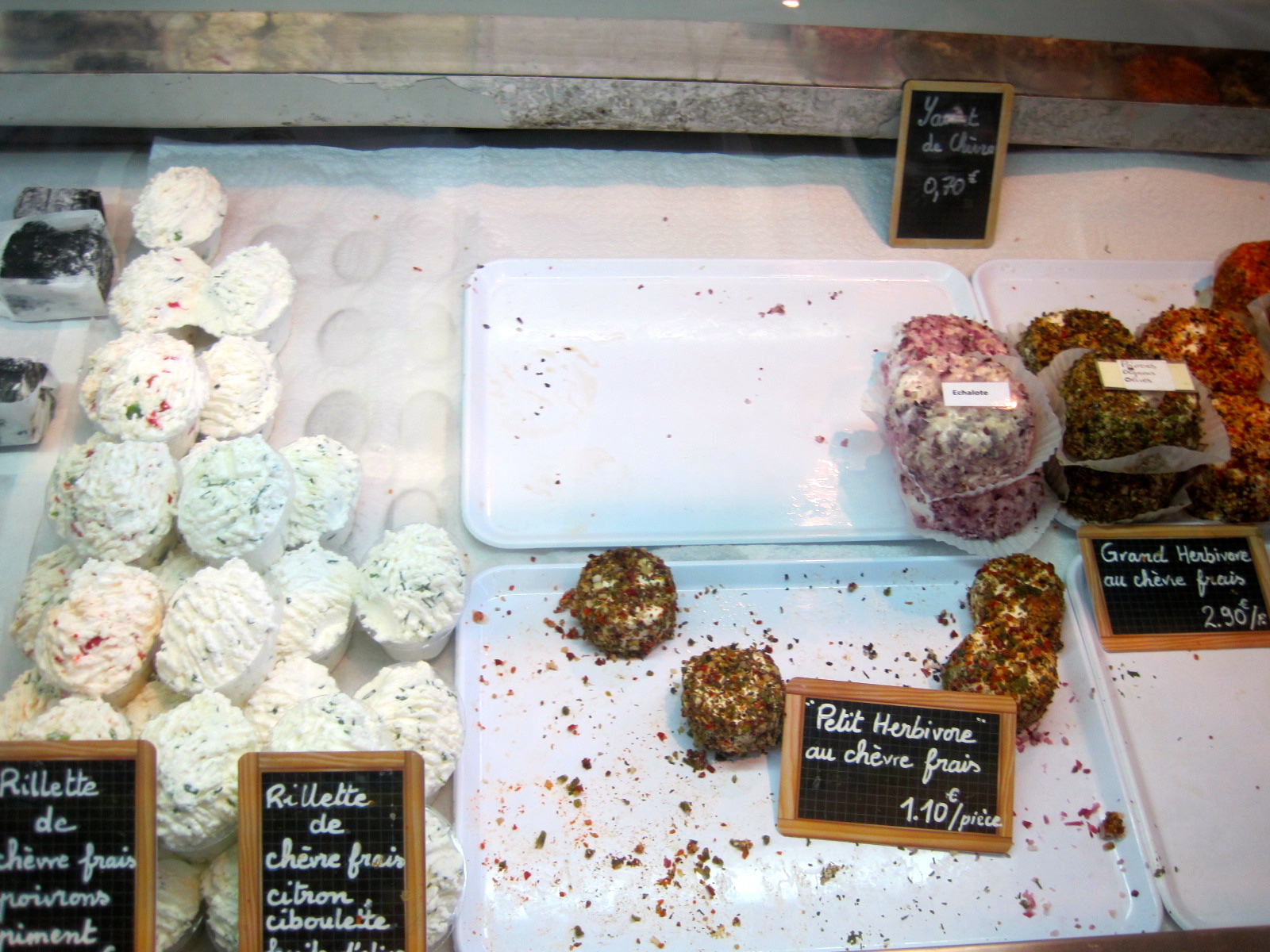
Once we have all of our produce, we brave the crazy interior of the glass and copper building. If my claustrophobia ever threatens to engulf me, I just take a deep breath and look up at this:

Or else this…

Hey, nothing calms me down like goat cheese! And this goat cheese is EPIC. I get some every week, to enjoy on salads and toasted baguette. I think you all know from last week’s post how I feel about goat cheese salads. In addition to the goat cheese, typical purchases include a half dozen eggs, a chicken to roast, some honey, and usually some sort of treat to snack on like some homemade macarons or  a mini kouign-amann  (the Breton delicacy that I posted about once before).

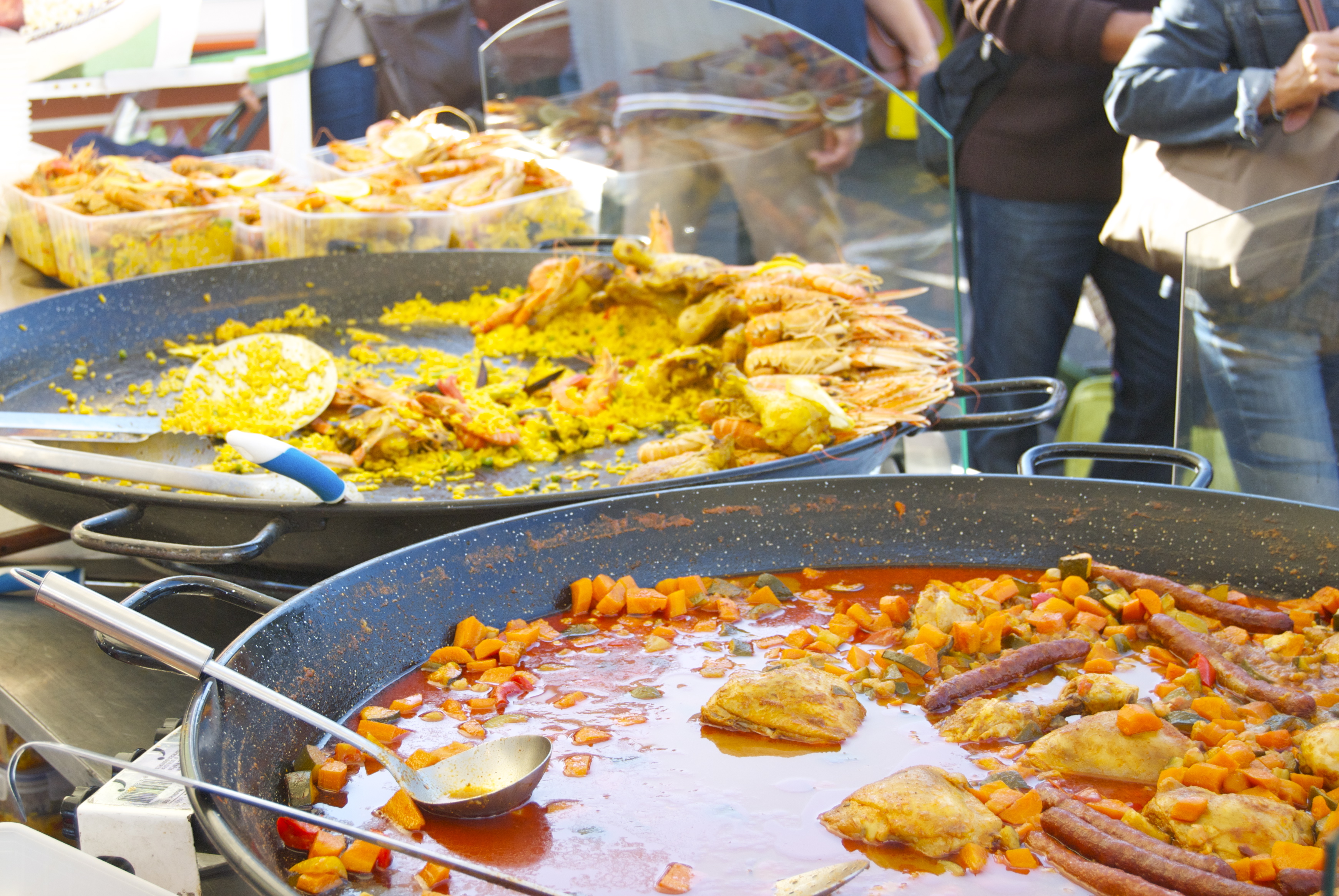
And arguably the best part of the market lies between the two glass buildings, where all of the pre-made food vendors are. There are vendors sporting huge drums of paella, North-African and Burmese food, and there are too many galette stands to count.

One of my first meals in Rennes was this paella, which I enjoyed while sitting on a street corner with my friend, our fingers covered in grease and seafood juice while passersby chuckled at us.

Every week, without fail, my friends and I turn to each other, galette in hand, and sigh, “what will we do when we don’t live in France anymore and can’t come to markets like this every week!?” Because yes, while it is true that farmer’s markets are growing more and more popular every day in the States with the whole eco-friendly craze that has engulfed us, there is one big difference: in France, this food is affordable. If I buy all of my produce at the open-air markets, it is much cheaper than if I buy it at the supermarket. And, it is local and sustainably grown. This is not the case in the States, where farmer’s market fare is often much pricier than their supermarket counterparts. So, please US, get your act together or I’ll never move back!

But, if we’re being honest here, I may never move back anyways….not when I can eat goat cheese and kouign-amann everyday!

Posted in Culture, Food | 12 Comments

Chèvre chaud

I don’t really discriminate when it comes to food. I love pretty much every thing, as long as it’s fresh and prepared well. I’ll eat any vegetable, every type of cuisine, spicy, salty, sweet, whatever texture. I’m always up for discovering new dishes, culinary techniques and flavor combinations. In fact, I’m realizing lately that it’s one of my very greatest pleasures in life. So if I had to narrow it down and make a list of my top favorite foods, it would be extremely difficult.

My preferences change with the weather, the season, and my moods. I go through phases, like everyone else. But if I had to pick, if, in some bizarre scenario someone put a gun to my head and shouted, “Tell me your 3 favorite foods!” I just know that I would blurt out “scallops, goat cheese and ice cream!” So, imagine my delight when I moved to the south of France four years ago (though it feels like yesterday) and discovered that every bistro menu featured a salade au chèvre chaud, simply known as chèvre chaud in Provence.

Chèvre is the French word for goat cheese, and let me tell you, they know how to make the stuff around here, especially in Provence. The chèvre chaud is a very straightforward salad: Toasted slices of baguette are topped with thick slices of goat cheese and broiled briefly, until the cheese is slightly carmalized and oozing with perfection. These are then placed upon a bed of fresh greens, such as mesclun, which is usually accompanied by tomato and toasted walnuts, all of which have been tossed in a light shallot vinaigrette.

A chèvre chaud I recently enjoyed at La Casa Pépé, a restaurant I posted about previously.

Every single time I went out to lunch during my 4 month stay in Provence, I had to convince myself to try something other than a chèvre chaud. I would battle with myself (a common occurance). The dialogue would go something like this:

Caely 1: “Dammnit Caely, try something new!”

Caely 2: “ But I love chèvre sooooo much”

Caely 1: “Okay fine, just this once. But next time, you’ll try something new! There are so many amazing Provençal dishes to sample…the seafood, the paté, the rillettes, the ratatouille. Next time, it’ll be something new! That’s an order…”

Caely 2: “Okay, okay. Next time….”

And the cycle repeated. But honestly, how is one to resist the allure of a refreshing chèvre chaud on a lazy, hot Provencal afternoon? Nothing goes better with a glass of rose…

And good news, it couldn’t be simpler to make chez toi. Here is a traditional recipe that I found on the blog of a fellow Francophile.

And, the next post really will be about the farmer’s market here in Rennes. Je vous jure!

Until then, bon appétit!

Posted in Food, Recipes | 5 Comments

Cancale (aka “The Seafood Tower”)

So, I know that I said in the last update that I would be posting about the farmer’s market next, but I took a last-minute trip to Cancale today, where a personal dream of mine came true: I finally had my damn seafood tower!

Anyone who has spoken with me in the last year and a half has heard me speak of “the seafood tower”. To call it an obsession would be using too kind and gentle a word: it has been a quest. I have annoyed friends, family and new acquaintances alike with my incessant ramblings about the seafood tower. It all started before I left for Brittany for the first time, over a year ago now (how time flies!). When my sister heard I was moving to Brittany, she sent me a link to Anthony Bourdain’s episode on Brittany. If you’re not familiar with Anthony Bourdain, you should change that right quick! He is a funny, wry and drunken professional chef who travels the world and eats amazing food in his Travel Channel show “No Reservations”.  I recommend that you all watch this episode (which can be bought on iTunes) if you are at all interested in my life here (and I assume you are if you’re reading this!).

In the episode, Anthony Bourdain had become obsessed with these seafood towers he had seen little old ladies attacking with vigor in various seaside restaurants in Breton cities such as Cancale. He became increasingly obsessed with doing a “seafood tower” scene, and began asking his producers repeatedly “when do I get to do my seafood tower scene?” Finally at the end of his trip, he got to do his seafood tower scene. And today, a year and a half later, I got to do mine.

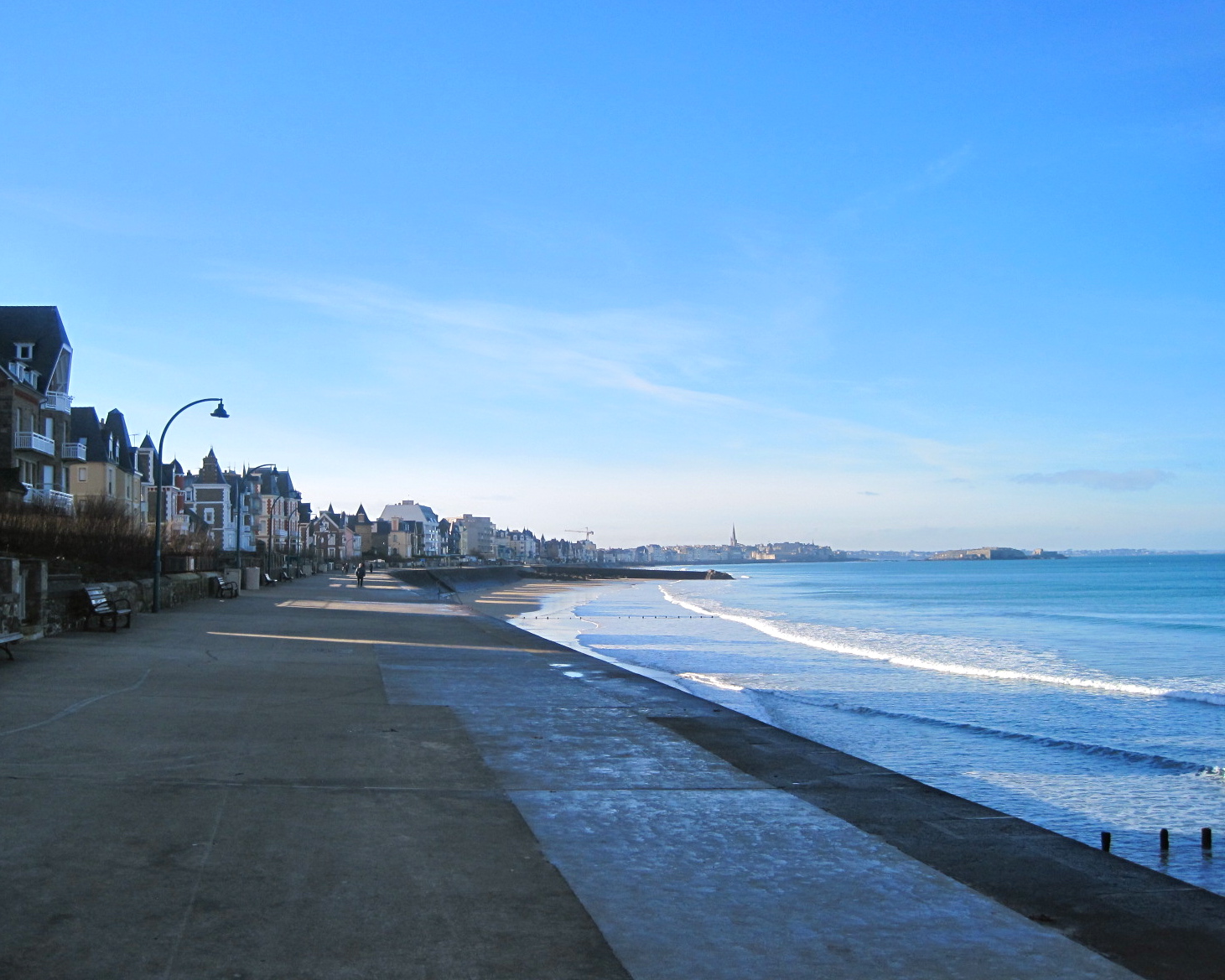
The day started when I met my friend Carolyn in St Malo, which is a beautiful seaside town about 2 hours from Rennes. I had already visited St Malo during the Routes du Rhum (a huge boat race) a couple of months ago, so I didn’t spend much time there today: I had more important things to do, like eat some serious seafood! Carolyn took me for a brief walk on the boardwalk while we waited for the bus to Cancale, and it was lovely to see the ocean again. Having almost always lived within sight of the Pacific, I get separation anxiety when I’ve been landlocked for too long!

The boardwalk of St Malo, with the ancient walled city in the distance

A short bus ride later, through beautiful and patchy farmland, we arrived on the boardwalk of Cancale. It’s a gorgeous little town, placed right on a crescent coastline. When the tide is low, it exposes miles of oyster beds that stretch out towards le Mont-Saint-Michele. You almost imagine that you could skip from oyster bed to oyster bed until you reach that famous island, which resembles a giant sand castle from that distance.

The tiny outline of Mont-Saint-Michel off in the distance

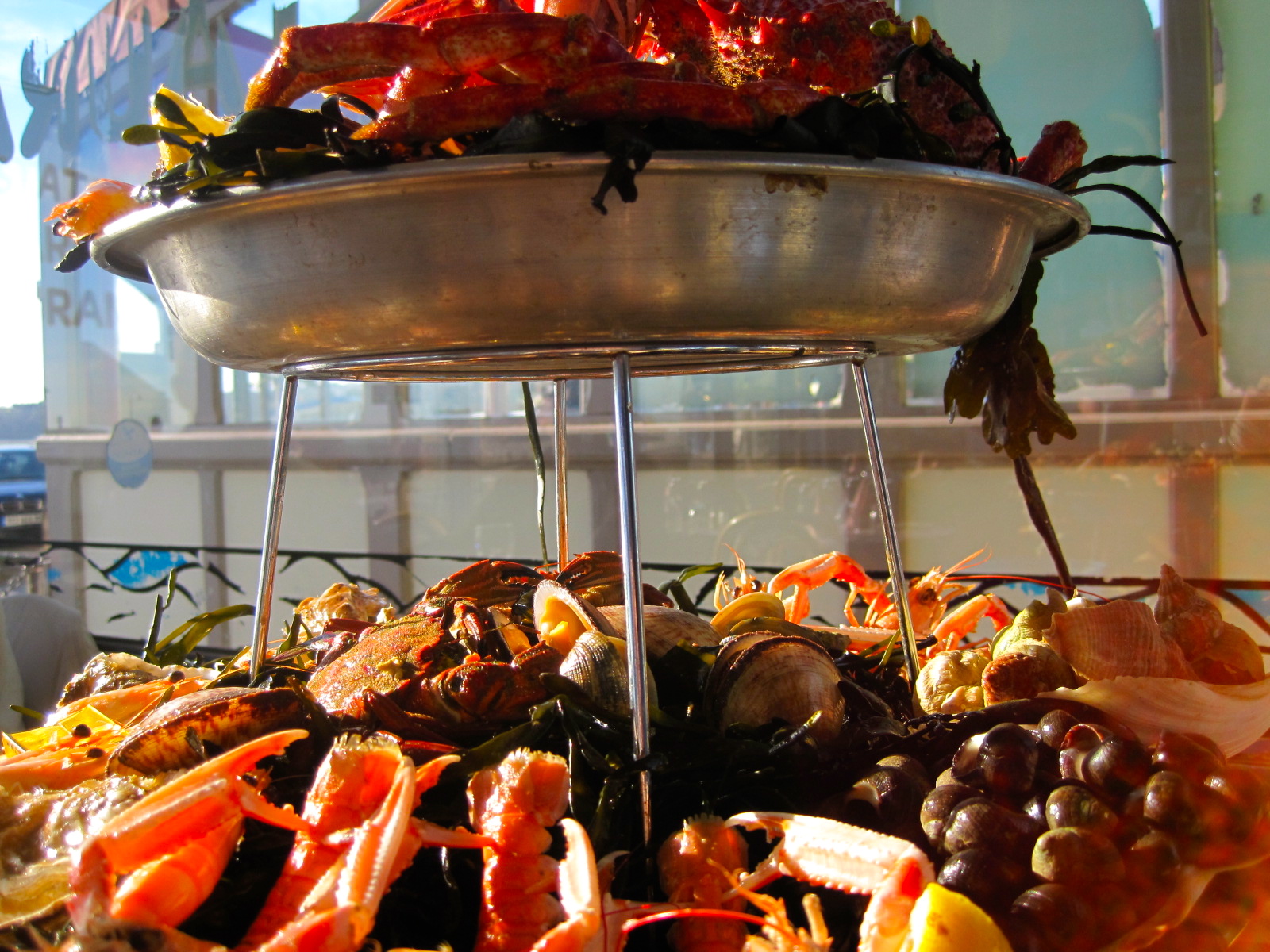
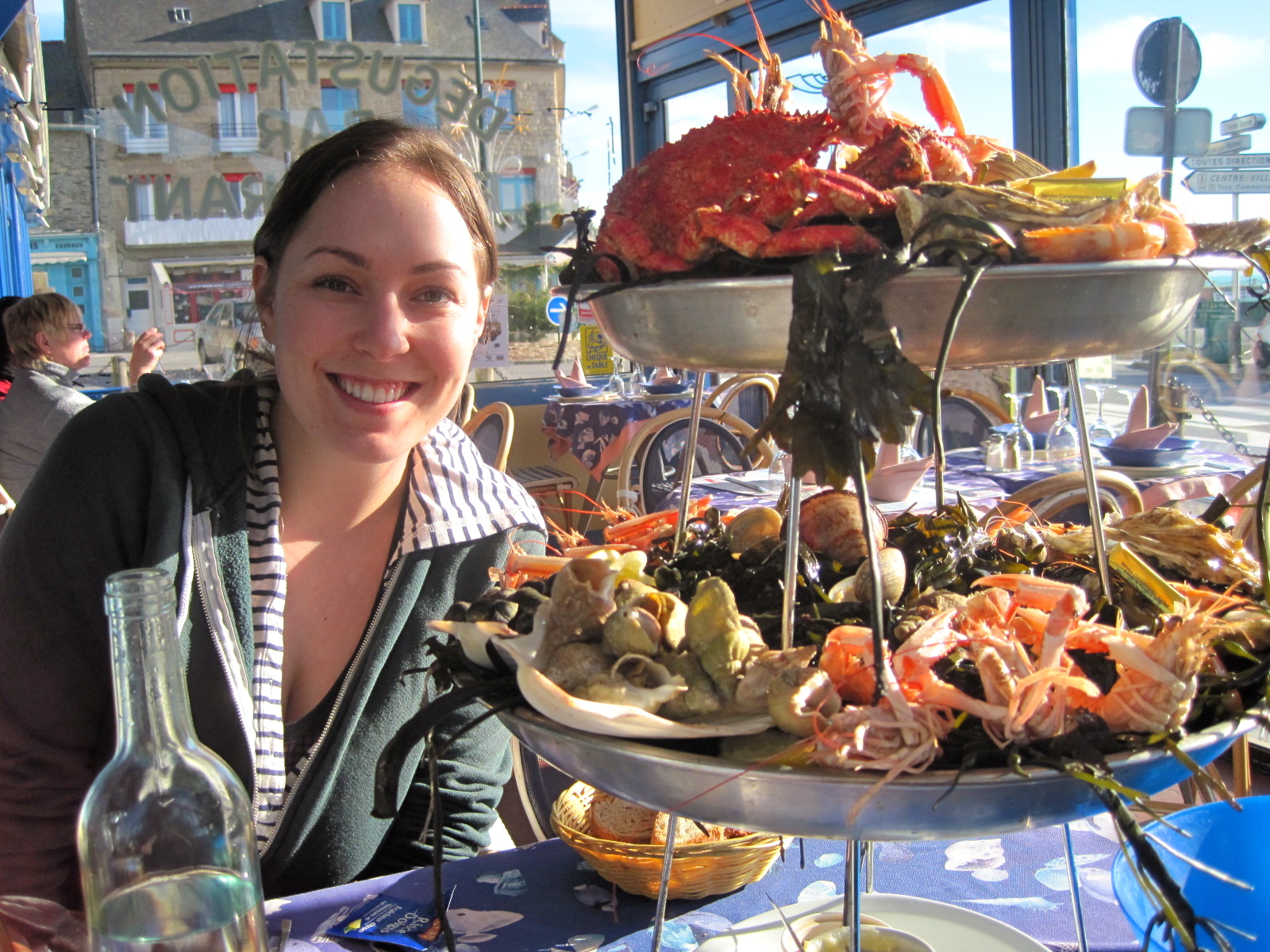
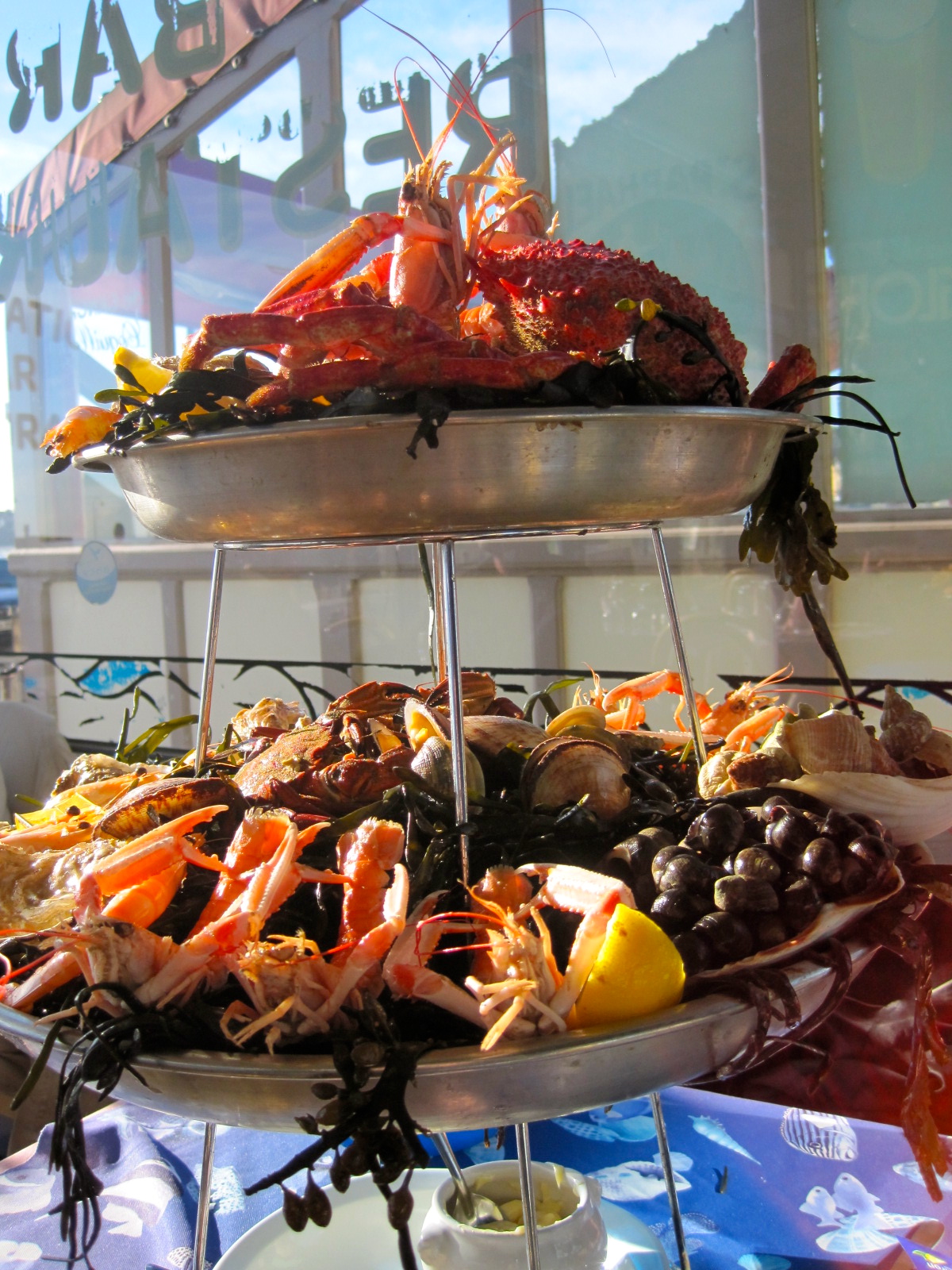
But enough about the scenery: let’s get to the goods. We quickly scouted out a promising seafood restaurant (aka it was neither void of customers nor overpriced). We were seated promptly and within minutes had ordered our plateau de fruits de mer pour 2 personnes, and a demi de vin blanc. We then waited with anticipation until finally the moment arrived: our tower of glistening pink and grey gems arrived.

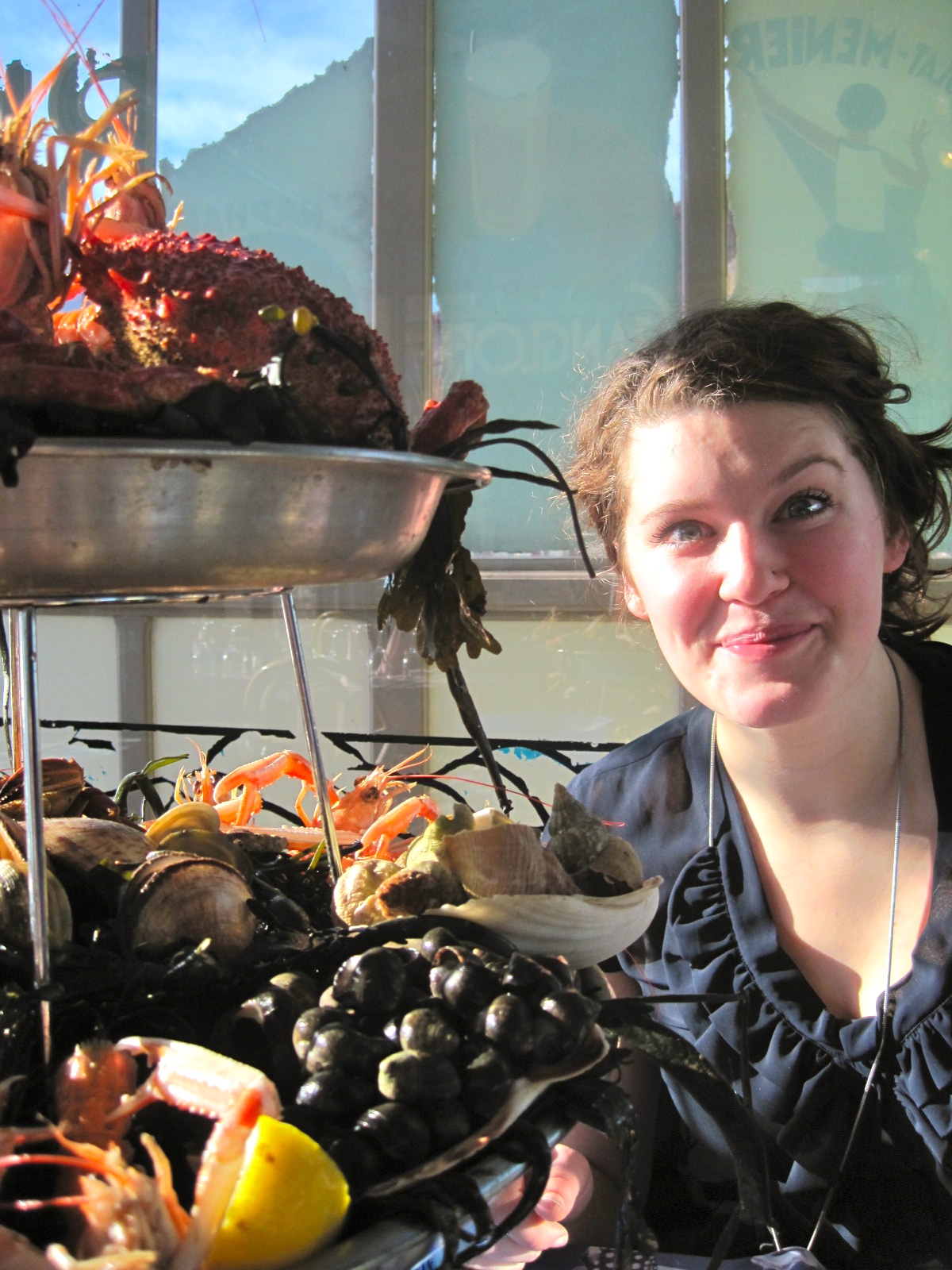
We attacked the unsuspecting victims with impatience and joy. We had no idea what we were doing, and joked that the chefs were spying on us and shaking with mirthful laughter at our novice seafood eating ways. And it was messy, very messy: I had shrimp brains, oyster brine, and bits of crab shell all over my face and hands. But it was oh-so-glorious…

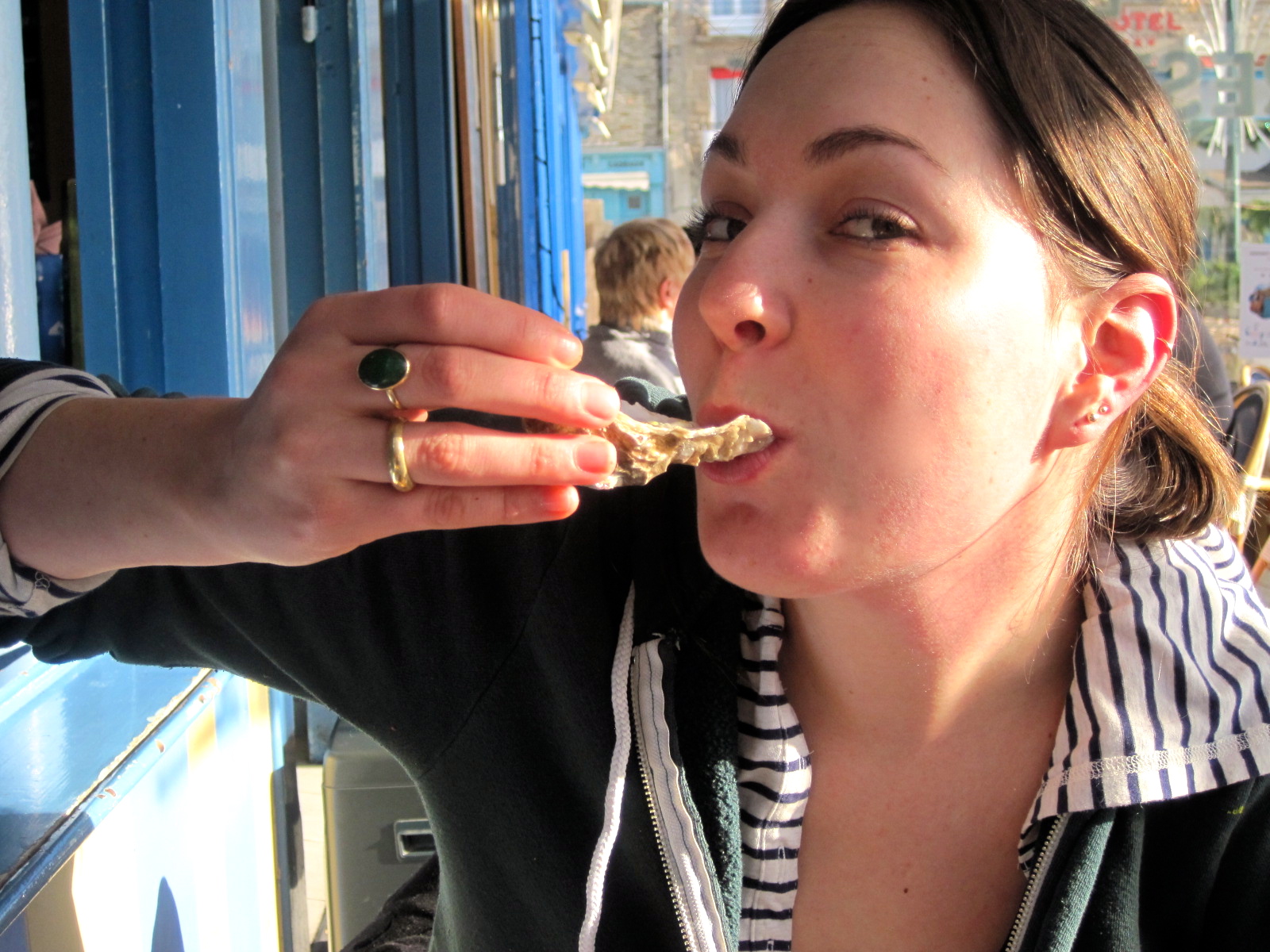
This oyster was dedicated to my brother Jess, a true fan of des huitres

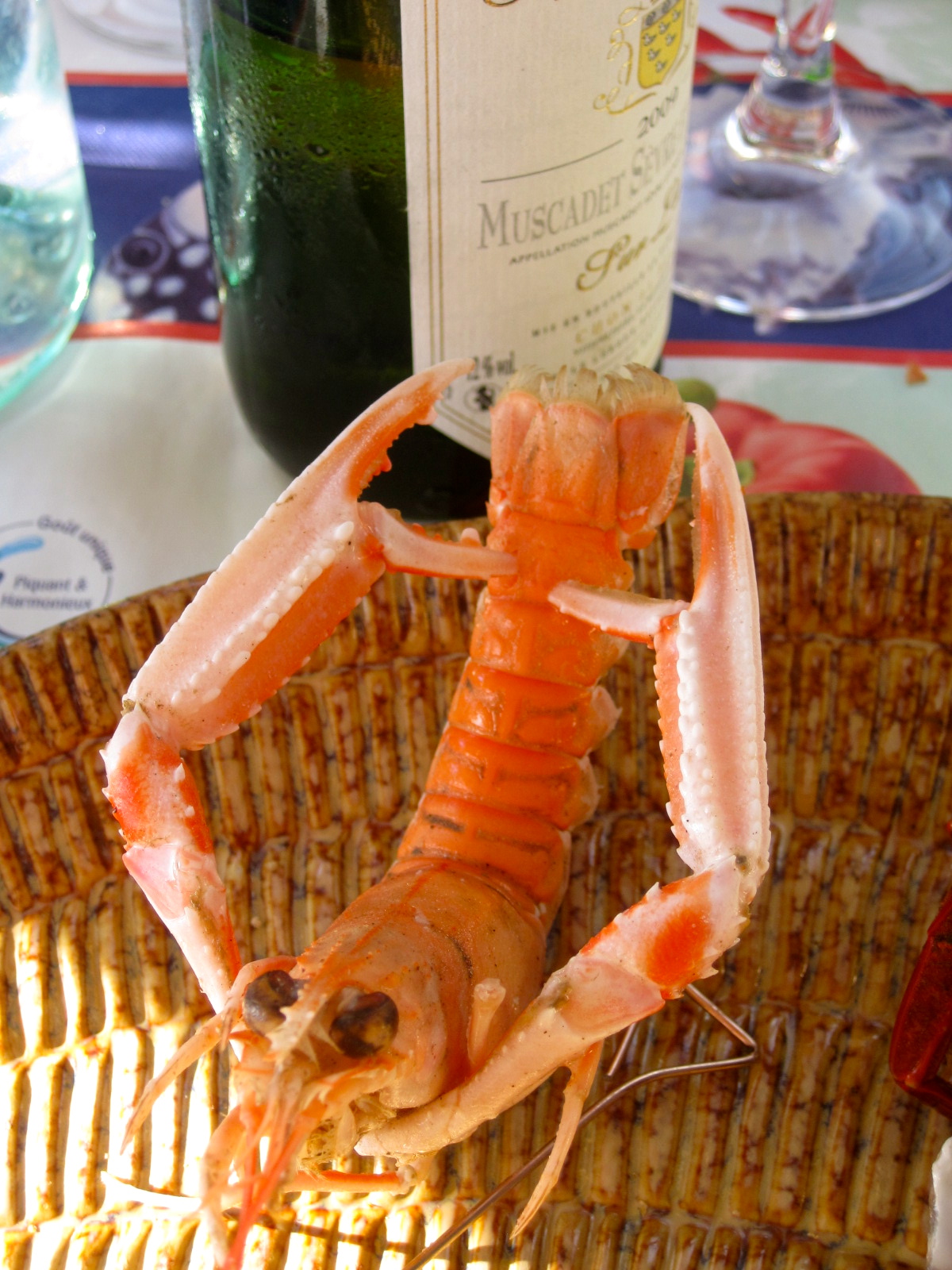
The platter included several sizes and varieties of both clams and sea snails (which I adored, surprisingly), along with shrimp, langoustines (a type of tiny lobster), a giant crab et des huitres, bien sur. It was served with an endless basket of bread, house-made mayonnaise, butter (of course) and beautiful shallot vinegar.

One of my favorite little buddies: a langoustine.

I meant to take an “after” picture of the graveyard of shell fish parts left behind after our voracious assault, but it got whisked away too quickly by the very attentive waitress, who waited for us patiently to finish devouring our massive pile of food. It took us a fair amount of time to work our way through all the obstacles involved in getting the various meats out of their shells!

Carolyn and I after our satisfying lunch (you can tell it was windy!)

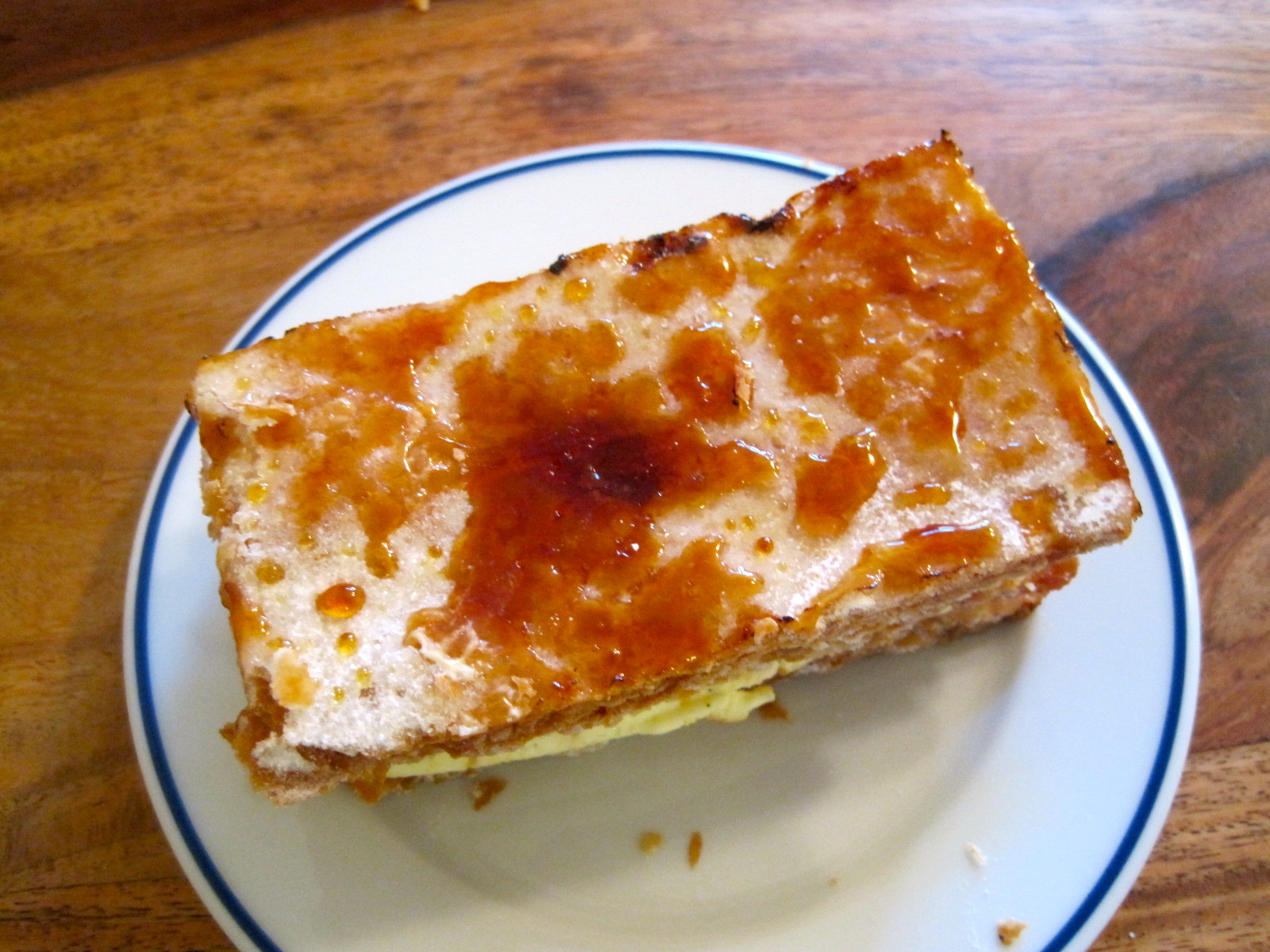
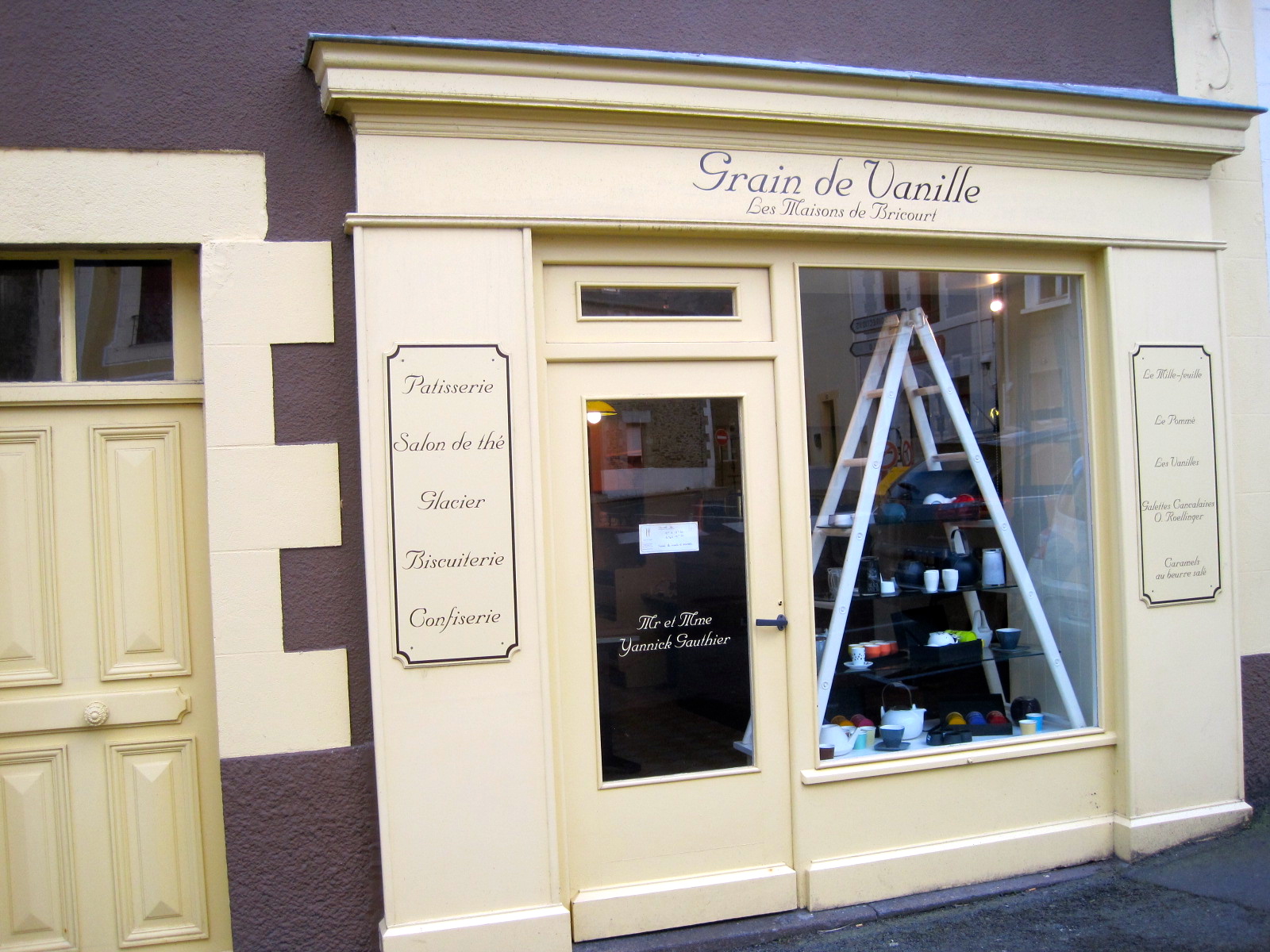
And then there was dessert…Cancale is home to one of my food idols: Olivier Roellinger (who is also featured in said Anthony Bourdain episode). He is a culinary visionary, and a fabulously offbeat one at that. He owns a hotel, restaurant, cooking school, spice store and dessert shop in Cancale.  So naturally, after lunch we rambled up towards city center and found our way to his patisserie, Grain de Vanille. I ordered the mille feuille, which they are known for.

_

In French, mille feuille means “a thousand leaves”. This mille feuille was composed of a thousand leaves of pure brilliance, and words cannot describe the delicate and delicious beauty of this dessert.

Roellinger's patisserie, Grain de Vanille

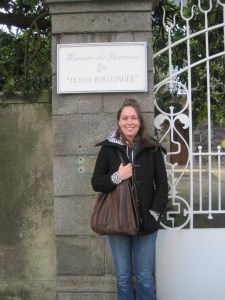
Afterwards, we checked out some of his other locations. Here I am, completely dorking out, in front of his headquarters.

So, all in all, it was a fabulously brilliant day. Several dreams came true for me today, and I was reminded once again, as I am everyday, why it is that I moved to this amazing little pocket of the world.

Thanks for reading, and who knows, if you come visit me in Brittany, it could be you on the other side of my seafood tower…

A shout out to Restaurant L'Escale, where all the magic happened

To see more photos from Cancale, and my other adventures in Brittany, click the link to my flickr page (scroll up and to the right).

Posted in Food | 34 Comments

Peter’s Seafood Gumbo

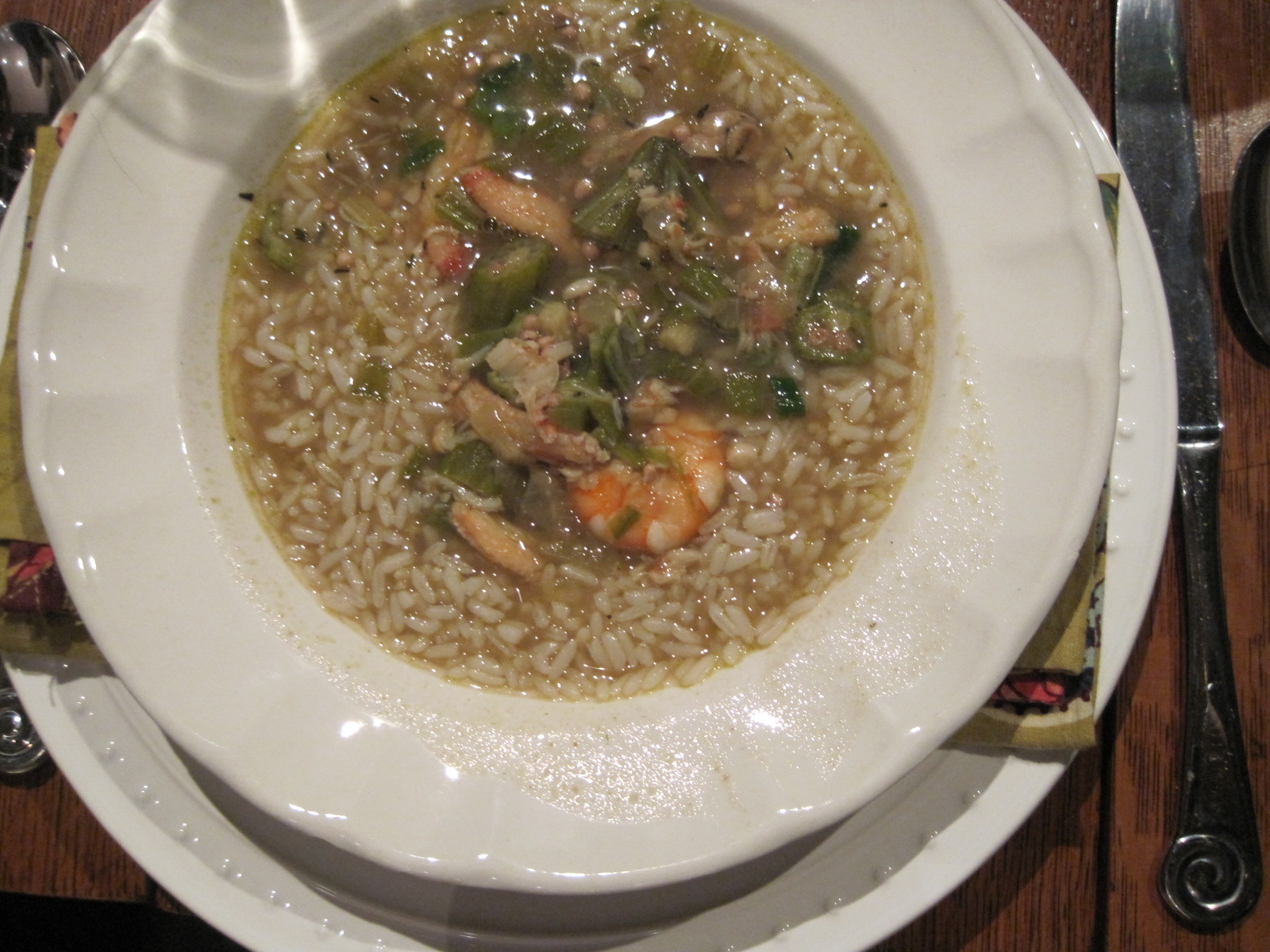
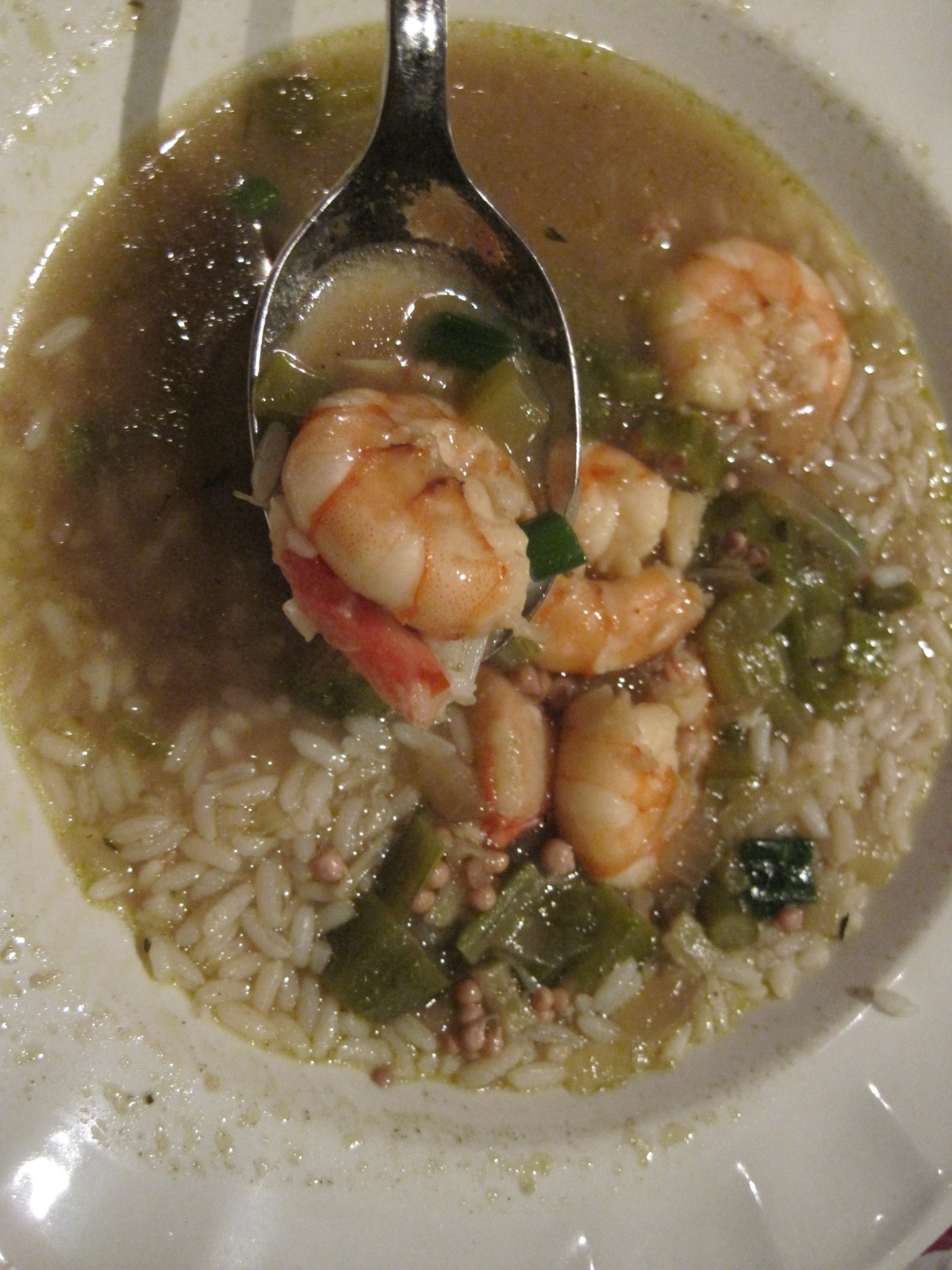
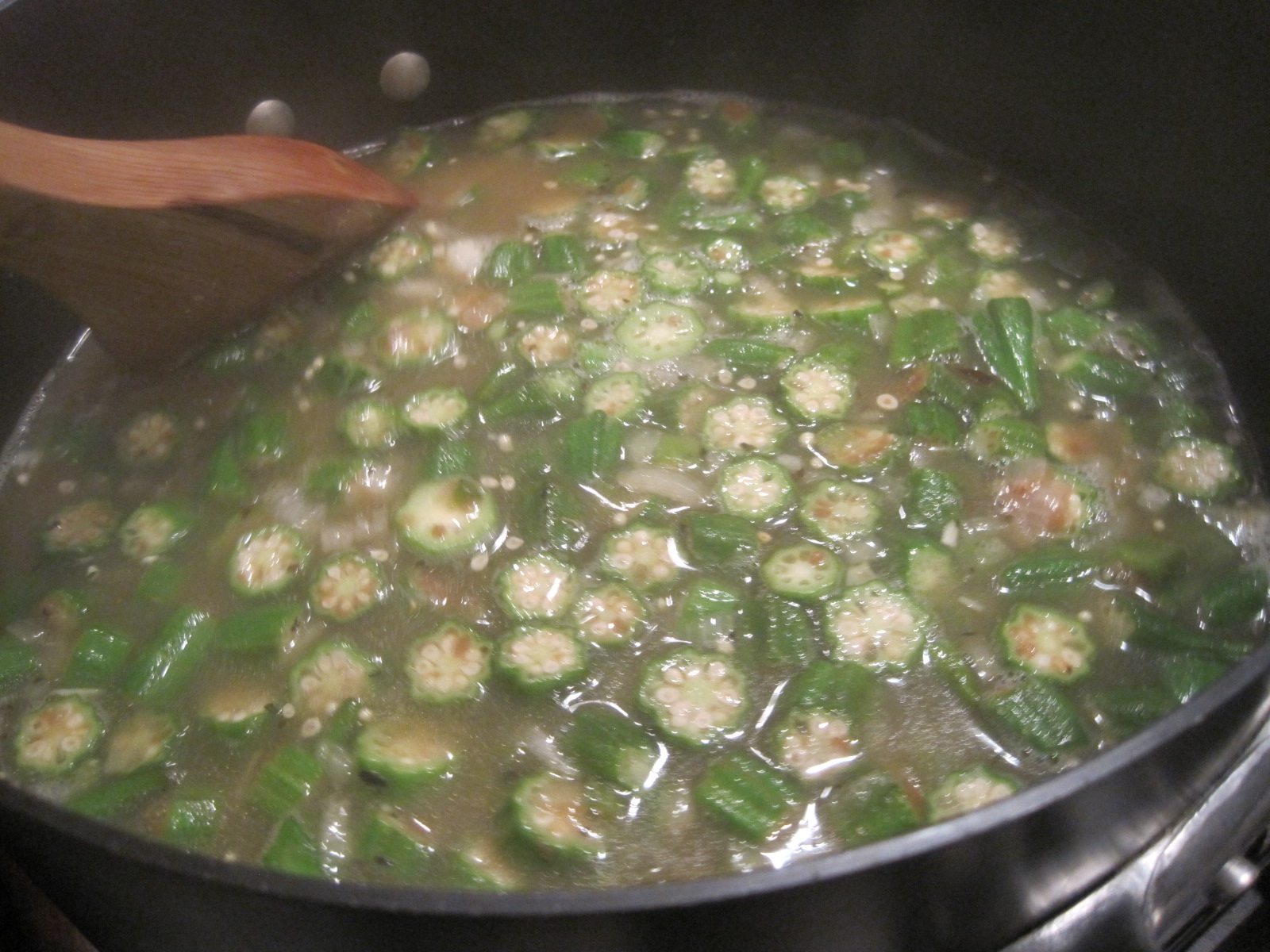
As previously mentioned, our New Year’s Eve meal was Seafood Gumbo a la my brother-in-law and native Mississippian Peter. He adapted his family recipe for Chicken and Sausage Gumbo and gave it a West Coast touch by substituting the meat and sausage for pounds of fresh seafood. It was delicious, and warming, and even better the next day. I highly recommend that you make this. Though Peter worked mostly from memory and therefore doesn’t have a recipe, he suggested this recipe he found on one of his favorite sites gumbopages.com. Also available on that same website is a recipe for shrimp stock which the seafood gumbo recipe calls for.
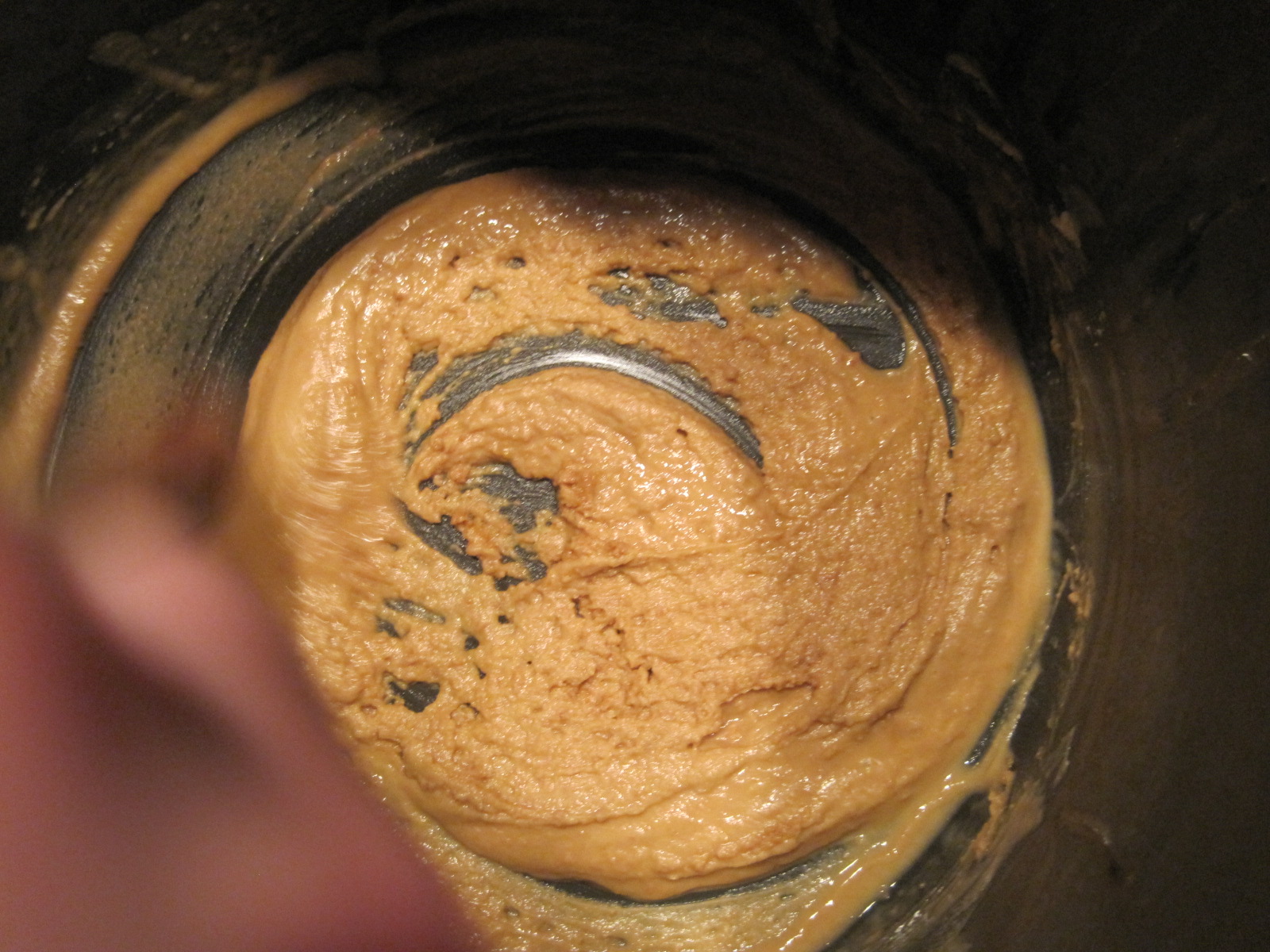
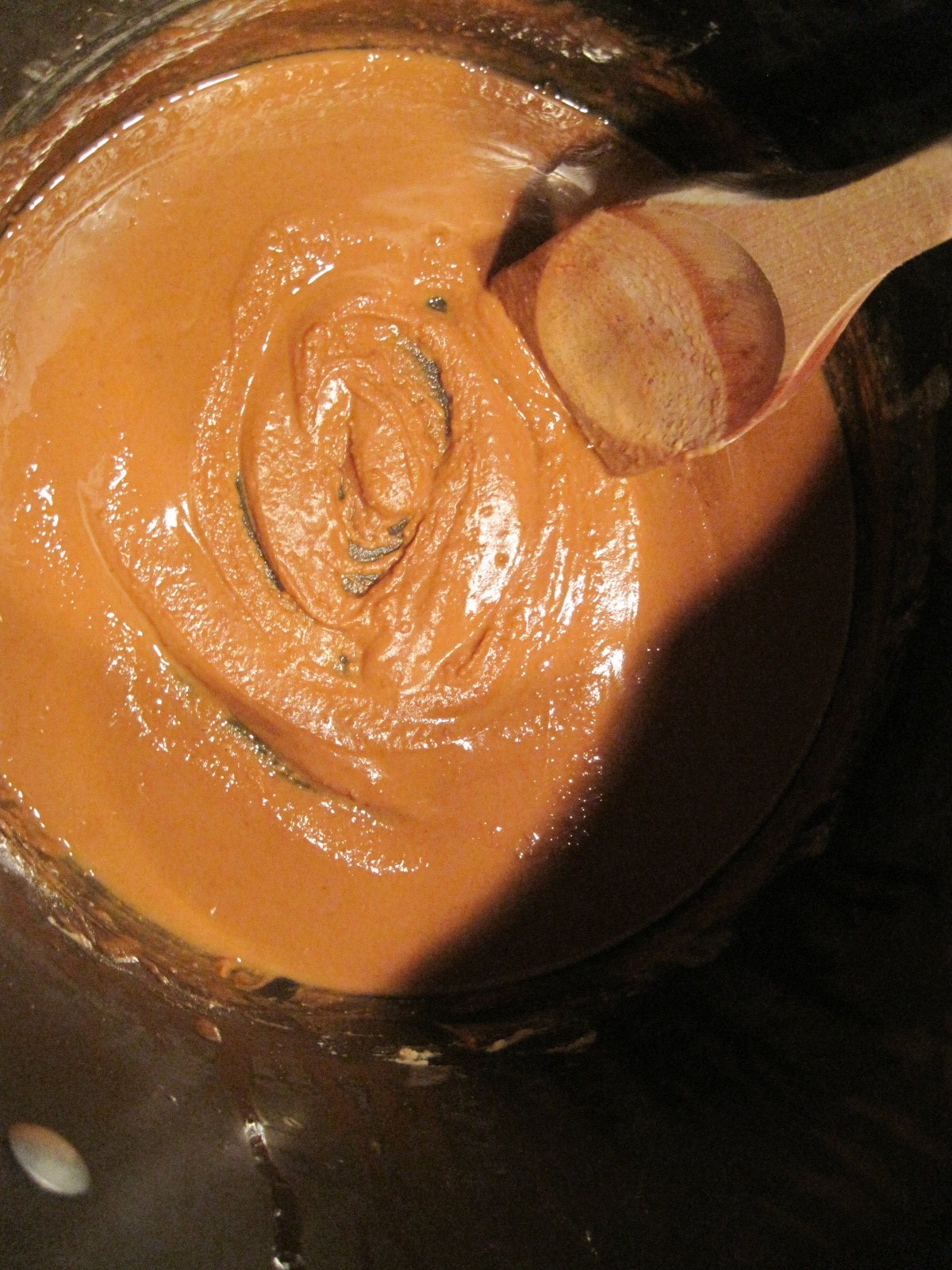
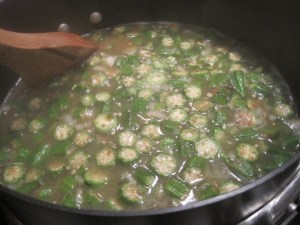
Peter started the recipe with the ever-important roux, which is the base of the gumbo and what gives it its hearty and vuluptuous thickness. Rouxs come in all shades and variations. For this recipe, he used a dark brown roux. The smell of it as it cooks is burnt and woodsy and delicious. Here it is as it comes to life…

The "money shot"

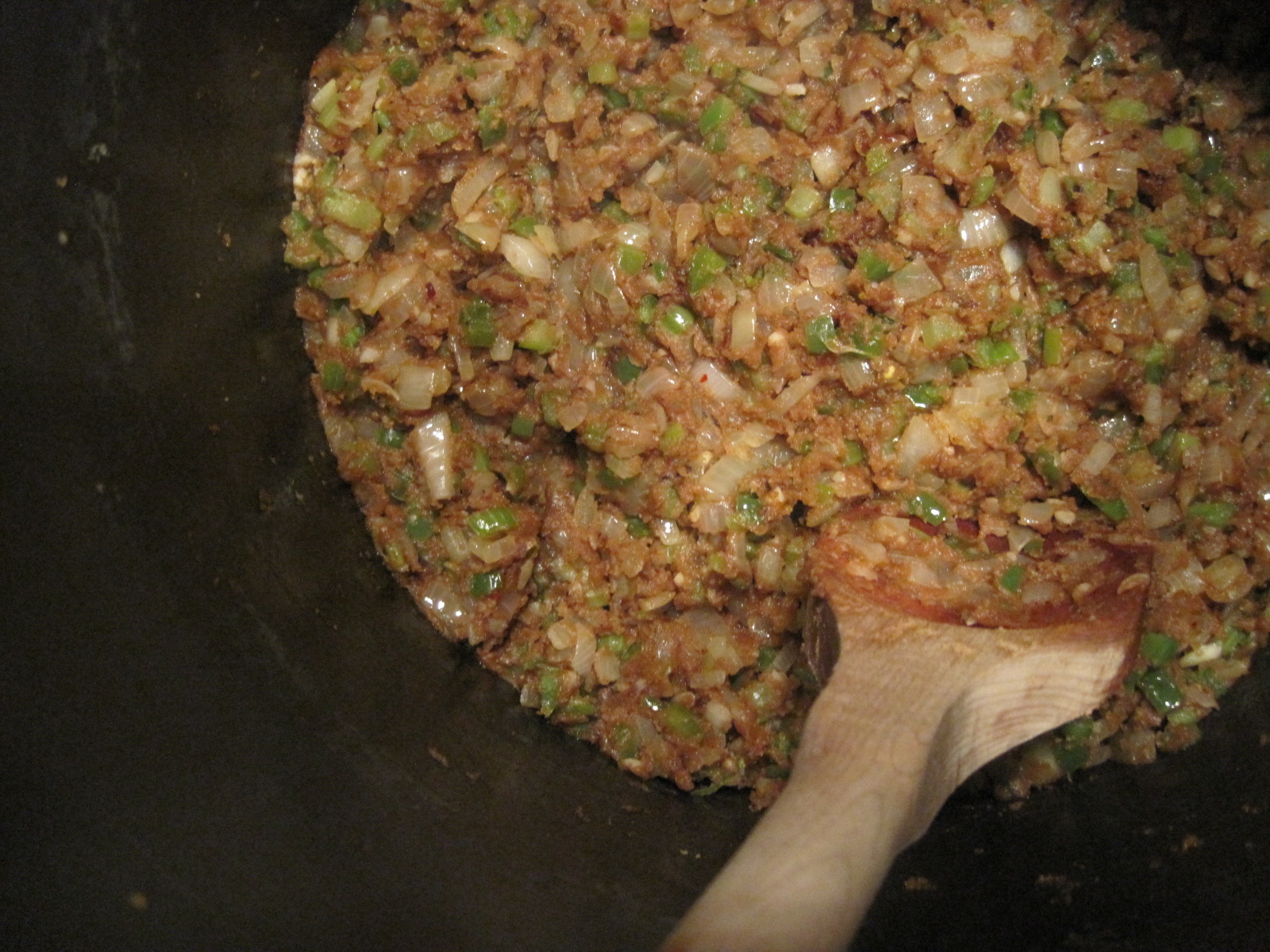
Next, the “trinity” is added to the roux. This consists of onions, bell pepper and celery. It is the créole adaptation of the french mirepoix (onions, celery and carrots).

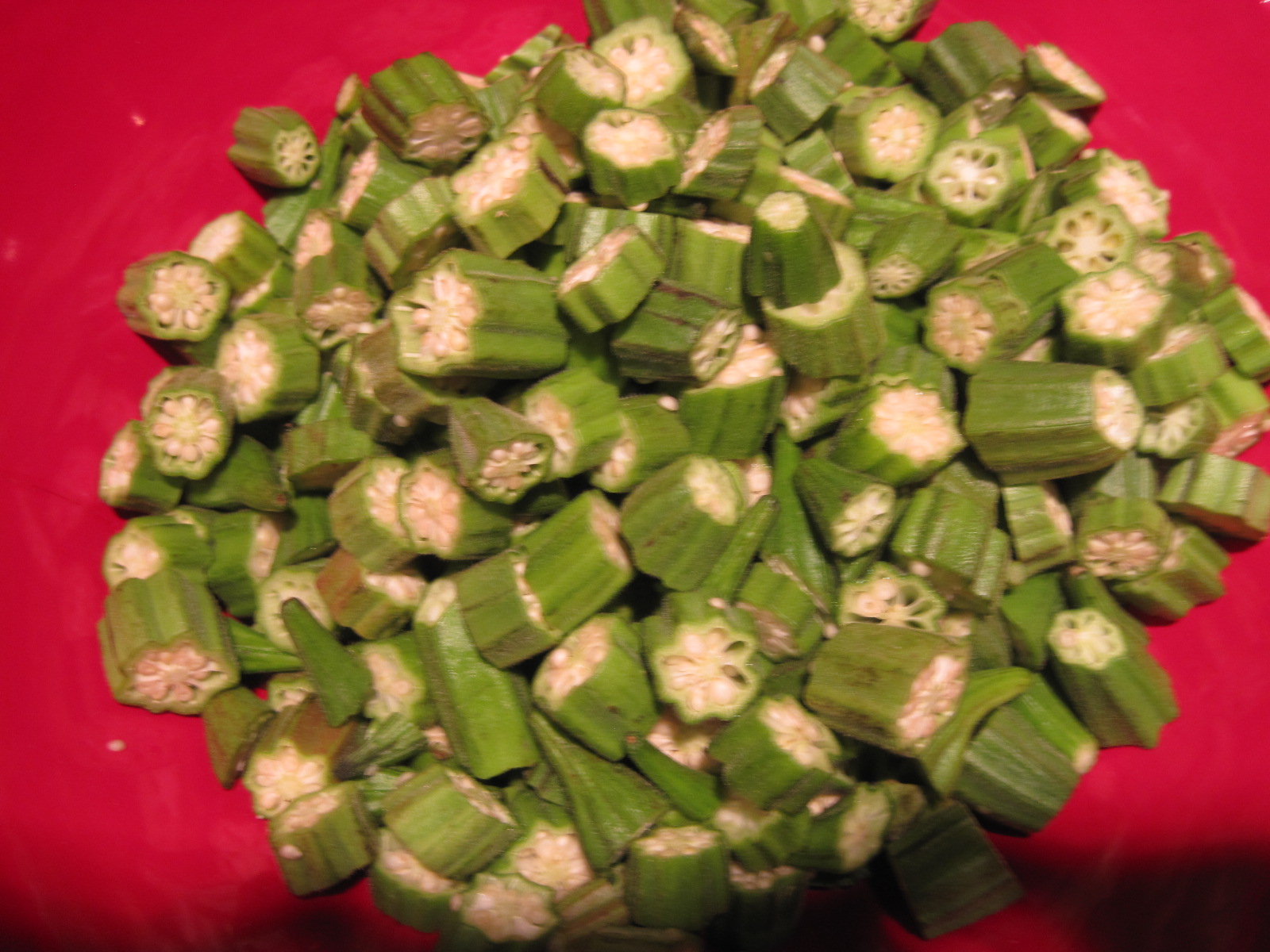
Then all the the other ingredients are added and the magic truly begins…

The "Bird Master" from Christmas Eve becomes the "Gumbo Master" for New Year's Eve

Once the gumbo was added, we tucked in voraciously (drinking all afternoon makes you hungry!!!).

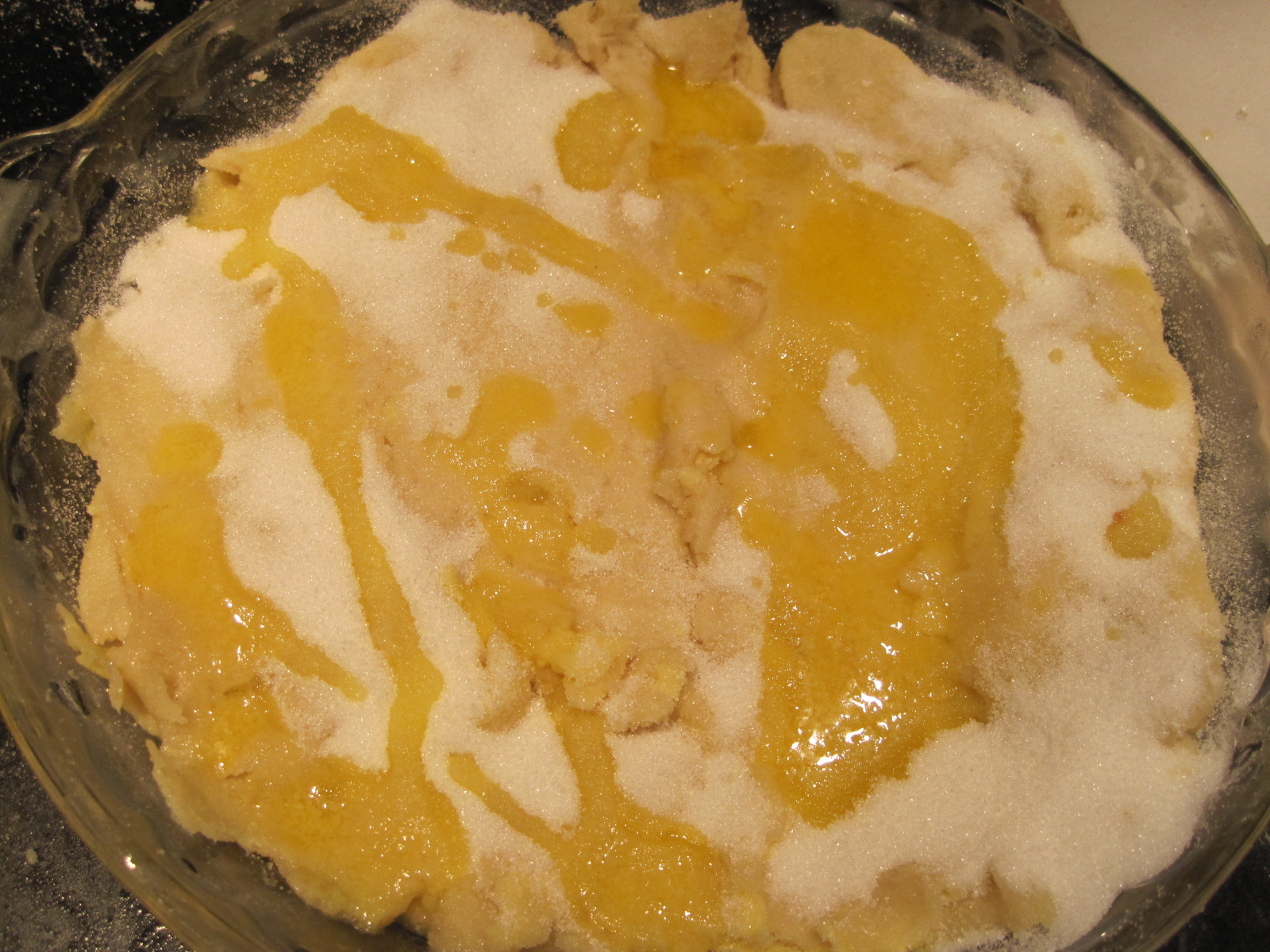
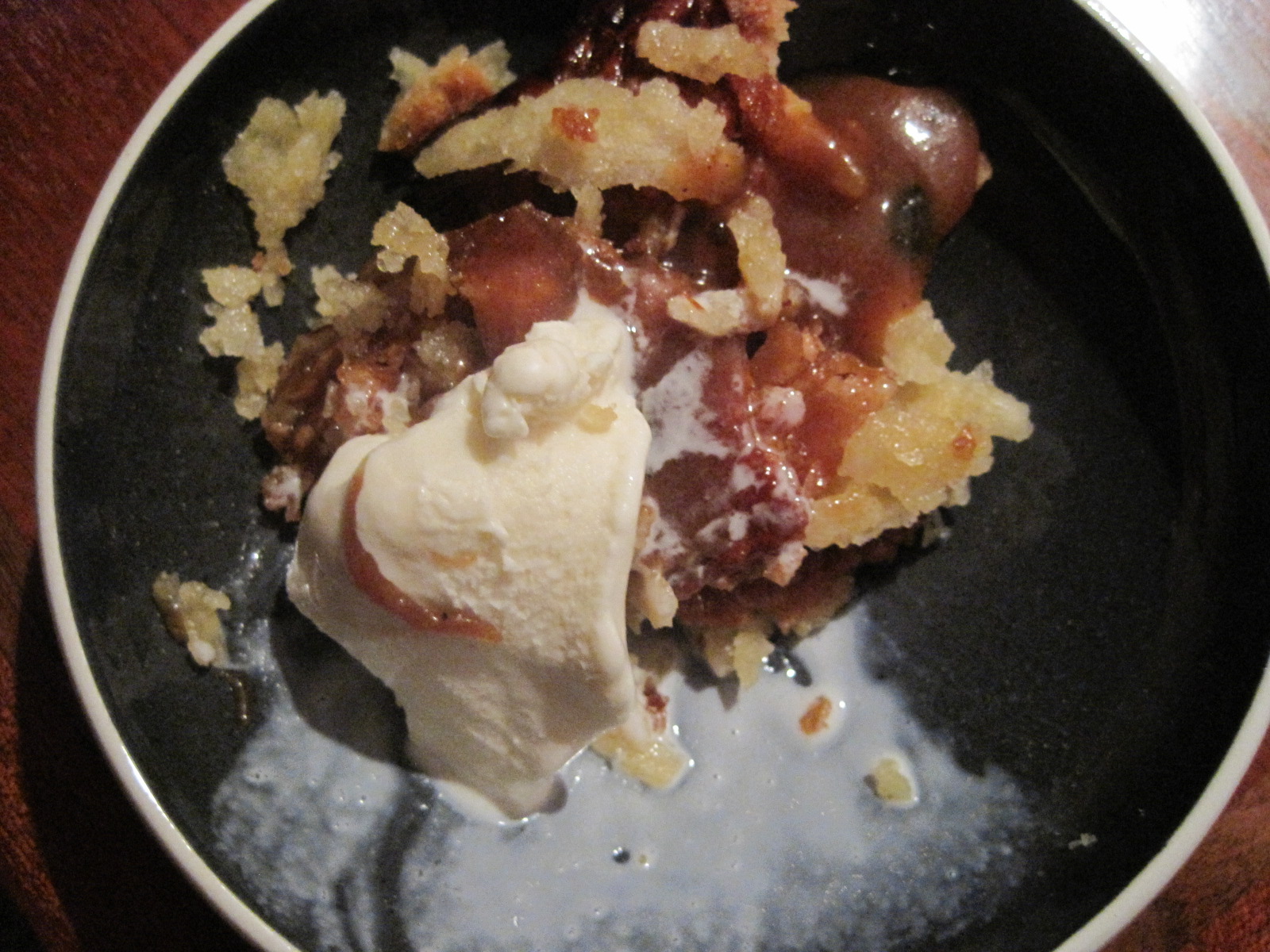
And for dessert, I attempted a kouign amann, that beautiful Breton cake/pastry that I posted about previously. Armed with the farm fresh salted butter I brought from Brittany and David Leibovtiz’s recipe, I set to work (and it is work – the dough needs to be kneaded for at least 10 minutes!). I have to say, it didn’t seem quite right to me, though I have grown accustomed to the perfection that is the kouign amann from my favorite market vendor in Rennes. These people have been making this their whole life. But, everyone enjoyed it, and swore that they loved it and I guess that’s what matters most!

Before the oven

Thanks Peter for your beautiful gumbo and for sharing your recipes.

In other news, the aforementioned avocados that I smuggled back from California are no more. I used them in vegetable soup with some sriracha (Thai hot sauce), on top of a galette (of course), smeared over a chèvre tartine, and on top of so many lovely salads such as the one that I just enjoyed for dinner.

Salad with avocado, radish, and farm fresh goat cheese covered in herbs and garlic

Coming up next, a detailed report on my favorite farmer’s market at the Place de Lices…

Until then, bon appétit!

Posted in Food, Recipes | 3 Comments

Home

My journey from Rennes to San Diego was rather long and terrible. I laughed, I cried, I cursed, but mostly I wondered how they haven’t created a faster/easier/better way to travel. How does it take 24 hours to get from Europe to the West Coast of the United States? But I can’t complain too much, because I made it out of Paris just in the nick of time: there were a lot of other unfortunate souls stuck there due to weather. The one thing I will complain about is that the stupid customs officials at Houston Airport stole my 20 euro worth of saucisson sec (dried sausage) that my family was avidly (almost rabidly) awaiting. Now I know – don’t declare meat! Luckily, the cheese and honey and caramel and all the other goodies made it through customs unscathed.

The view from the plane as we descended into San Diego

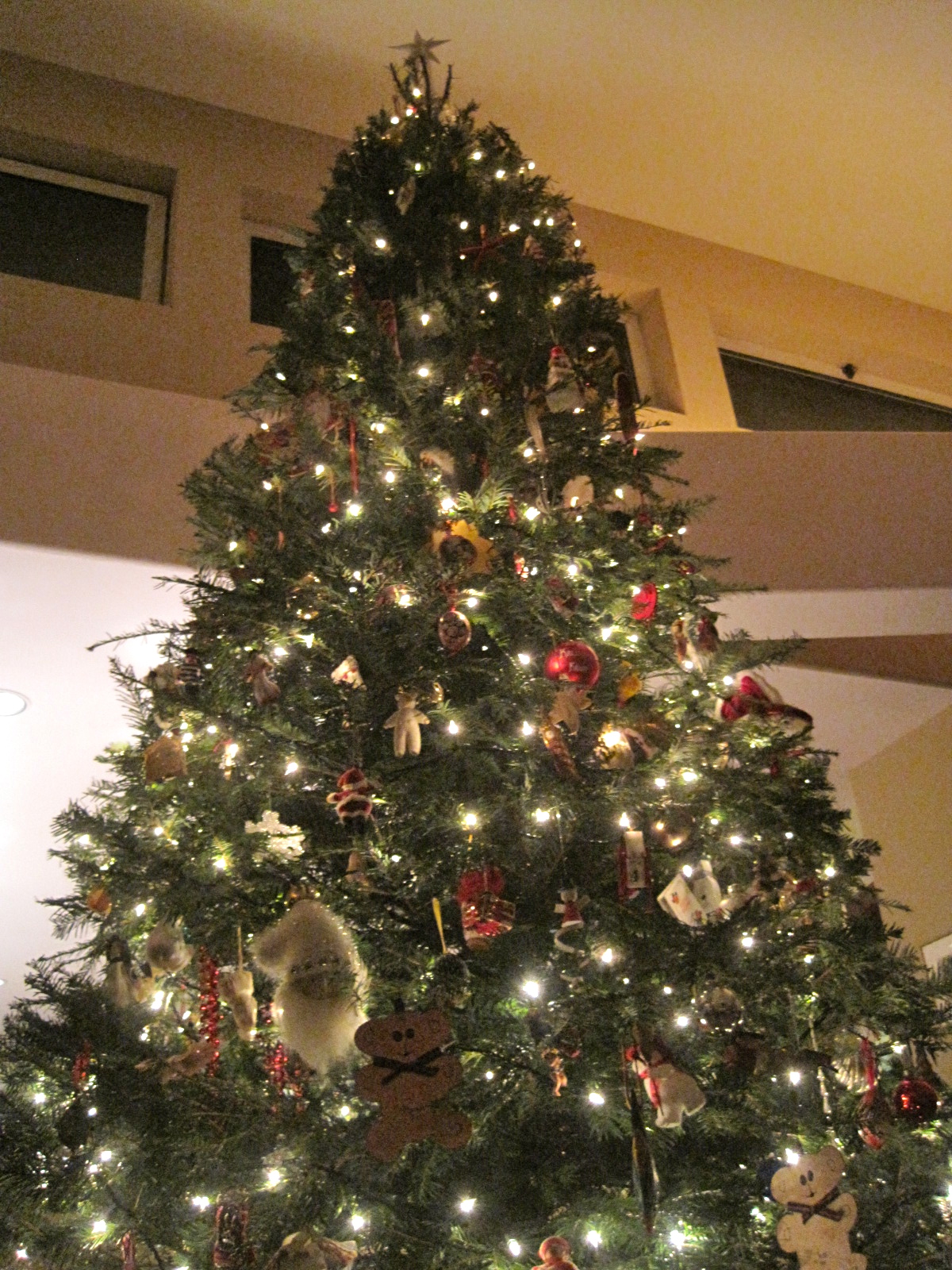
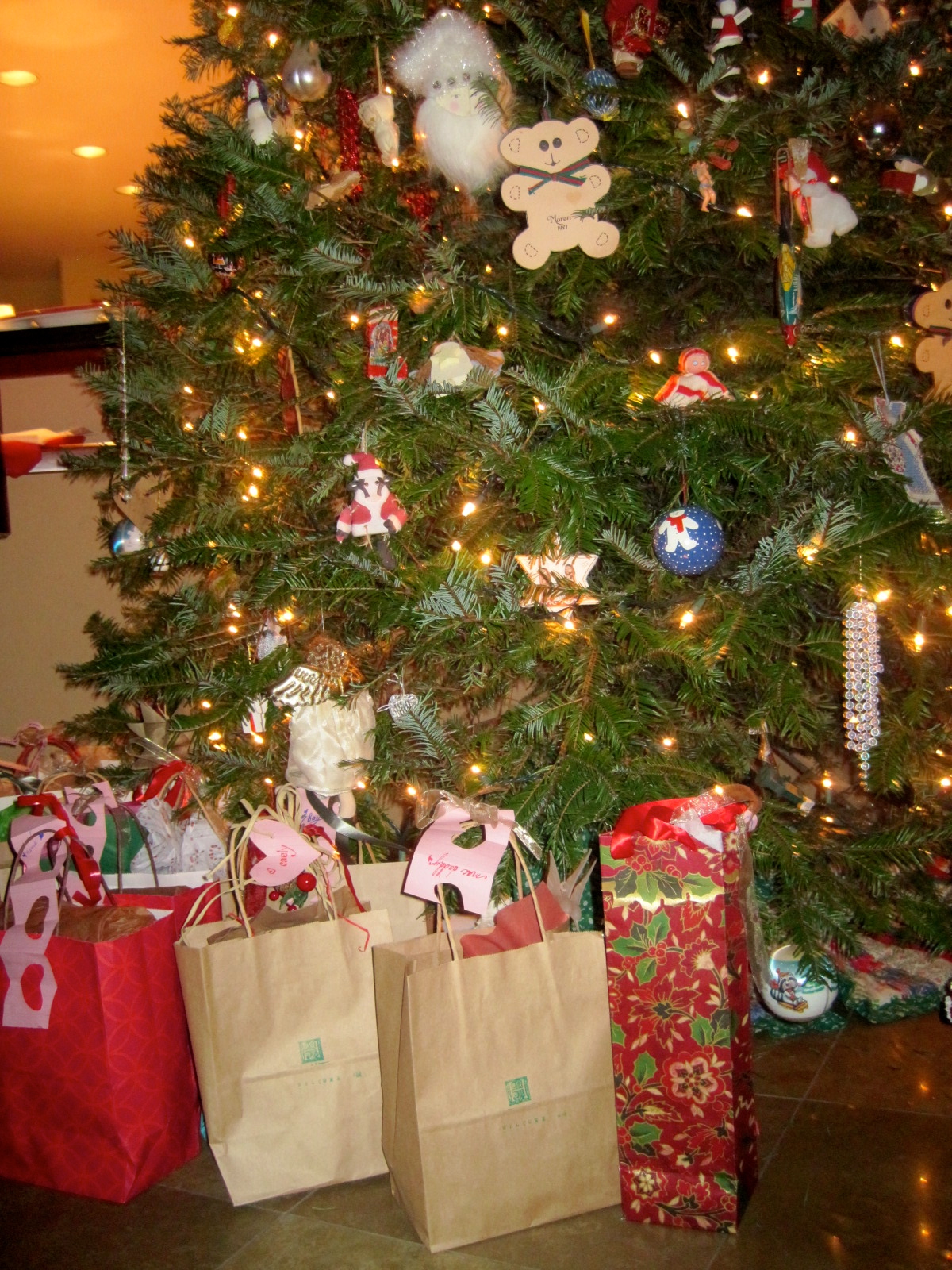
I knew that the hassle of traveling was worth it when I saw my parents happy, shiny faces, and I knew it even more so when I walked into our home and there was the most gigantic Christmas tree waiting there for me, welcoming me home like a giant ambassador for holiday joy. I couldn’t fit one of those into my tiny attic apartment in France, that’s for sure. And in anticipation of the whole family being home for Christmas for the first time in two years, the house was all decked-out as it hasn’t been in years.

As I write this, it’s the eve of my departure back to France (well, it was when I started this very long entry anyways). I’ve been home in San Diego for 2 weeks. Here I sit, at the desk in my room in my home where I grew up, tying to stay awake. It is New Year’s Day, which means of course that I‘ve been hung over all day and would love nothing more than to sleep. But I refuse to sleep. If I sleep now, I won’t sleep on my flight tomorrow. And If I don’t sleep on my flight tomorrow, that means it will be a jet-lagged Caely showing up for work this week. I’ve never done it before, but I imagine teaching a bunch of elementary school kids is not so fun when jet-lagged.

So here I am, finally writing the entry I should have written ages ago, but to be honest, time just moves differently here in sunny San Diego, and I have just been too busy enjoying the holidays to do any sort of work other than lifting yet another tortilla chip up to my Mexican-food deprived mouth. And let me tell you, it is hard work to plow through all the amazing food I’ve eaten here! Here are some of the culinary highlights from my time in California:

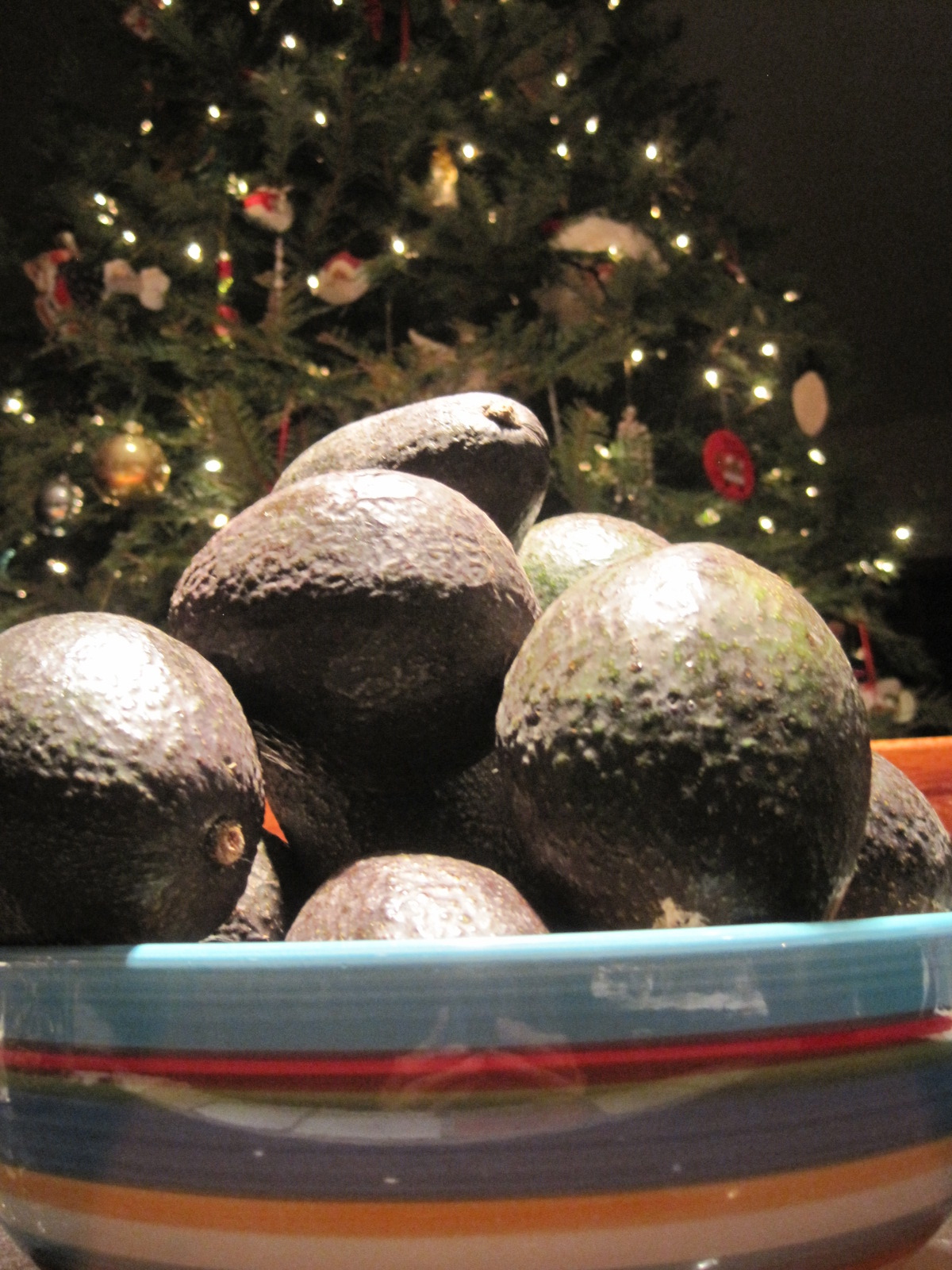
I got home a few days before the holidays, and my diet up until Christmas was all Mexican-food, all the time. Bean tostadas, shrimp and fish tacos, and endless tortilla chips with salsa and guacamole. And avocado. Avocado on everything. This California girl can never get enough of it (I snuck 3 of them back into France, and have been enjoying these last little morsels of delight lovingly and appreciatively).

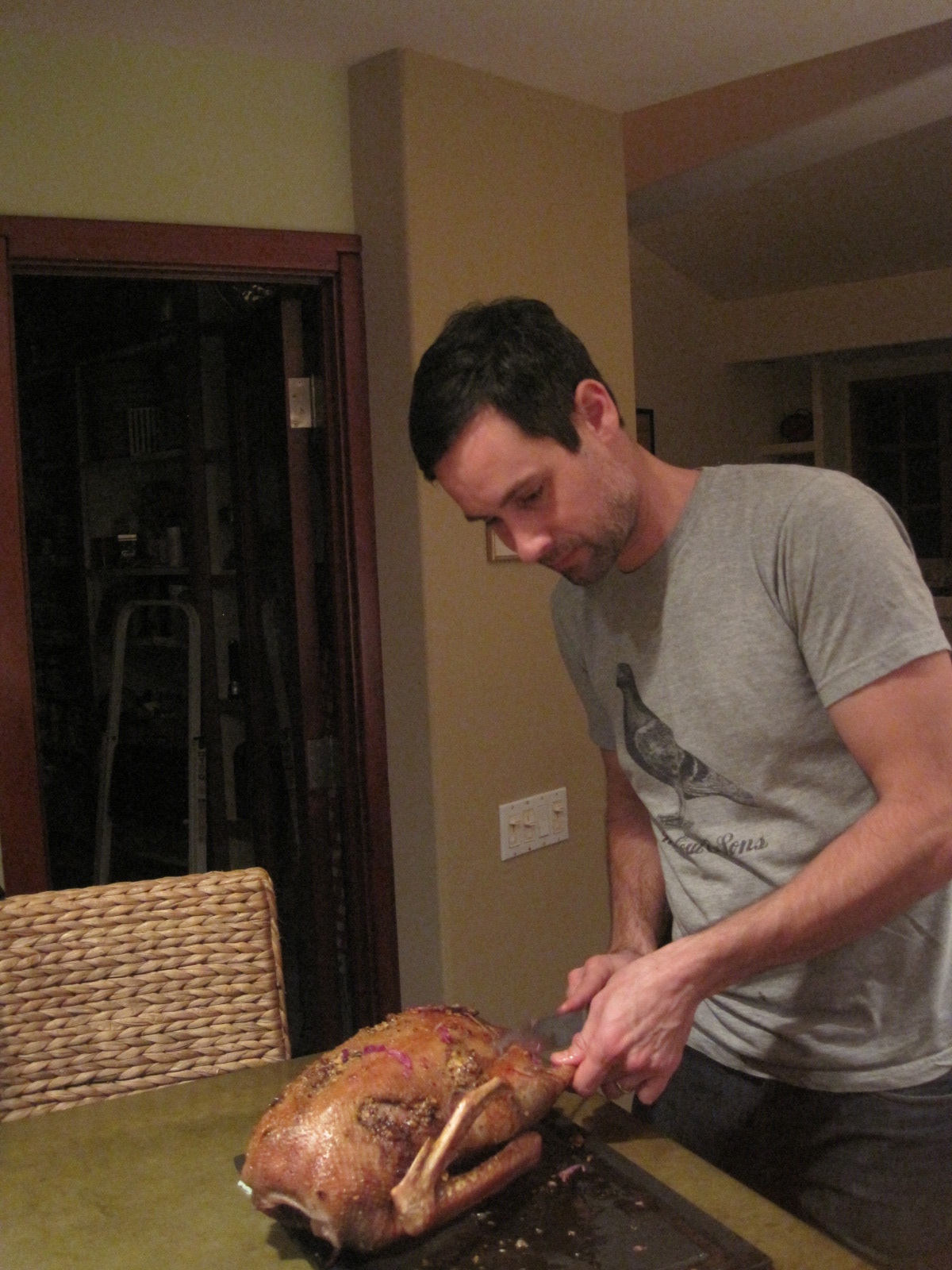
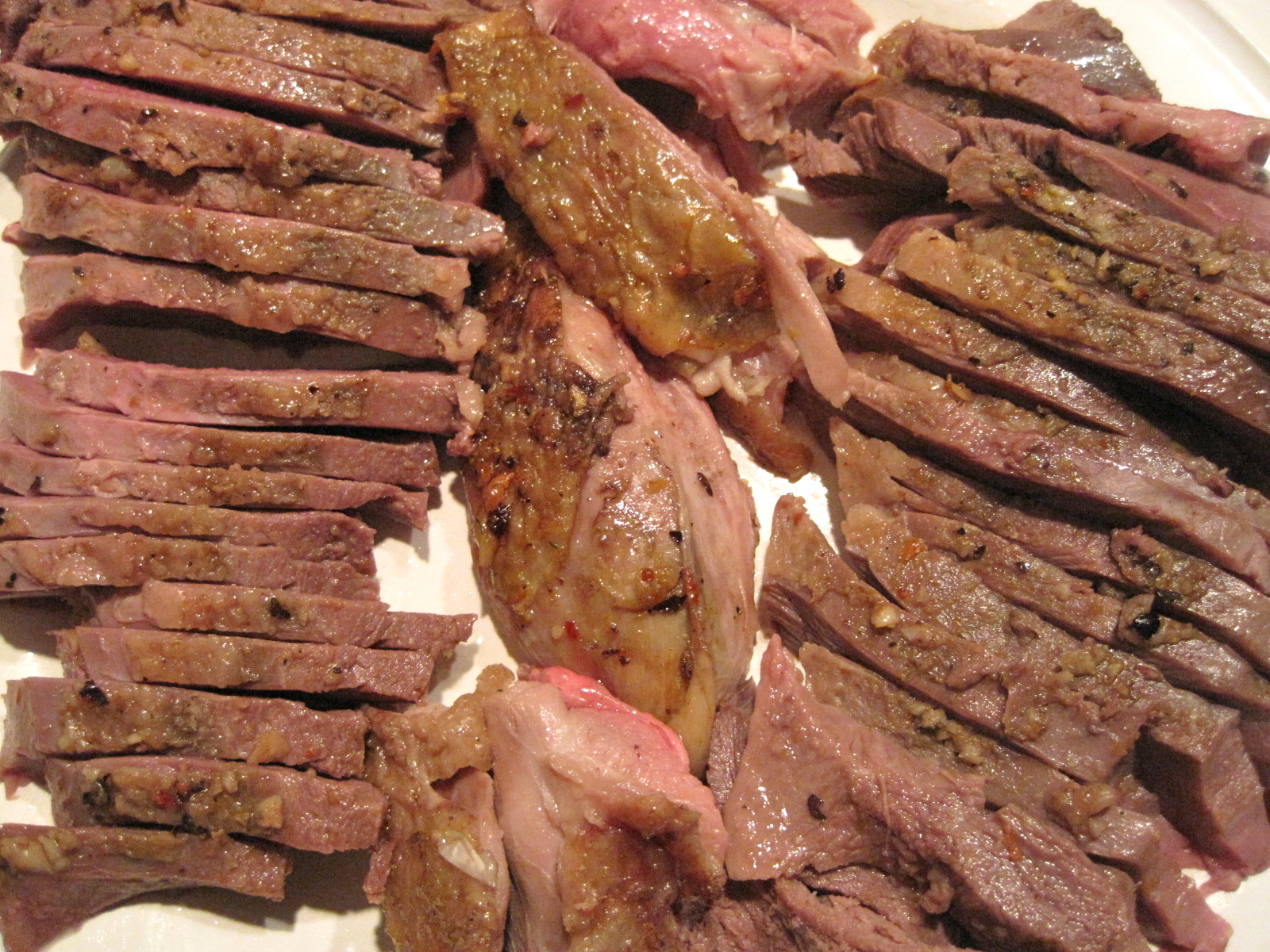
However, the Mexican-food extravaganza cannot last forever: I finally broke my pattern and ate non-Mexican food on Christmas Eve. Our meal this year consisted of a roasted wild goose, stuffed with cabbage, chestnuts and juniper. My brother-in-law Peter is the bird master, so he took the reigns on that one. If you’ve never had goose, I highly recommend it: it has the texture of venison but doesn’t taste quite so gamey. To accompany the goose, we had fingerling potatoes (fried in goose fat, yum yum) and brussels sprouts as well as the cabbage that was roasted in the goose cavity. All in all a beautiful, traditional and deeply satisfying Christmas Eve meal!

The Bird Master hard at work

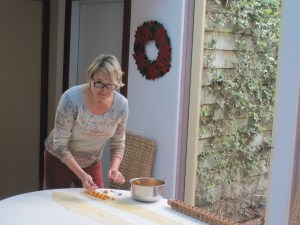
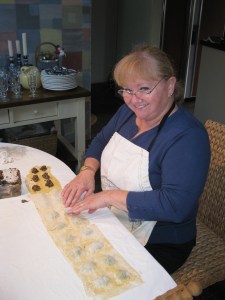
Christmas Day meal was even more of a production. Our Christmas tradition has always been to honor our Italian roots  by eating ravioli. However, decent ravioli had become scarcer and scarcer in San Diego, so the last few years we started making it ourselves. It is a lot of work, but so worth it.

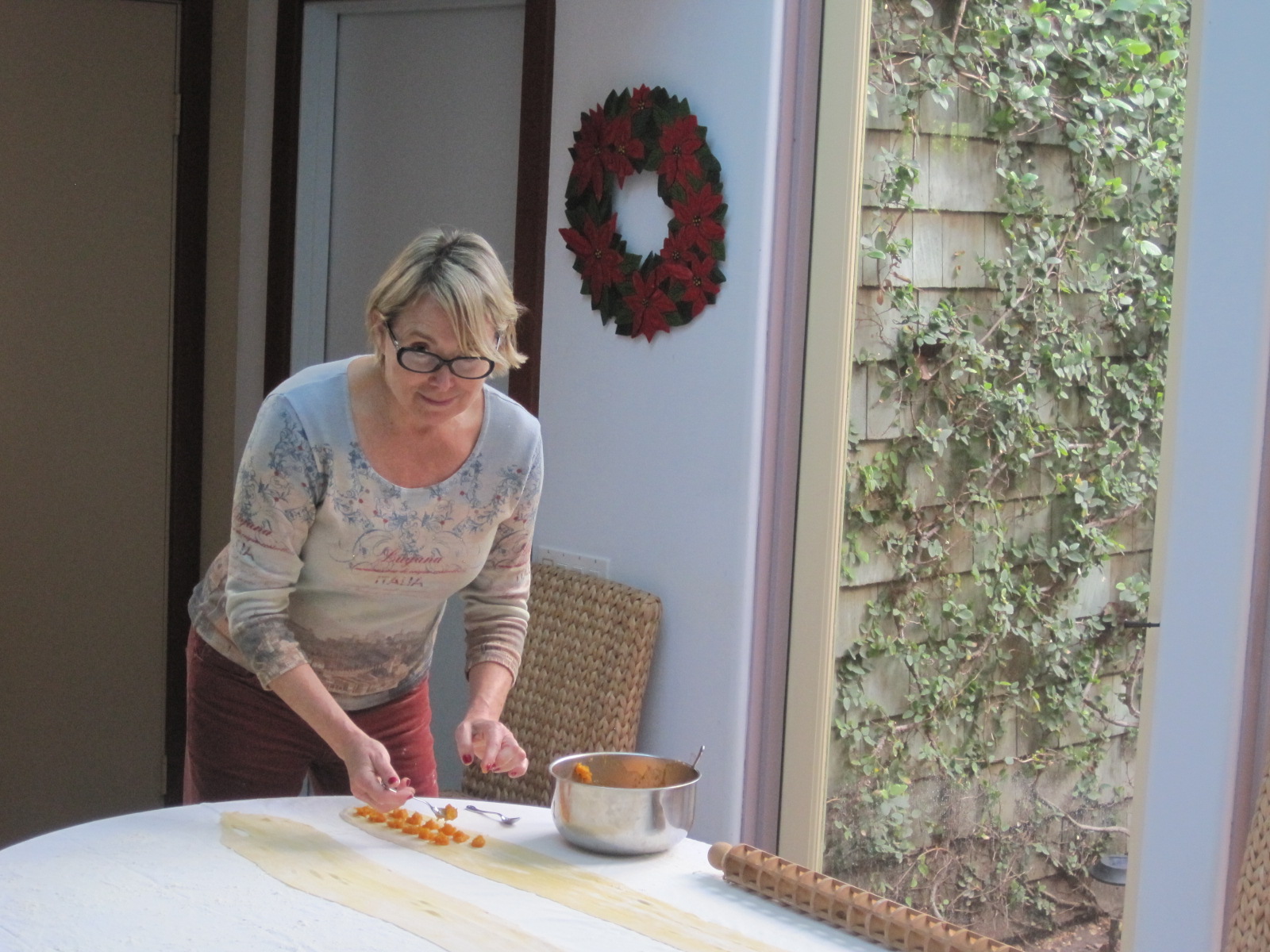
I cannot imagine a better way to spend Christmas Day than making ravioli with my family. Like cogs in some weird machine, we all do our little bit to contribute to the meal. Between making the dough, rolling it out, making the fillings and the sauces, and then finally cutting and stuffing the ravioli, it is a lot of work! This year, we had a bit of help in the form of friends who showed up to lend a hand and share their homemade pomegranate liqueur…and all the champagne certainly makes the job easier! But mostly, what makes it all fun and easy, is knowing that we are creating something from nothing, and that we are doing it together. I’m convinced that there is no better moment than that in which you sit down with your family to a meal that you all coaxed into fruition.

So, for the ravioli itself: first, we make the dough. Through trial and error, we finally settled on this recipe:

McCarterini Ravioli Dough

Ingredients:

2 cups flour

3 eggs

Pinch salt

2 tablespoons olive oil

2 tablespoons water

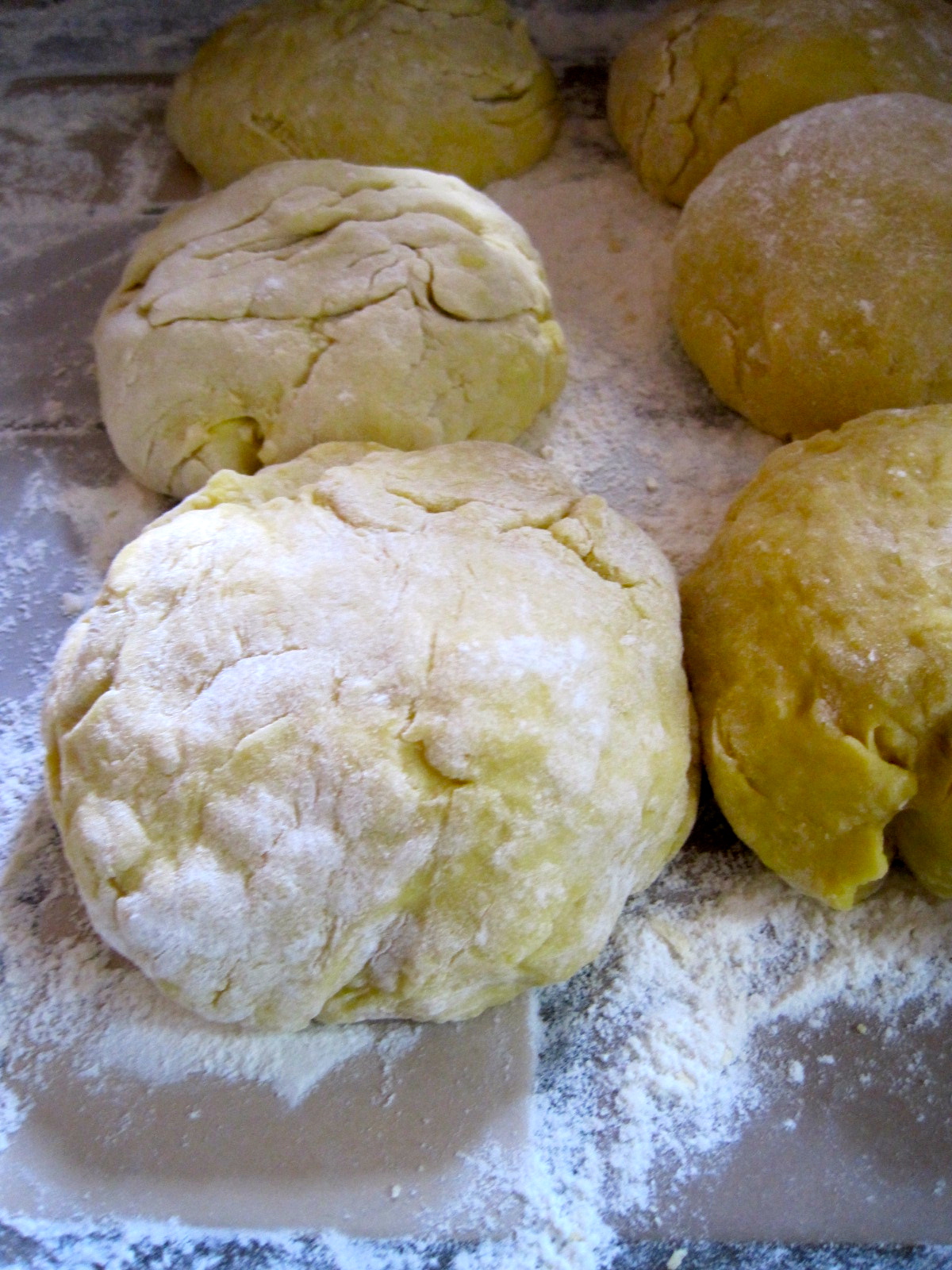
Directions: In the Cuisinart combine the liquid ingredients and blend. Add 1 cup flour and pinch of salt. Blend for 5 seconds. Continue to add flour from the second cup until the dough ball forms and pulls up around the dough blade, slowly pulsing.

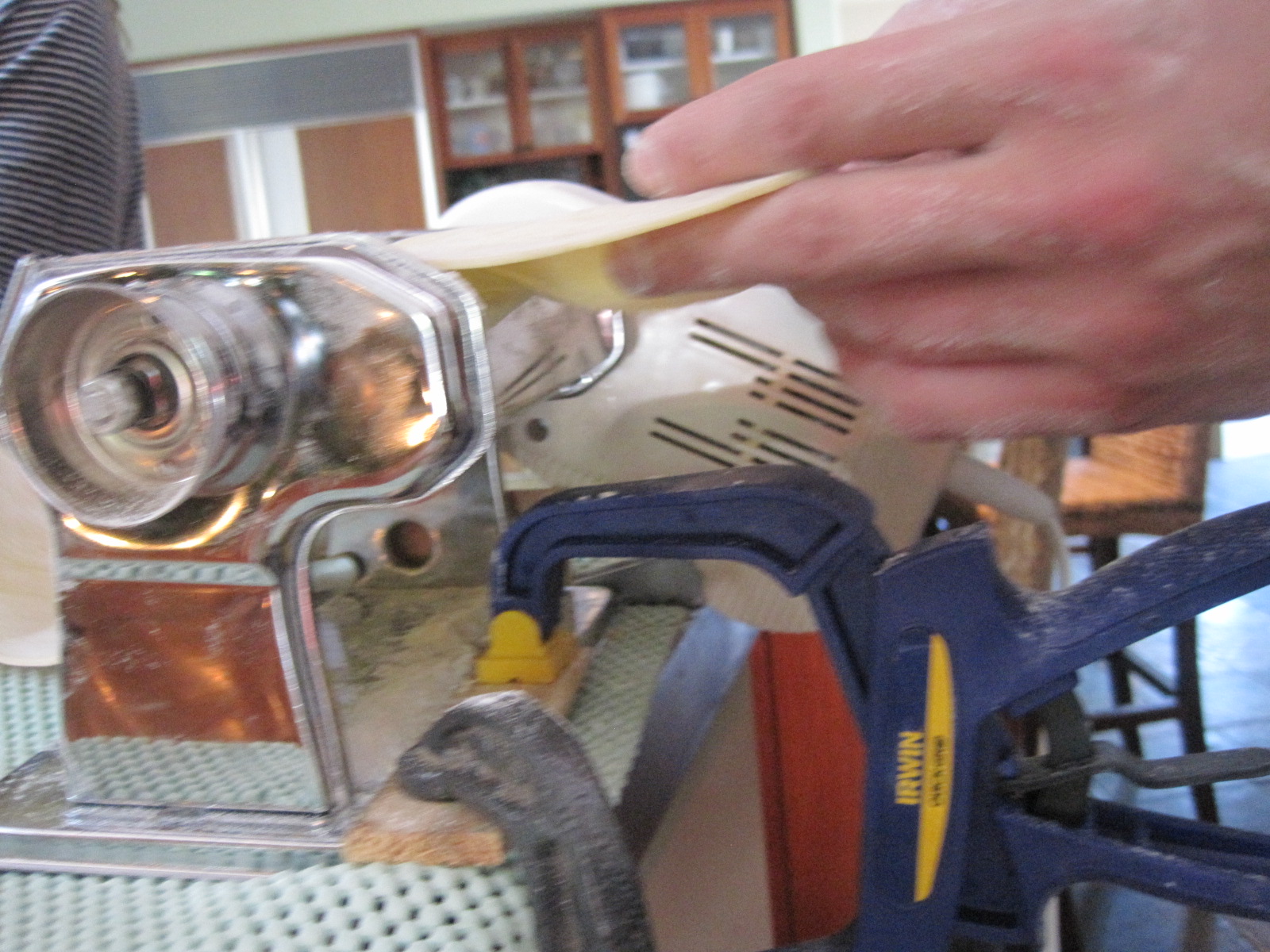
Once the dough was made, we set about to rolling it out with the help of our pasta roller, onto which my dad clamped a McGyvered  motor. We tried the hand pumping method the first year we made ravioli and it wasn’t fun, let me tell you.

Our super special ravioli rolling equipment

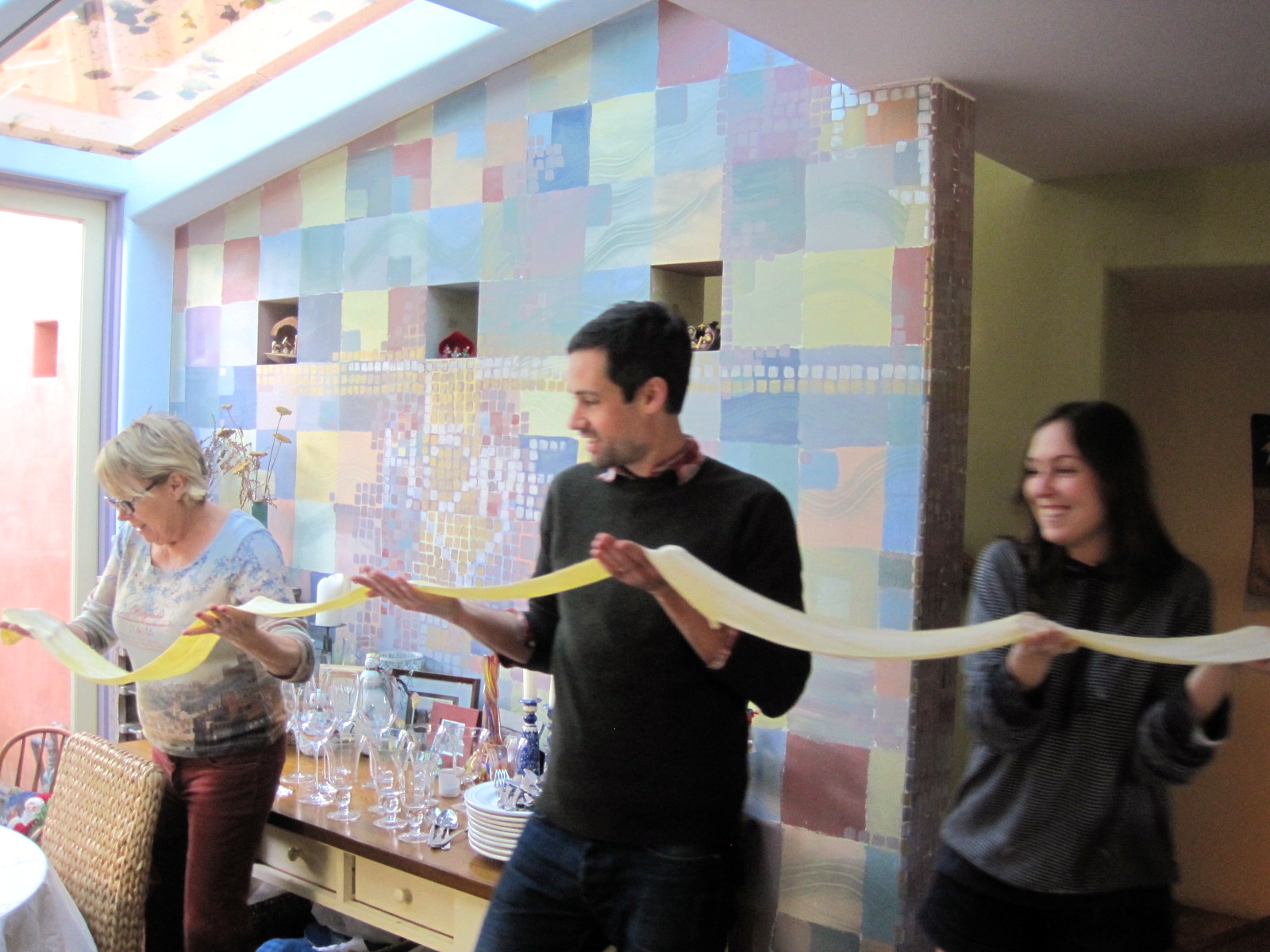
We rolled out countless sheets of dough that were so long it took several of us to transport them to  the filling station.

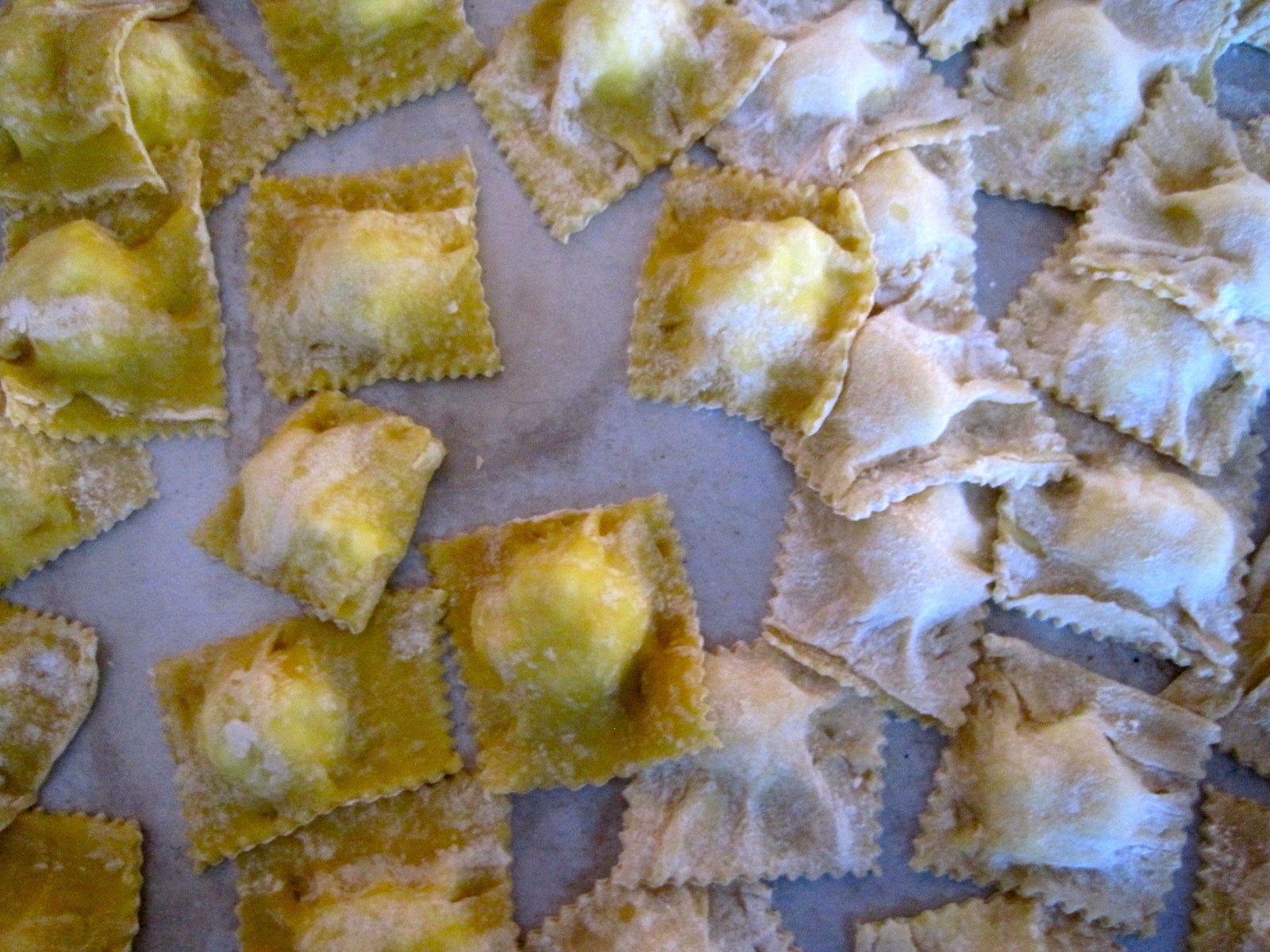
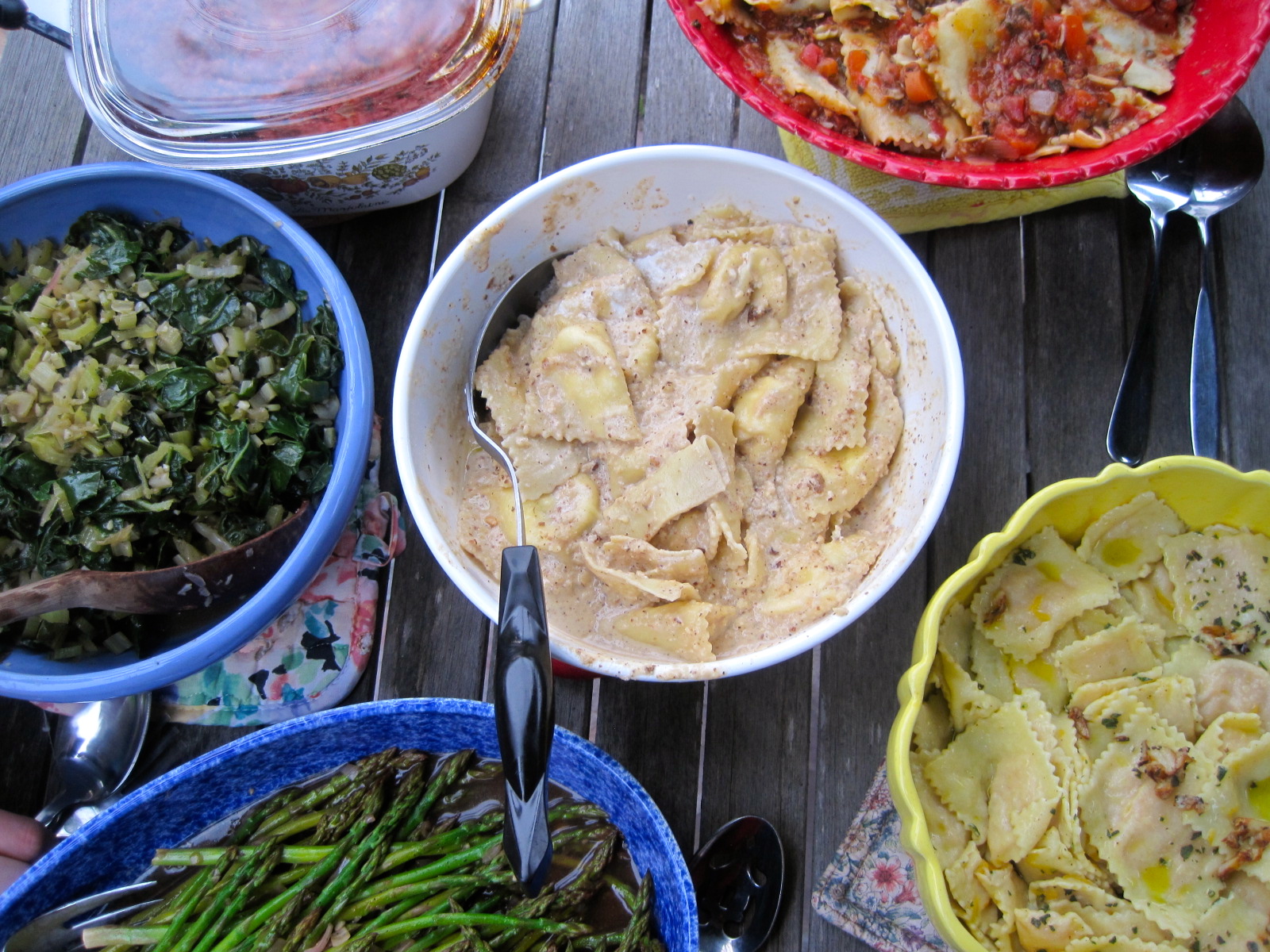
Next, we filled the ravioli. For our stuffings, we used wild mushroom, butternut squash and goat cheese.

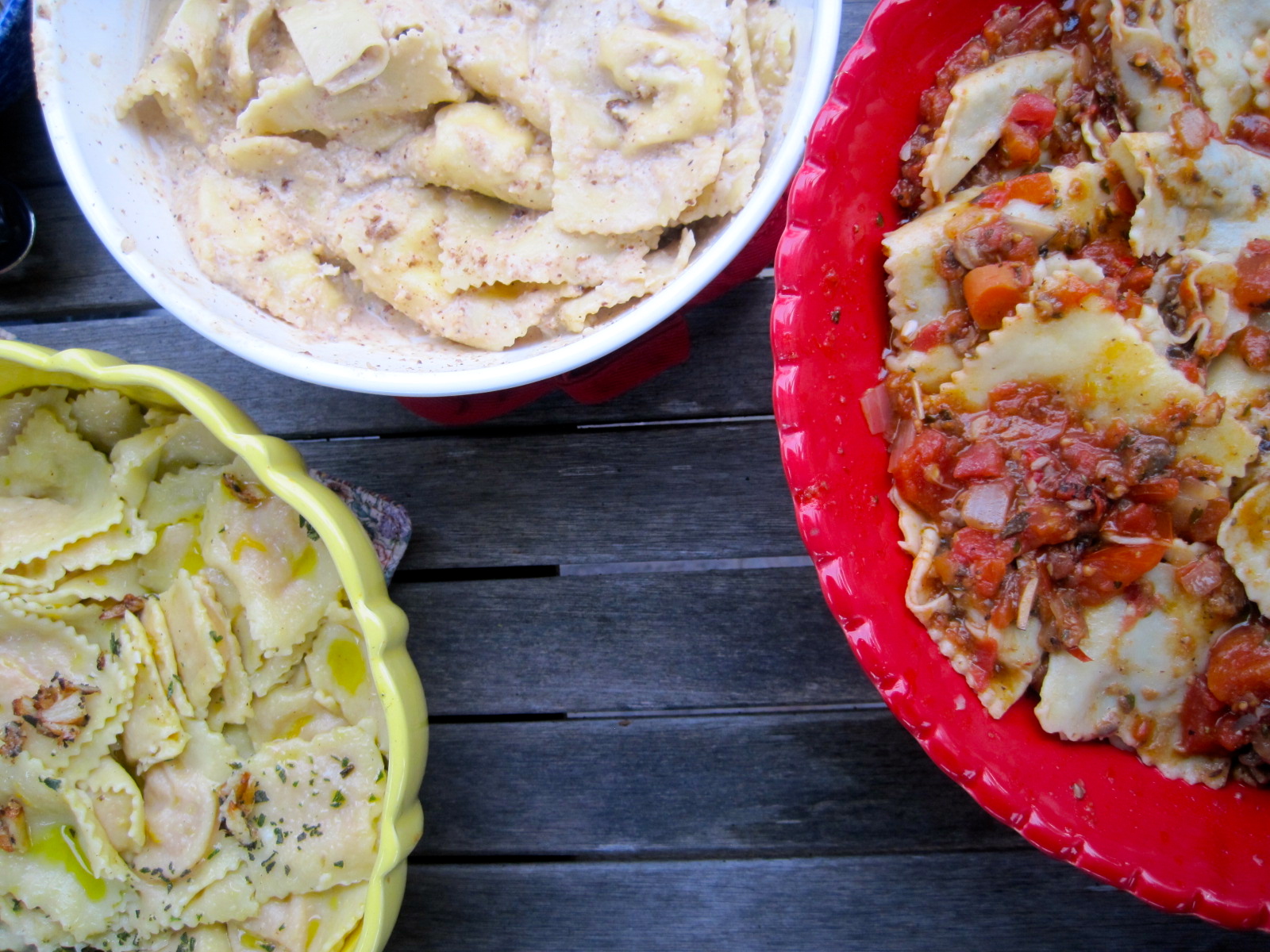
Voici, the menu:

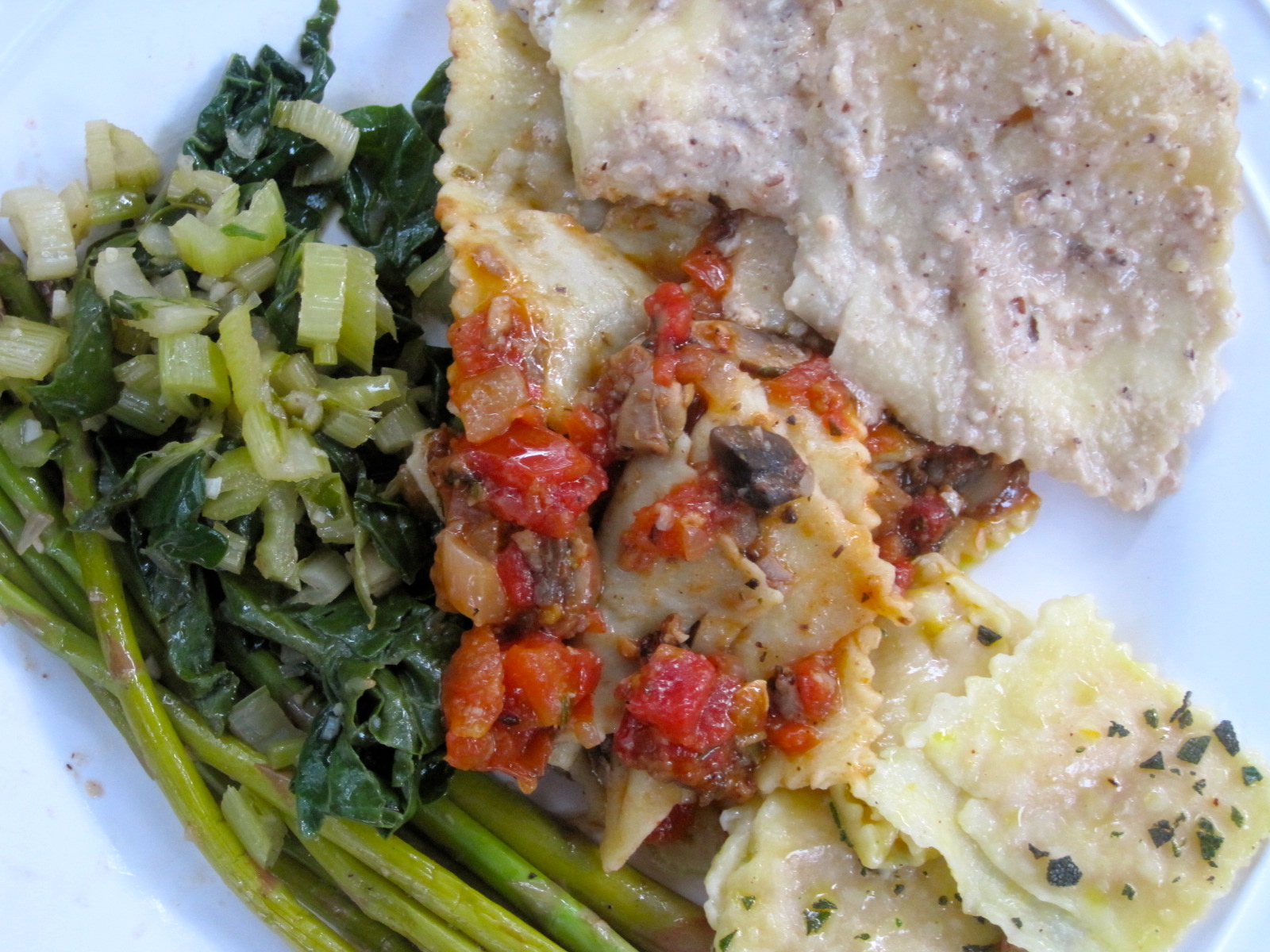
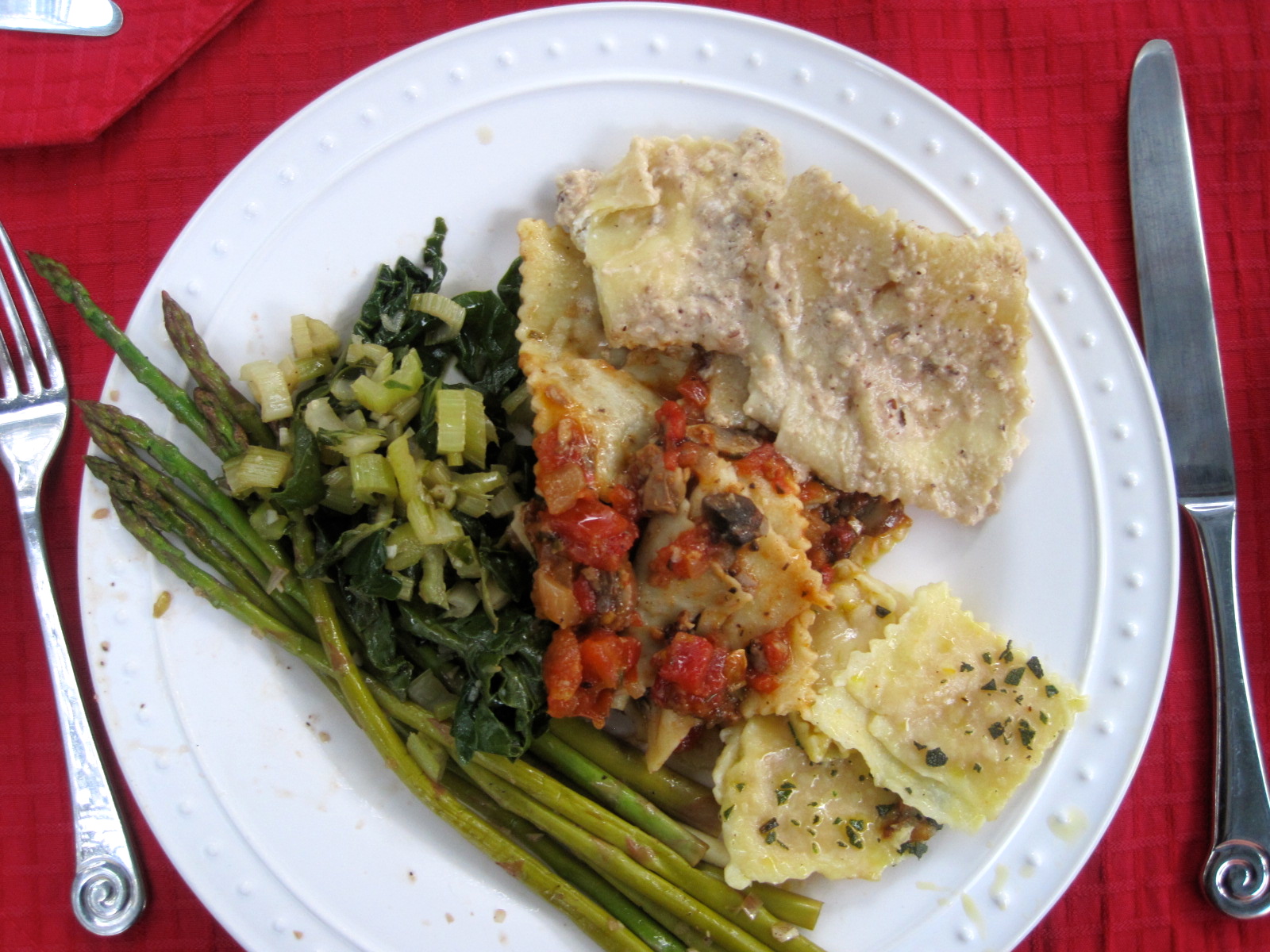
Butternut squash ravioli with sage and garlic infused olive oil

Goat cheese ravioli with walnut cream sauce and shaved truffle

Wild mushroom ravioli with mushroom arrabiatta sauce

Sautéed chard

Mixed greens salad with radish and radish sprouts and balsamic vinaigrette

Selection of cheese from France

Eggnog crème brulée

And then in between New Year’s and Christmas, there was Mexican food. And Mexican food. And then some more Mexican food. And only because I was in danger of becoming a corn tortilla chip myself, did I concede to eat something different on New Year’s. No one can refuse my brother-in-law’s seafood gumbo. He was born and bred in the South, and you can taste the authenticity in every bite. The pictures and recipe for Peter’s Seafood Gumbo will be coming soon in a later post.

But it wasn’t the food that drew me home. It was this:

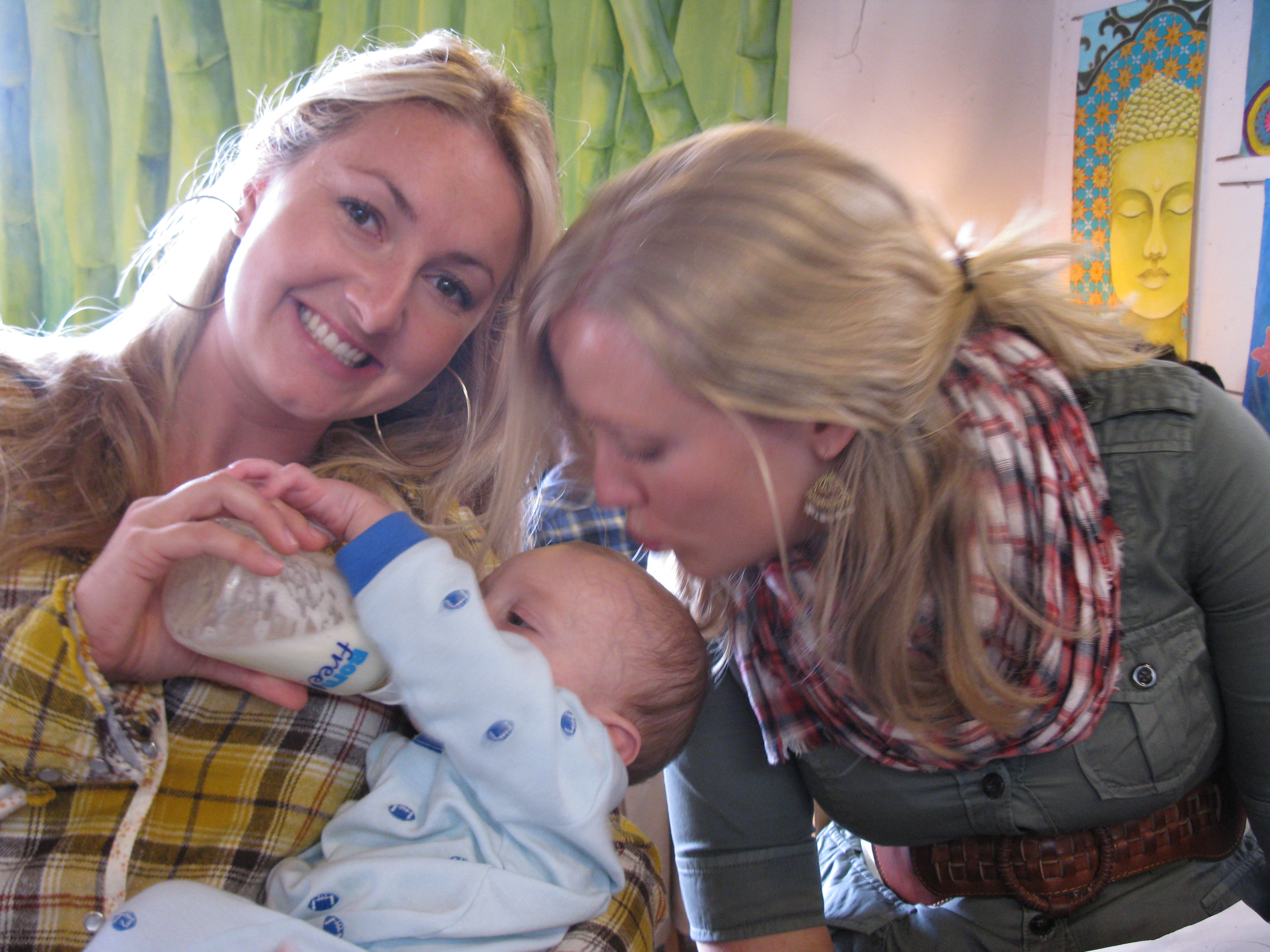
My parents and siblings and my best friends who are more like sisters, and my little “nephew” who just turned 7 months old. It is a strange feeling, because Rennes has become a true home to me in the last few months. I have a job, an apartment, a great group of new friends, and a brilliant boyfriend. But this fits too, and so did San Francisco where I went to school, and Hawaii where I spent so much of my childhood, and Brooklyn where my sister and brother-in-law live. As I have gotten older, I have learned to call many places home, less because of the amount of time that I have spent there, and more because of the experiences I had there and the people I shared those experiences with. So I am not sad to leave, because I am going to a new home that through me will become a home to so many others who visit me there and fall in love with it as much as I have. So, let’s raise yet another glass of champagne (there has been no shortage of them for us McCarters this holiday season).

Here’s to home, and friends, and damn good food, and above all is else, here is to a beautiful and happy New Year to all of you, the people I call home.

And just for good measure, here are some southern California sunsets and beach scenes for your enjoyment…

Posted in Food, Recipes | 1 Comment

The Addict’s Mushroom Lasagne

This is without a doubt my most requested recipe, and I have now most recklessly gotten several people addicted to it (hence the name). I’m not sure what it is about this lasagne (yes – it is spelled with an ‘e’), but people tend to freak out over it, and none of them miss the meat. I always make my own tomato sauce, and I believe that therein lies the secret. It’s also all the other little touches, like drizzling olive oil over the top of the assembled lasagne before baking it, to give it that extra beautiful, brown, bubbly deliciousness. I think the biggest secret though is simply having the love and passion for cooking that allows you to patiently caress a dish into existence. Taking the time to cook for myself and for other people who will deeply appreciate a homemade meal is one of the most satisfying and rewarding ways I can spend my time. So make this for someone who will enjoy eating it just as much as you enjoyed making it (it shouldn’t be hard to find such a person!).

  For the sauce

2 tablespoons extra-virgin olive oil
50 grams (1/2 cup) mushrooms, sliced thinly
1 small carrot, halved and sliced thinly
1 large onion, chopped
4 cloves garlic, minced
120 ml (½ cup) white or red wine
900 grams (2 cups) tomato puree
6 fresh, in-season or a 400 gram (8 0unce) can of tomatoes, chopped
2 tablespoons tomato paste
2 tablespoons herbs of your choice (I recommend thyme, herbes de provence, tarragon, basil, and oregano)
1 bay leaf
Salt and pepper to taste

For the lasagne

2 tablespoons extra-virgin olive oil
400 grams (4 cups) mushrooms
1 onion, chopped
120 ml (½ cup) cider, white wine, sherry or Marsala
2 cloves minced garlic
2 tablespoons thyme
340 grams (3/4 lb) ricotta cheese
225 grams (1/2 lb) soft garlic cheese
2 eggs
945 ml (4 cups) tomato sauce
1 package lasagna noodles
225 grams (1/2 lb) fresh, grated mozzarella (or emmenthal)

For the tomato sauce

In a large sauté pan, heat the oil over medium/high heat. Once oil is sizzling, add onions, mushrooms, and carrot. Season to taste with salt and pepper. Cook until the vegetables begin to brown, and then add the wine and garlic. Simmer until reduced to about half the amount of liquid.

Add in tomato paste, tomato puree, chopped tomatoes, herbs of your choice, bay leaf and salt and pepper to taste

Bring to a boil, then reduce heat and simmer uncovered for 1 hour. Like a soup, the longer a tomato sauce sits and matures, the more depth of flavor it will have. Therefore, it’s great to do this the day before or the morning of so it has time to age before you assemble the lasagna.

For the lasagne

Add the olive oil to a large sauté pan and heat over medium/high heat. Once the oil is sizzling, add the onions. Let them sit 2-3 minutes until they begin to brown, then add in mushrooms. Cook the vegetables until they are beginning to brown, about 15 minutes.

While waiting for the mushrooms to cook, mix together in a medium bowl ricotta, garlic cheese, eggs, and salt and pepper to taste. Set aside.

Once the mushrooms have browned and they are beginning to stick to the bottom of the pan, add in the cooking alcohol, garlic, thyme, and pepper to taste. Make sure to scrape all the brown bits up from the bottom of the pan. Reduce the heat and simmer lightly until the alcohol has evaporated and the mushrooms are soft and the onions are translucent. Set aside.

Add about 2 ladlefuls of tomato sauce to the bottom of the lasagna dish and spread it around evenly. Layer uncooked noodles over the sauce, then half of the cheese and egg mixture, followed by half of the vegetable mixture, and another generous ladleful of tomato sauce. Repeat the last four steps (starting with the noodles).

To finish, add one last layer of noodles, followed by the remainder of the tomato sauce. Top off with the mozzarella (or emmenthal) cheese. Drizzle with olive oil (only if using emmenthal).

Bake for 30-40 minutes at 350 degrees faranheit, or until the top of the lasagna is brown and bubbly.

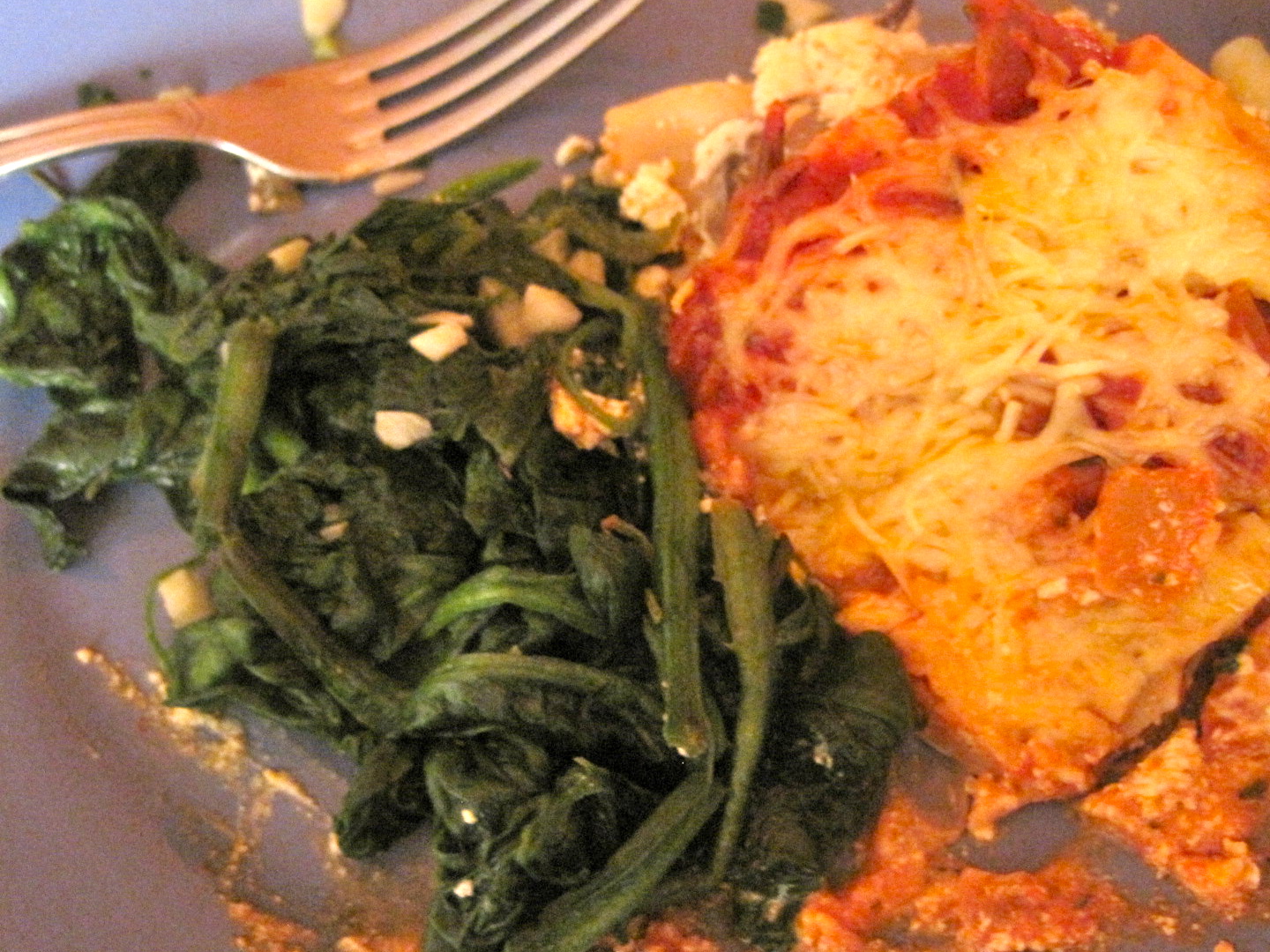
Enjoy with red wine, a vegetable side dish (we must be semi-healthy at least!) and of course, at least one good friend.

Posted in Food, Recipes | Leave a comment